Red Sea Shipping Crisis 2026: The Strategic Survival Guide for Europe Freight and Amazon FBA
How the Red Sea & Hormuz Crisis Impacts Europe Freight Rates
The combined 2026 Red Sea and Hormuz blockade triggers a dual cost shock to Europe's supply chains: an immediate $30–$35 per TEU increase in BAF (Bunker Adjustment Factor) for every $10 rise in Brent crude, and a mandatory 14–21 day lead time extension due to Cape of Good Hope rerouting. For Amazon FBA sellers, this results in an immediate risk of BSR (Best Seller Rank) collapse, requiring a 20/80 bifurcated rail-sea strategy to maintain inventory velocity and avoid out-of-stock events.
I. Introduction: The 2026 "Double Choke" and the Financial Reality
In early 2026, the global maritime landscape faced an unprecedented "Double Choke" event. With the Red Sea already volatile, the sudden closure of the Strait of Hormuz forced a fundamental repricing of all Asia-to-Europe lanes. For B2B importers and high-volume sellers, this is not a temporary delay; it is a mandatory moment for Supply Chain Architecture.
At Zbao, we view this crisis as a test of resilience. The "cheapest" route has officially vanished; certainty is now the only currency that matters in global trade.
II. Forensic Audit: Decoding the 2026 "Crisis Surcharges"
A freight quote in 2026 is no longer a static number. According to the latest data from the Joint War Committee (JWC), vessels operating near the Gulf of Oman and Red Sea face significantly higher insurance premiums, which are passed directly to the shipper.
1. The Brent-to-BAF Correlation
Fuel is the primary engine of this volatility. Our forensic audit reveals a rigid mathematical link between oil prices and your final invoice:
$$\Delta BAF \approx 3.5 \times \Delta Brent$$
For every $10/bbl increase in Brent Crude, the BAF on Far East-to-Europe lanes rises by approximately $35 per TEU. With Brent currently testing the $100–$120 range, your landed cost per unit is likely to inflate by 15%–20%.
2. Understanding ECS and WRS Surcharges
Carriers like MSC and Hapag-Lloyd have implemented Emergency Conflict Surcharges (ECS) and War-Risk Surcharges (WRS) ranging from $1,500 to $4,000 per container.
Internal Strategy Note: Shippers should also understand the difference between a freight forwarder and a broker when evaluating surcharge transparency to ensure they are not paying "Conflict Premiums" on vessels that have already been rerouted.
III. The Jebel Ali Paradox: Why Geography Trumps Hardware
Jebel Ali (Dubai) is a 19.4 million TEU powerhouse, but in 2026, it is a "Logistics Ghost Town." The issue is not the terminal infrastructure, but Marine Access.
-
The Capacity Gap: Fallback hubs like Salalah and Fujairah offer less than one-third of Jebel Ali’s scale.
-
The Equipment Imbalance: Rerouting via the Cape of Good Hope delays empty containers returning to China by 14+ days. According to the Drewry Container Index, this imbalance is the primary driver behind the second-wave rate hikes seen at China’s main export ports. When turnaround time increases, the global supply of equipment effectively shrinks.
IV. Amazon FBA: The "Ghost" Lead Time and BSR Protection
For Amazon FBA sellers, the 2026 crisis is a ranking crisis. On Amazon, "Out of Stock" (OOS) is a terminal illness for your brand.
1. The Inventory Performance Index (IPI) Risk
When transit time jumps from 35 days to 55+ days, your Inventory Turnover Ratio (ITR) slows down. This traps capital and risks an OOS event.
Expert Insight: Many sellers underestimate how transit time affects FBA replenishment planning. In our guide on Amazon FBA shipping timelines, we explain how to calculate safe inventory buffers when transit times suddenly extend by 21 days.
2. The LCL "Black Hole"
If you are shipping LCL via a transshipment hub inside the Persian Gulf, your cargo is effectively "dark." Zbao recommends bypassing the Gulf entirely for 2026 and routing all FBA shipments through the Middle Corridor Rail or direct sea lanes to North European gateways.
V. 2026 Decision Matrix: Red Sea & Hormuz Mitigation
| Importer Profile | Recommended Mode | Core Strategic Benefit |
| High-BSR FBA Bestseller | Middle Corridor Rail | 20-day transit; 0% OOS risk; Ranking protection. |
| Bulk Industrial / Low Margin | Cape of Good Hope (Sea) | Lowest cost-per-unit; Requires 21-day buffer. |
| High-Value / Electronics | Enhanced Security Rail | Bypasses conflict zone; High capital velocity. |
| Urgent Replenishment | Express Rail (TITR) | 16-day "Life-line" for top-selling SKUs. |
VI. Strategic Solution: The 20/80 Bifurcated Supply Chain
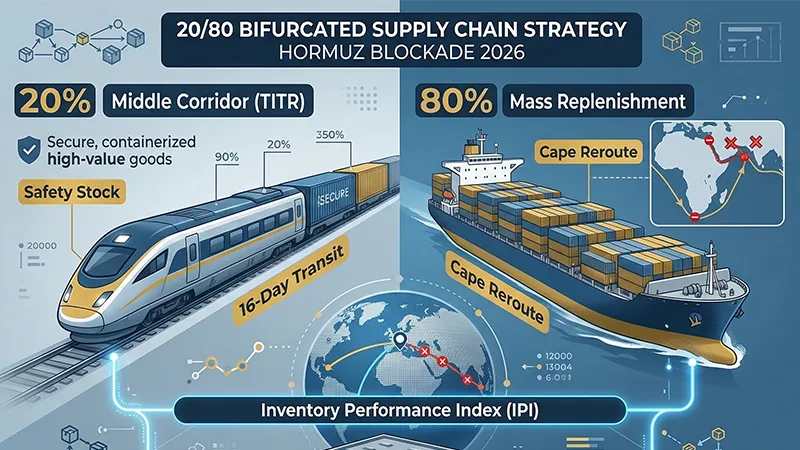
We advise high-growth brands to move away from a "Single Route" mentality. A bifurcated strategy balances cost and velocity:
-
20% via Rail (Middle Corridor): To ensure a constant "drip" of inventory into Europe within 20 days.
-
80% via Sea (Cape Reroute): For mass replenishment to maintain a lower per-unit landed cost, provided you have adjusted your lead time.
VII. FAQ: Solving 2026 Logistics Dilemmas
Can I use "Force Majeure" for Amazon late inbounds?
No. Amazon algorithms do not account for maritime blockades. If your shipment is late, your BSR will drop, and your IPI score will be penalized. You must adjust your inbound shipping dates manually and buffer your inventory.
Is the Middle Corridor safe from the conflict?
Yes. The Trans-Caspian route (TITR) stays north of the conflict zone, moving through Kazakhstan, Azerbaijan, and Georgia. It is the most resilient inland "Hedge" against Persian Gulf volatility.
How do I handle the BAF spike on my Amazon pricing?
Use a Risk-Adjusted Landed Cost model. Calculate the fractional increase per unit. If it is under $0.50 per unit, it may be more effective to absorb the cost rather than lose the Buy Box by raising prices and inviting competitors with local stock to take your market share.
VIII. Conclusion: Design for Resilience, Not Just Rates
The 2026 shipping crisis is a reminder that in global trade, certainty is more valuable than a low quote. For the European importer and the Amazon seller, the goal is no longer just "shipping cargo"—it is managing inventory velocity.
By auditing your surcharges, bypassing the Jebel Ali "Access Trap," and leveraging the Middle Corridor as a strategic buffer, you transform a global crisis into a market-share opportunity.
Protect Your 2026 Margins
Are your shipments currently stuck at sea? Don't wait for your rankings to disappear. Contact Zbao Logistics today for a free Route Risk & Margin Audit. Our strategy team will help you reroute and re-calculate your landed costs for the 2026 landscape.


