Shipping Lithium Batteries by Sea Freight from China to the USA: What Every Importer Needs to Know
If you are shipping lithium batteries to the USA in 2026, the rules have changed. The IMDG 42-24 amendment is now strictly enforced, and a single documentation error can cost you $30,000 in carrier fines or get your container turned away at the port.
A lot of importers still believe lithium batteries can only move by air. That is not true. Batteries ship by sea from China to the USA every week. But there is a real difference between a shipment that sails and one that gets rejected at the booking stage, and that difference almost always comes down to documents and carrier selection, not the cargo itself.
This guide covers the decisions you need to make before you book: which UN code applies to your product, which carriers will accept it, what paperwork is required, and what FBA sellers need to do on the Amazon side while the cargo is still on the water. For the step-by-step DG declaration and port approval process, see our complete DG sea freight declaration guide. If you want to explore routing options first, visit our sea freight services from China page.
What Is CLASS 9 in Sea Freight — And Why Lithium Batteries Fall Under It
The IMDG Code divides dangerous goods into nine classes based on their primary hazard. CLASS 9 covers miscellaneous dangerous substances that do not fit neatly into the other eight categories. Lithium batteries belong here because of their thermal runaway risk, not because they are flammable liquids or traditional explosives.
The practical consequence is important: CLASS 9 is currently the only DG class open for standard FCL booking on most China to USA routes. Classes 2, 3, 4, and others are either restricted outright or require special vessel authorization that most forwarder bookings cannot access. If your product contains any other class of dangerous goods, sea freight is generally not an option.
UN3480 vs UN3481 — Which Code Applies to Your Product?
Your UN code determines your document checklist, your packing instructions, and how closely carriers review your booking. Get this wrong and your entire shipment gets held up.
| UN3480 | UN3481 | |
|---|---|---|
| Full Name | Lithium Ion Batteries — Standalone | Lithium Ion Batteries Packed with or Contained in Equipment |
| Typical Products | Power banks, spare battery packs, replacement cells | Phones, laptops, e-bikes, electric scooters, power tools |
| Risk Level | High | Medium |
| DG Packaging Certificate | Required (P903 exemption may apply) | Often not required |
| SoC Limit in 2026 | 30% max — mandatory | PI 966 (packed with): 30% max, mandatory PI 967 (contained in): 30% max, recommended |
| Branded Products | Brand authorization letter required | Brand authorization letter required |
- UN3480 means standalone batteries with no device included, such as power banks or spare cells. This is the highest-scrutiny category. A dangerous goods packaging certificate is required in most cases, and if the product carries a brand name, you also need a brand authorization letter.
- UN3481 packed with equipment (PI 966) means the battery ships in the same box as the device but is not built in. From January 1, 2026, the 30% SoC cap is now mandatory for this category under IMDG 42-24.
- UN3481 contained in equipment (PI 967) means the battery is built into the device, like an internal phone battery. The 30% SoC cap is a strong recommendation here but not yet mandatory.
Which Ocean Carriers Accept Lithium Batteries on China to USA Routes?
Not every carrier accepts CLASS 9 DG cargo, and among those that do, coverage varies by destination. Before you lock in a supplier production schedule, confirm your carrier options. The table below reflects current booking availability on China to USA and China to Canada lanes through our sea freight services.
| Carrier | US West Coast | US East Coast | Gulf Coast | Canada |
|---|---|---|---|---|
| COSCO | Yes | Yes | Yes | Yes |
| EMC (Evergreen) | Yes | Yes | Yes | Yes |
| OOCL | Yes | Yes | Yes | Yes |
| ONE | Yes | Yes | Yes | Yes |
| WHL | Yes | Yes | No | No |
| HEDE | Yes | No | No | No |
| SML | Yes | No | No | N/A |
Three carrier rules that catch importers off guard:
- OOCL summer restriction (June 1 to September 30): During these four months, OOCL will not accept CLASS 9 battery cargo if the batteries come from more than one manufacturer in the same container. If your shipment mixes batteries from different factories, plan around this window or switch carriers.
- COSCO Canada routing: VAN/VAN transshipment does not accept DG cargo. Only PRR transshipment works for CLASS 9 shipments going to Canada.
- EMC Canada emergency contact: The 24-hour emergency contact on the DG Form must be a landline registered with an approved response organization. CANUTEC, CHEMTREC, INFOTRAC, and 3E are all accepted. Mobile numbers and voicemail are not.
Documents Required to Ship Lithium Batteries by Sea Freight
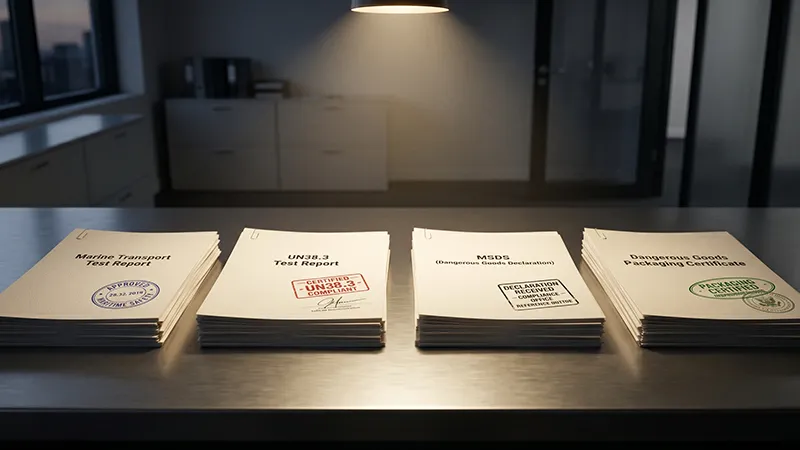
Document errors are the number one reason DG bookings get delayed or rejected. The list below covers what you need, not how to fill each form out. For field-by-field instructions on the DG Form and port approval process, see our complete DG sea freight declaration guide.
Required for All Lithium Battery Shipments
- Maritime Survey Report — Must be the 2026 version. A 2025 report will not be accepted even if the product has not changed. If the battery and equipment are packed together, the report covers the device. If the battery ships alone, the report covers the battery.
- UN38.3 Test Report — The mandatory safety test series defined by the UN38.3 testing standard. Must match the exact product being shipped, including model number and watt-hour rating.
- MSDS (Material Safety Data Sheet) — Must be issued by an accredited third-party testing body and stamped with the manufacturer's official company seal. The testing agency stamp alone is not enough. The document must also comply with the current IMDG Code edition.
- DG Form (Dangerous Goods Declaration) — Contains all 27 required dangerous goods fields. Valid 24-hour emergency contacts for both the export and import sides must be included.
Additional Requirement for UN3480
- Dangerous Goods Packaging Certificate — Required for standalone battery shipments. Shipments that meet the conditions of IMDG Special Provision P903 may apply for an exemption. Not all UN3480 shipments qualify. Confirm this with your forwarder before assuming the exemption applies.
Branded Products — An Extra Step Most Guides Skip
If your product carries any brand name or trademark, you need one more document that most logistics guides never mention:
- Brand Authorization Letter — Confirms that the exporting party has the brand owner's permission to ship goods under that brand name. It applies to both UN3480 and UN3481 products. Without it, carriers can refuse the booking outright, and US Customs can hold or seize the shipment at the port of entry. The letter should be on the brand owner's official letterhead, signed, and specify the product category and authorized territory.
US Gateway Ports for CLASS 9 DG Shipments
Where your cargo arrives affects transit time, last-mile cost, and how long DG clearance takes. Here is a practical breakdown by region:
- Pacific Southwest (LAX, LGB, OAK): Best for California distribution and Amazon West Coast fulfillment centers such as ONT8 and LAX9. Highest volume, well-equipped for DG handling.
- Pacific Northwest (SEA, TIW): Lower congestion than Southern California. Good for Pacific Northwest distribution and inland Canada points.
- US East Coast (SAV, NYC/NJ): Savannah is now the second-busiest container port in the USA and a preferred entry point for Amazon's East Coast fulfillment network. NYC/NJ handles a large share of consumer electronics imports.
- Gulf Coast (HOU, Miami, Tampa): Serves the South and Southeast. WHL, HEDE, and SML do not cover Gulf ports for DG cargo, so carrier options are more limited here.
5 Mistakes That Get Your Shipment Rejected or Fined $30,000
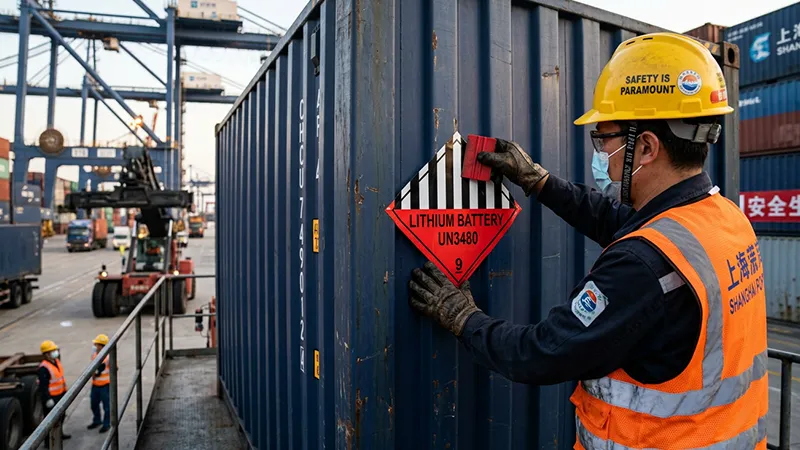
These are not edge cases. Every one of the following errors happens regularly on China to USA DG bookings.
- Using last year's maritime survey report. Carriers require the current-year version. A 2025 report submitted on a 2026 booking will be rejected with no exceptions and no grace period. Refresh your documents before each shipping season, ideally before you place the production order.
- Submitting an MSDS without the manufacturer's company seal. The third-party testing agency stamp is not enough on its own. The manufacturer's official seal must also appear on the document. This is a hard requirement for COSCO and is one of the most common reasons first-time DG shippers get bounced at review.
- Providing a 24-hour emergency contact that goes unanswered. Carriers require this number to be reachable at any hour, any day. If the vessel encounters an incident and the contact cannot be reached, the container may be refused discharge at the destination port. Every cost that results, including demurrage, re-routing, and potential disposal, is the shipper's responsibility.
- Changing cargo details after DG approval is confirmed. Any change to piece count, gross weight, or volume after approval requires the full 27-field application to be resubmitted and re-approved. If this happens close to the vessel cutoff, there may not be time to complete re-approval before the sailing. The shipment misses the vessel and all costs fall on the cargo owner.
- Misdeclaring or hiding DG information. COSCO charges a penalty of USD $30,000 per container for any misrepresentation of dangerous goods information, on top of recovering all actual losses. This is not a negotiable fee. If you are unsure whether your product qualifies as DG or which UN code applies, work with a reliable freight forwarder before booking.
Amazon FBA Sellers — What Most Sea Freight Guides Do Not Cover
Most logistics guides stop at the port. For Amazon FBA sellers, the compliance work continues well past arrival. A container that clears US Customs without a problem can still be turned away at the fulfillment center if you have not handled the FBA side in parallel.
The Hazmat Review Problem
Every ASIN containing a lithium battery must pass Amazon's Dangerous Goods review process before it can be received into a standard fulfillment center. This review runs on Amazon's timeline, not yours.
- You need to submit a Safety Data Sheet (valid within the past 5 years) and a UN38.3 test report through Seller Central. Both documents must match the ASIN listing exactly, including product name, model number, and watt-hour rating.
- Amazon does not explain why a submission was rejected. The response is usually "additional information required," which can mean multiple rounds of resubmission over several weeks.
SoC 30% and Your Production Timeline
The 2026 mandatory SoC cap creates a real supply chain problem. Most factories default to shipping batteries at or near full charge because it simplifies their quality checks. Discharging to 30% adds a step, and some factories will push back.
- Amazon has confirmed that products failing SoC compliance can only be replenished via ground transportation within the US. Air freight replenishment is not available for non-compliant batteries, which significantly stretches restock timelines.
- The most reliable fix is to put the SoC requirement in writing in your purchase order terms and your pre-shipment inspection checklist. If it is not written down, it probably will not happen.
The 300Wh Ceiling for Standard FBA Warehouses
Standard Amazon fulfillment centers do not accept batteries over 300Wh. E-bike batteries, large portable power stations, and high-capacity industrial packs frequently exceed this limit. If your product is above 300Wh, you need a Hazmat-certified 3PL to receive and process the cargo before it enters the FBA network. That adds cost, time, and a handling step to every inbound shipment.
Also worth noting: the Lithium Battery Mark label format changed in 2026. The phone number field is being phased out in stages. If your label includes both the old format and the new format at the same time, it creates a conflict that will get the shipment flagged. Use only the current 2026 label template.
Frequently Asked Questions
Can you ship lithium batteries by sea freight from China to the USA?
Yes. Lithium batteries qualify as CLASS 9 dangerous goods under the IMDG Code and can be shipped by sea freight from China to the USA. Full documentation must be submitted and approved by the ocean carrier before booking is confirmed. CLASS 9 is currently the only DG class accepted for FCL bookings on most China to USA routes.
What is the difference between UN3480 and UN3481 in sea freight?
UN3480 covers standalone lithium ion batteries shipped without any device, such as power banks and spare battery packs. UN3481 covers batteries packed with or contained in equipment, such as phones, laptops, and e-bikes. UN3480 carries a higher risk classification, requires a dangerous goods packaging certificate in most cases, and faces stricter carrier review than UN3481.
Do lithium batteries need to be at 30% charge for sea freight in 2026?
As of January 1, 2026, under IMDG Code Amendment 42-24, the 30% State of Charge limit is now mandatory for UN3480 and for UN3481 batteries packed with equipment (Packing Instruction 966). For UN3481 batteries contained in equipment (PI 967), the 30% cap is a strong recommendation but not yet mandatory.
What documents are required to ship lithium batteries from China to the USA by sea?
You need a current-year maritime survey report, a UN38.3 test report, an MSDS issued by a third-party lab and stamped by the manufacturer, and a completed DG Form covering all 27 required fields. UN3480 shipments also need a dangerous goods packaging certificate unless the P903 exemption applies. Branded products require a brand authorization letter.
What is the P903 exemption for dangerous goods packaging?
Special Provision P903 under the IMDG Code allows certain lithium battery shipments to skip the dangerous goods packaging certificate. Eligibility depends on battery size, watt-hour rating, and packaging configuration. Not every UN3480 shipment qualifies. Confirm with your freight forwarder before assuming the exemption applies. You can cross-reference UN numbers using the US DOT ERG reference tool.
Do branded lithium battery products need extra documentation for sea freight?
Yes. Any product carrying a brand name requires a brand authorization letter confirming the exporting party has the brand owner's permission to ship under that brand. Without it, carriers can reject the booking and US Customs may hold the shipment at the port of entry.
How long does DG approval take for COSCO China to USA bookings?
DG approval for COSCO China to USA bookings typically takes 2 to 3 business days once all 27 DG fields are submitted correctly and completely. If any information needs correction, the review starts over. Submit everything at least 5 to 7 business days before the vessel cutoff to stay safe.
Ready to Ship CLASS 9 DG from China to the USA?
Our team handles lithium battery FCL bookings on COSCO, EMC, OOCL, and other major carriers, with full DG document review before your booking is confirmed.
Get a Free Quote Within 24 Hours View Sea Freight Services

