Dangerous Goods Sea Freight: How to Declare CLASS 9 Cargo from China to the USA (2026)
Your DG shipment gets rejected at the port. Your container is sitting at Yantian. Your freight forwarder calls to say one field in the 27-point declaration form is wrong. Getting it corrected means restarting the approval process, missing the vessel cutoff, and paying demurrage you did not budget for. This happens every week to shippers who treat DG compliance as an afterthought.
This guide walks you through the complete declaration process for CLASS 9 dangerous goods shipped by sea from China to the USA, from document preparation through port authority approval and final container handoff. The content is based on our day-to-day operations handling COSCO, EMC, and OOCL bookings on the China-US trade lane.
If you are looking for a broader overview of transporting lithium batteries door-to-door, see our Shipping Lithium Batteries from China to USA: Door-to-Door Guide. This article focuses specifically on the declaration and compliance steps that happen before your cargo reaches the vessel.
IMDG Code Amendment 42-24 became mandatory on January 1, 2026. Three changes affect CLASS 9 shippers immediately:
- All MSDS documents must reference Amendment 42-24 in Section 14 (Transport Information). Documents still citing 41-22 are now invalid and will be rejected at carrier review.
- UN3481 devices with batteries over 100Wh must be shipped at 30% State of Charge (SoC) or below. Notify your factory before packing.
- Electric vehicles powered by lithium-ion batteries must now use UN3556 (previously classified under UN3171).
What Is CLASS 9 Dangerous Goods and Why It Matters for China-USA Shipments
CLASS 9 is the miscellaneous dangerous goods category under the IMDG Code (International Maritime Dangerous Goods Code), published by the International Maritime Organization. It covers materials that present a hazard during transport but do not fit neatly into the other eight classes.
For the China-USA trade lane, CLASS 9 is the most relevant DG category for e-commerce and Amazon sellers because it includes:
- UN3480: Lithium-ion batteries shipped on their own (not installed in or packed with equipment)
- UN3481: Lithium-ion batteries installed in equipment or packed with equipment
- UN3090 / UN3091: Lithium metal batteries (standalone or with equipment)
- UN3556 / UN3557: Electric vehicles powered by lithium-ion or lithium metal batteries (new classification effective 2026)
- Magnetized materials and dry ice (less common in e-commerce)
At Zbao, we currently handle CLASS 9 DG shipments only. We do not accept chemicals, flammables, explosives, or other DG classes. If your cargo falls under CLASS 9, particularly lithium batteries and battery-powered products, you are in the right place.
On the China-USA and China-Canada trade lanes, the main carriers that accept CLASS 9 cargo include COSCO, EMC, and OOCL. Note that WHL has no service to the US Gulf or Canada, HEDE does not cover the US East Coast, US Gulf, or Canada, and SML does not serve the US East Coast or US Gulf. Carrier selection matters when routing DG shipments. For port strategy, see our China Base Ports Guide 2026: Yantian vs. Shanghai and DG Strategy.
The 4 Core Documents You Must Prepare Before Booking
To book a CLASS 9 DG shipment from China, you must submit four essential documents: a Marine Transport Test Report (current year), a UN38.3 Test Report, an MSDS compliant with IMDG Amendment 42-24, and a DG Packaging Certificate. Missing any one of these will result in your booking being rejected before it reaches the carrier's DG review team.
1. Marine Transport Test Report (海运鉴定报告)
This report certifies that your product is safe for ocean transport. The report must be the current year's version, a 2025 report is not valid for 2026 shipments. The scope of the report depends on how the battery is packaged:
- Battery built into or installed inside the device: provide the device's transport test report
- Battery packed separately from the device: provide the battery's transport test report
2. UN38.3 Test Report
The UN38.3 standard, maintained by the United Nations, defines the safety testing requirements for lithium batteries in transport. Every lithium battery shipment requires a valid UN38.3 test report. There are no exceptions. Carriers will not process a DG booking without it.
3. MSDS (Material Safety Data Sheet)
The MSDS must meet three conditions to be accepted:
- Issued by a third-party testing institution (not self-prepared by the factory)
- Stamped with the manufacturer's official company seal
- Section 14 (Transport Information) must reference IMDG Code Amendment 42-24
Make sure the document was issued within the last one to two years and is based on current GHS (Globally Harmonized System) standards. Last month, an importer faced a 7-day delay at Yantian simply because their MSDS carried the testing lab's stamp but was missing the factory's official red seal. One missing stamp. Seven days of demurrage costs.
4. DG Packaging Certificate (危包证)
A DG Packaging Certificate is required for UN3480 (standalone lithium-ion batteries). For UN3481 shipments, the certificate may be waived if the shipment meets the P903 exemption conditions under the IMDG Code. Confirm with your freight forwarder whether your specific product qualifies for the P903 exemption before assuming you do not need this document.
Step-by-Step: The Complete DG Declaration Process for Sea Freight from China
The DG declaration process for sea freight from China involves five steps: submitting the 27-point booking form, obtaining carrier approval, completing the port authority review, submitting the DG manifest after stuffing, and labeling the container with correct placards. Each step has a hard deadline and specific requirements that cannot be skipped.
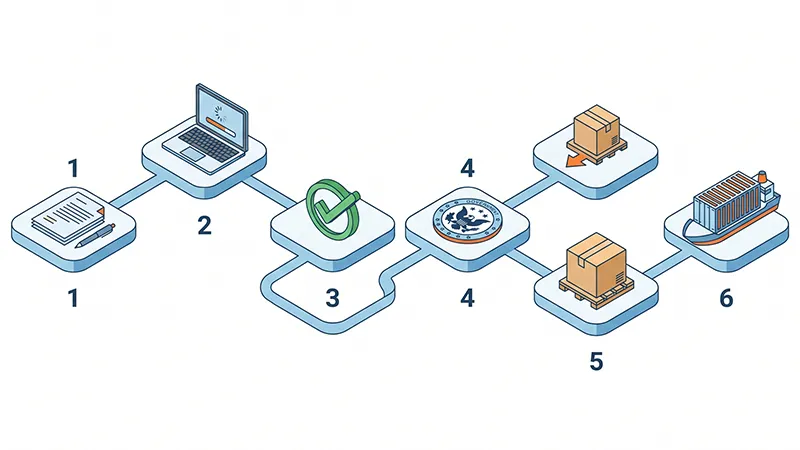
Step 1: Submit the 27-Point DG Booking Form
When booking a DG shipment, you must submit accurate information across 27 mandatory fields, along with your MSDS and transport test report. The carrier's DG review team checks every field before approving the booking.
Key requirements at this stage:
- Packaging unit format must follow the correct notation, for example:
CTNS = FIBREBOARD BOXES/4G - Weight, piece count, and volume (件重体) must be accurate. Any change after approval requires a full re-submission and re-approval.
- A 24-hour emergency contact must be provided for both the export and import side. The phone number must be reachable at any time of day. A number that goes to voicemail or a business line that closes at 5pm is considered invalid.
- For Canada-bound cargo via EMC, you must pre-register with an approved emergency response organization such as CANUTEC or CHEMTREC before the carrier will accept your DG form.
COSCO charges $30,000 USD per container for misdeclared, undeclared, or incorrectly reported dangerous goods regardless of intent. This is not an isolated policy. ONE (Ocean Network Express) enforces penalties from $3,000 to $30,000 per container. Wan Hai penalties can reach $100,000 per container. All resulting costs from cargo removal, re-inspection, or return shipment are charged to the shipper.
Step 2: Wait for Carrier DG Approval
After submitting your booking with all required documents, allow 3 to 5 business days for the carrier's DG review team to process the approval. Approval is not automatic. Do not schedule container pickup or stuffing until written approval has been confirmed.
If anything changes after approval, the piece count shifts because you consolidated two factory orders, the weight is slightly different from the packing list, or the battery spec was updated. You must notify your freight forwarder immediately and apply for a revised approval. Earlier this year, a Shenzhen-based electronics exporter had their booking rejected two days before vessel cutoff because their Marine Test Report was still the 2025 version. Getting a new one issued and re-approved cost them a missed peak-season vessel.
Step 3: Port Authority Review and Approval
Before dropping your loaded container at the terminal, the port authority in your export city must approve the DG port entry. This is a separate process from the carrier's booking approval, and both must be completed before your container can enter the terminal.
Using Shenzhen's Yantian Port as an example, the process works as follows:
- Submit the DG Port Entry Declaration Form (DG进港申报单) and MSDS to the port authority system at least one full working day before the planned port entry
- Log in to the port dangerous goods declaration system and enter your booking number or container number to check the approval status
- Only when the status shows "Approved" (已批准) can the container be delivered to the terminal
- DG containers at Yantian may not remain in the terminal for more than 72 hours
This example reflects Yantian's specific system. If you are exporting from Shanghai, Ningbo, Guangzhou Nansha, or another port, the local port authority and declaration platform will differ, but the core requirements are similar. Check with your freight forwarder for the specific platform and timeline at your origin port.
Step 4: Submit the DG Manifest After Stuffing
Once the container is stuffed and the container number is confirmed, submit the following to your freight forwarder before the CY (container yard) cutoff deadline:
- A single PDF combining the DG Declaration Form and the MSDS, in that order (Declaration Form first, MSDS second)
- The PDF file must be 10MB or under and must display the container number
- Submit per container, one PDF per container
If you notify your forwarder of any cargo changes after stuffing, the shipment is at risk of being flagged for misdeclaration. The carrier may require a full document re-review, and if this cannot be completed before the vessel's deadline, the container will not load. A seller consolidated two factory orders last minute, adding 200kg to the declared weight. COSCO flagged the discrepancy at manifest review. The shipment missed the vessel entirely.
Step 5: Affix Dangerous Goods Placards to the Container
Before the container is handed over to the terminal, DG placards must be affixed to all four sides of the container:
- Placard position: at least 1.5 meters (5 feet) above the base of the container on each of the four sides
- Placards must not block or be damaged by the container doors when opening or closing
- All applicable DG class labels must be represented on the placard set
COSCO vs. EMC: DG Form Requirements for US and Canada Routes
Here is the exact comparison of DG declaration requirements between COSCO and EMC for US and Canada routes. The differences are significant enough that using the wrong form format, or omitting a Canada-specific field, will cause your booking to be rejected.
| Requirement | COSCO (US/Canada) | EMC (US/Canada) |
|---|---|---|
| Declaration Format | 27-point DG declaration form | DG FORM, one container, one S/O, one form |
| Multiple UN Numbers | Each UN number declared separately | Each UN number on a separate line with corresponding DG data |
| US DOT ERG Number | Required for US-bound cargo | Required for US-bound cargo. Format: UN3481/147 |
| 24-Hour Emergency Contact (USA) | Must be reachable at all times | Must be reachable at all times. Reference the US DOT ERG for correct number format |
| Canada 24-Hour Contact | Fixed landline or registered emergency org | Must be registered with CANUTEC, CHEMTREC, INFOTRAC, or 3E Company. Mobile phones and voicemail not accepted. |
| Canada Contract Number | Not required | Must include: organization name, 24-hour contact number, contract number, and registered company name |
| Packing Group Display | Follow applicable rules | USA: write NIL or NONE if not applicable. Canada: leave blank if not applicable. |
| Canada IPI (Inland Point) Routing | VAN/VAN transit does not accept DG. PRR transit only. | Confirm with forwarder per booking |
OOCL Summer Restriction: What Lithium Battery Shippers Need to Know (June 1 to September 30)
Based on our operational experience handling OOCL bookings on the China-USA trade lane, during the summer months from June 1 through September 30, OOCL requires that all lithium batteries within a single DG shipment originate from the same manufacturer. If the batteries in your shipment come from two different factories, even if they carry the same UN number and the same specifications. OOCL will not accept the booking.
This is a practical issue for Amazon sellers who source from multiple suppliers and consolidate at a freight station. If you are planning a summer shipment with battery products from more than one factory, either split them into separate bookings or switch to a carrier without this restriction for that particular shipment. Contact us before consolidating multi-source battery cargo during peak season.
5 Common Reasons DG Shipments Get Rejected at Chinese Ports
The five most common reasons DG shipments are rejected at Chinese ports are: expired test reports, missing factory stamps on MSDS, unreachable emergency contacts, undeclared cargo weight changes, and premature container drop-off before port authority approval. Each of these is preventable with the right process in place.
1. Expired Marine Test Report
The Marine Transport Test Report must be renewed every year. Carriers check the issue date during booking review. Earlier this year, a Shenzhen-based electronics exporter had their booking rejected two days before vessel cutoff because their report was still the 2025 version. Getting a new one issued and re-approved cost them a missed peak-season vessel and a full week of delay.
2. MSDS Missing the Factory's Official Stamp
A third-party testing lab issues the MSDS, but the manufacturer must also apply their official company seal before the document is valid. The testing lab's stamp alone is not enough. Last month, an importer faced a 7-day delay at Yantian because the factory seal was missing. One stamp. Seven days of demurrage.
3. Unreachable 24-Hour Emergency Contact
Carriers are required to be able to reach your emergency contact at any hour. A freight coordinator once submitted a valid-looking phone number that went to a sales rep who worked standard business hours. At 11pm on a Friday, the carrier's safety team called for a routine check. No answer. The container was flagged and could not be loaded. The emergency contact must be a live, always-on line.
4. Weight or Count Changes Not Re-Declared
Any change to the declared piece count, gross weight, or volume after booking approval requires a full re-submission. This is not optional. A seller consolidated two factory orders last minute, adding 200kg to the declared gross weight. They assumed it was close enough. COSCO flagged the discrepancy at manifest review, and the shipment missed the vessel entirely.
5. Container Dropped at Terminal Before Port Authority Approval
This is the most expensive mistake we see regularly. An operator drops the container at the Yantian terminal before logging into the port authority system to verify approval status. The approval was still pending. The terminal refused the container, and the demurrage clock started immediately. Always confirm the port authority status shows "Approved" before sending the driver to the terminal.
For more on how to vet your logistics partner for DG handling, read our guide on 5 Red Flags When Choosing a China Freight Forwarder.
Frequently Asked Questions about CLASS 9 DG Sea Freight
Here are the most frequently asked questions about shipping CLASS 9 dangerous goods by sea freight from China.
What documents are required to ship lithium batteries by sea freight from China?
You need four core documents: a Marine Transport Test Report valid for the current year, a UN38.3 test report, an MSDS compliant with IMDG Amendment 42-24 (Section 14 must reference 42-24), and a DG Packaging Certificate. For UN3481 shipments that meet the P903 exemption conditions, the packaging certificate may be waived.
What is the difference between UN3480 and UN3481 for sea freight?
UN3480 covers lithium-ion batteries shipped on their own, with no device included. UN3481 covers batteries either installed inside equipment or packed in the same box as equipment. UN3480 shipments carry stricter requirements: a mandatory DG packaging certificate and a maximum 30% state of charge at the time of loading.
Does my MSDS need to be updated for 2026?
Yes. IMDG Code Amendment 42-24 became mandatory on January 1, 2026. Your MSDS must reference Amendment 42-24 in Section 14. If it still references Amendment 41-22, carriers will reject it at booking review. Make sure the document was issued within the last one to two years and is based on current GHS standards.
What happens if I misdeclare dangerous goods on a container?
Penalties are enforced industry-wide and applied per container. COSCO charges $30,000 USD per container. ONE enforces penalties from $3,000 to $30,000 per container. Wan Hai can charge up to $100,000 per container. On top of the fine, your shipment may be offloaded, held for inspection, or returned at your expense.
How long does the DG approval process take for sea freight from China?
Allow 3 to 5 business days for the carrier DG booking approval after submitting complete documents. Port authority approval requires submission at least one working day before planned port entry. During peak season, build in extra lead time. Same-week approval is not reliable when cargo readiness and vessel cutoff are tight.
Ready to Ship CLASS 9 Cargo from China?
DG compliance is not optional. A single documentation error can cost you a vessel, a penalty, and a week of delays. Our team handles COSCO, EMC, and OOCL CLASS 9 DG approvals daily, and we review your documents before the booking goes in.


