How to Fill Out a DGD Form for Sea Freight from China
If your shipment from China contains lithium batteries, chemicals, or any regulated cargo, your carrier will not accept the booking without a correctly completed Dangerous Goods Declaration form. One wrong field — or one missing number — and your container gets rolled, or rejected outright. This guide provides a field-by-field breakdown of the IMO DGD form, explains the 2026 IMDG Code 42-24 requirements now in mandatory effect, and details the specific differences for US versus Canada destinations.
The Dangerous Goods Declaration (DGD) is not a formality. It is the primary legal document that defines what your cargo is, who is responsible for it, and whether it can be safely loaded onto a vessel. For sellers and importers shipping from China, getting this document right is the difference between a smooth departure and a costly cargo hold.
For a broader introduction to CLASS 9 regulated cargo, see our CLASS 9 DG Sea Freight from China: Declaration Guide 2026.
1. What Is a Dangerous Goods Declaration (DGD) Form?
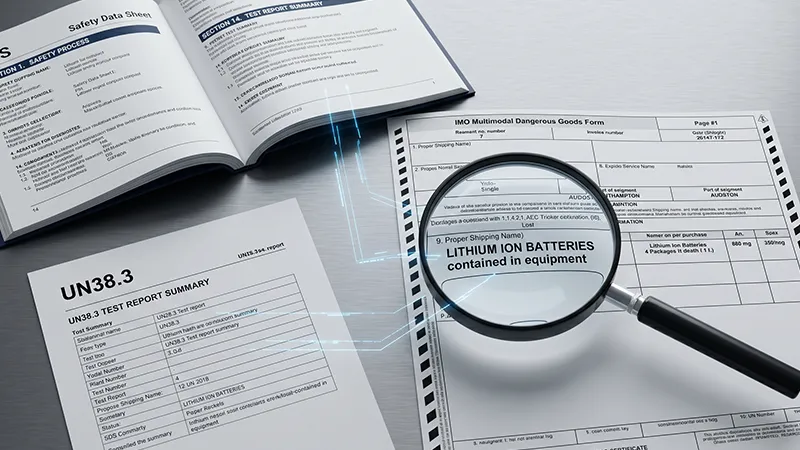
The DGD, officially known as the IMO Multimodal Dangerous Goods Form, is the standardized document required under Chapter 5.4 of the International Maritime Dangerous Goods (IMDG) Code for all sea shipments of regulated cargo. The form identifies the goods, their hazard classification, packaging details, and the party legally responsible for the declaration.
The Legal Basis
IMDG Code Section 5.4.1 mandates that a shipper must provide a DGD before dangerous goods can be accepted for sea carriage. The requirement applies to both Full Container Load (FCL) and Less than Container Load (LCL) shipments. There are no exceptions based on shipment size or cargo value.
The legal liability rests entirely with the Shipper of Record. The signature on Box 22 is a formal legal declaration — not a signature of convenience. A freight forwarder who handles the paperwork on your behalf cannot sign the DGD in place of the shipper. This point is addressed in detail under the Box 22 section below.
DGD vs. Container Packing Certificate (CPC)
These two documents are frequently confused. The DGD certifies what the cargo is — its UN number, hazard class, and IMDG Code compliance. The Container Packing Certificate (CPC) certifies how the cargo was loaded — that the container was packed and secured in accordance with applicable regulations. Both documents can appear on the same IMO Multimodal form, but they carry distinct legal responsibilities and may require different signatories.
2. Do You Actually Need a DGD? A Quick Eligibility Check
Not every shipment with a safety data sheet requires a full DGD. The requirement depends on the cargo classification under the IMDG Code.
Cargo That Always Requires a Full DGD
- Any cargo assigned a UN number, including UN3480 (lithium-ion batteries, standalone), UN3481 (lithium-ion batteries packed with or contained in equipment), and UN3171 (battery-powered vehicles)
- All Class 1 through Class 9 dangerous goods shipped under their full IMDG Code classification
- Sodium-ion batteries classified under UN3551 and UN3552, newly added under IMDG Amendment 42-24 effective January 1, 2026
Limited Quantity, Excepted Quantity, and Non-Regulated Cargo
- Limited Quantity (LQ): A full DGD is still required, but labeling requirements are simplified. The form must reference the LQ provision.
- Excepted Quantity (EQ): The DGD requirement is waived, but the relevant exemption provision must be noted on the shipping documents.
- Non-Regulated (ordinary goods): No DGD required. However, retaining an MSDS on file is strongly recommended in case of carrier inquiry.
3. Before You Start: 4 Documents You Must Have Ready
Attempting to complete the DGD without these four items will result in an incomplete or non-compliant submission. Gather all of the following before opening the form.
- UN Number and Proper Shipping Name
Source these from Section 14 of your cargo's Safety Data Sheet (SDS), or directly from the IMDG Code. The Proper Shipping Name on the DGD must match the SDS exactly — character for character. - Sea Transport Test Report (SEA CERT)
This is the laboratory certification that your cargo meets sea transport safety standards. Under COSCO's requirements — the strictest benchmark in the industry — the SEA CERT must be valid for the current calendar year. A certificate issued in 2025 is not acceptable for 2026 shipments. From January 1, 2026, all SEA CERTs must also comply with IMDG Amendment 42-24. See our complete guide to shipping lithium batteries by sea for more on test report requirements. - Material Safety Data Sheet (MSDS / SDS)
The MSDS must be issued by an accredited third-party testing body and stamped by the manufacturer. Critically, Section 14 (Transport Information) must reference the current edition of the IMDG Code. From January 1, 2026, any MSDS that still cites "Amendment 41-22" is considered out of date and will be rejected by major carriers. - US DOT ERG Number (US destinations) or 24-Hour Emergency Contact (Canada destinations)
These are destination-specific requirements that affect how you complete Box 9 and Box 20. Details are covered in the field-by-field breakdown below. The current US DOT Emergency Response Guidebook (ERG 2024) is available through the PHMSA website and as a free mobile application.
4. Field-by-Field Breakdown of the IMO DGD Form
The IMO Multimodal Dangerous Goods Form is divided into four sections. What follows is a precise, field-level guide to completing each one correctly for trans-Pacific sea freight from China to the United States or Canada.
Section A: Shipper and Transport Details (Boxes 1–7)
| Box | Field Name | Completion Requirements |
|---|---|---|
| Box 1 | Shipper | Full legal name and complete address of the Shipper of Record. This must match the Bill of Lading exactly. Any discrepancy between the two documents will cause a customs hold at the destination port. |
| Box 2 | Transport Document No. | Enter the Shipping Order (S/O) number. One S/O corresponds to one DGD. Multiple containers under separate S/O numbers each require an independent DGD form. Do not consolidate. |
| Box 3 | Page / of Pages | If the DGD covers one page, enter "1 of 1." For multi-page declarations covering multiple UN numbers, number each page sequentially. |
| Box 4 | Shipper's Reference | Your internal order or reference number. Not mandatory under IMDG Code, but completing it aids internal tracking and carrier communication. |
| Box 5 | Freight Forwarder's Reference | Your freight forwarder's booking reference number. Can be left blank if not applicable. |
| Box 6 | Vessel and Voyage No. | The vessel name and voyage number as shown on the Booking Confirmation from your carrier. Use the confirmed vessel, not an estimated one. |
| Box 6-1 | Port of Loading / Port of Discharge | Use standard UN/LOCODE format. Examples: CNYTN (Yantian), CNSHA (Shanghai), USLAX (Los Angeles), USNYC (New York), CAVCR (Vancouver). |
| Box 7 | Marks, Numbers, and Package Description | Shipping marks if any, and the total number and type of outer packages. Example: "200 Cartons." This must correspond with the packing list. |
Section B: Cargo Identification (Boxes 8–14)
This section carries the highest rate of errors and rejections. Every field must be completed with precision. Cross-reference your SDS Section 14 before entering any value.
| Box | Field Name | Completion Requirements |
|---|---|---|
| Box 8 | UN Number | Always write the "UN" prefix followed by the four-digit number. Correct format: UN3481. Do not write the number alone without the prefix. For shipments containing multiple UN numbers, each must appear on a separate line. |
| Box 9 | Proper Shipping Name | Write the full IMDG-designated Proper Shipping Name in capital letters. Example: LITHIUM ION BATTERIES PACKED WITH EQUIPMENT. This must match your SDS Section 14 exactly. See the compliance warning below for US and Canada destination requirements. |
| Box 10 | Class / Division | The primary hazard class. For lithium batteries: 9. For flammable liquids: 3. Source from your SDS Section 14. |
| Box 11 | Subsidiary Risk | Secondary hazard classification, if applicable. Most Class 9 lithium battery shipments have no subsidiary risk — enter N/A. |
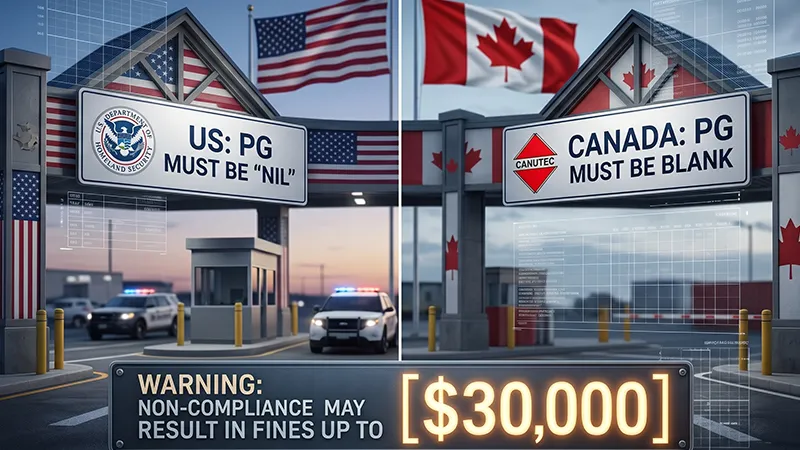
| Box 12 | Packing Group | See the compliance warning below. This field has different requirements depending on your destination country. |
| Box 13 | Marine Pollutant | Indicate whether the cargo is classified as a marine pollutant. Lithium batteries are not marine pollutants — enter No. |
| Box 14 | Flash Point | Required for flammable liquids (Class 3). Enter the flash point temperature in degrees Celsius with the unit specified. For Class 9 cargo and non-flammable goods, enter N/A. |
US-bound cargo: Append the US DOT Emergency Response Guidebook (ERG) number at the end of the Proper Shipping Name using this exact format: LITHIUM ION BATTERIES PACKED WITH EQUIPMENT, UN3481/147. The emergency contact telephone number in Box 20 must be dialable from outside the United States. Do not use a 1-800 toll-free number — these cannot be reached from international locations.
Canada-bound cargo: Append a registered 24-hour emergency contact to Box 9. CANUTEC (613-996-6666) alone is not sufficient as the sole contact — regulations require a technically qualified contact person from the shipper's organization. A pre-registered service such as CHEMTREC (703-527-3887) is an accepted alternative, provided the shipper has an active registration with that service.
US-bound cargo: This field MUST explicitly state NIL, NO, or NONE. Leaving the field blank for a US destination will trigger a document rejection.
Canada-bound cargo: This field MUST be left completely blank. Entering NIL or NONE is treated as an error by Canadian carriers and port authorities.
This single field difference is one of the most common reasons DGD forms are rejected on trans-Pacific routes. If you ship to both the US and Canada, maintain separate DGD templates for each destination.
Section C: Packaging and Quantity (Boxes 15–19)
| Box | Field Name | Completion Requirements |
|---|---|---|
| Box 15 | Number of Packages | Total count of outer packages (cartons, drums, pallets). This must match the packing list. |
| Box 16 | Kind of Packages | The outer packaging type. Standard descriptions: Cartons, Drums, Jerricans, Pallets. Use IMDG-recognized terms. |
| Box 17 | Total Quantity | The net quantity of the dangerous goods only, excluding packaging weight. Specify the unit clearly: kg, L, or number of batteries. For lithium batteries, declare total watt-hour (Wh) capacity if required by the carrier. |
| Box 18 | Total Gross Weight | Combined weight of cargo and all packaging materials, in kilograms. This figure must correspond to the weight declared on the Bill of Lading. |
| Box 19 | Additional Handling Information | Special handling instructions. Common entries: KEEP UPRIGHT, THIS SIDE UP, STORE AWAY FROM HEAT SOURCES. Leave blank if no special instructions apply. |
Section D: Emergency Contacts and Declaration (Boxes 20–22)
| Box | Field Name | Completion Requirements |
|---|---|---|
| Box 20 | Emergency Contact | A 24-hour telephone number reachable from outside the origin country. Must be answered by a person — not a voicemail system — at any hour. See the US/Canada guidance in the Box 9 warning above. |
| Box 21 | Additional Information | Supplementary declarations including the SEA CERT reference number and any applicable exemption clauses. For Activated Carbon (UN1362) shipments, IMDG 42-24 now requires the production date, packing date, and material temperature at time of packing to appear here. |
| Box 22 | Shipper's Declaration and Signature | See the legal warning below. |
Under IMDG Code Section 5.4.1.1.3, the person who signs Box 22 legally declares that the cargo has been fully classified, packaged, marked, labeled, and described in compliance with the IMDG Code. This declaration can only be made by the Shipper of Record. A freight forwarder, customs broker, or trading company cannot sign this form on the shipper's behalf — doing so constitutes a fraudulent declaration under maritime law.
If undeclared or misdeclared dangerous goods cause a maritime incident, fire, or regulatory violation, the signatory bears full legal and financial liability. Under COSCO's misdeclaration penalty policy, fines reach $30,000 per violation. Under US federal law (49 U.S.C. § 5124), criminal penalties for hazardous material misdeclaration include fines of up to $84,425 per violation and potential imprisonment. Do not treat this signature as a routine administrative step.
Regarding e-signature: IMDG Amendment 42-24 does not mandate electronic DGD adoption, but several carriers now accept digital signatures through their booking portals. Confirm your carrier's policy in writing before submitting electronically for the first time.
5. 2026 IMDG Code 42-24: What Changed for Your Paperwork
IMDG Code Amendment 42-24 became mandatory on January 1, 2026. The transition period that allowed continued use of Amendment 41-22 ended on December 31, 2025. Any shipment departing a Chinese port on or after January 1, 2026 must fully comply with 42-24. There are no carrier-granted extensions.
The January 1, 2026 Mandatory Cutover
The most immediate paperwork impact is on the MSDS. If the Transport Information section (Section 14) of your SDS still references "IMDG Code Amendment 41-22," the document is considered invalid under 42-24. Carriers including COSCO, Evergreen, and OOCL have confirmed they will reject DGD submissions supported by out-of-date MSDS documents. Contact your third-party testing body to confirm the version cited in your current MSDS before your next shipment.
New Cargo Categories Requiring a Full DGD in 2026
As sodium-ion battery exports from China have grown significantly, IMO responded by closing a previous regulatory gap: UN3551 (sodium-ion batteries) and UN3552 (sodium-ion batteries packed with or contained in equipment) are now formally classified under Class 9. From January 1, 2026, any shipment of sodium-ion batteries previously handled as ordinary cargo must go through the full DGD process, including SEA CERT and carrier pre-approval. This change affects a growing number of electronics, e-bike, and energy storage exporters who may not yet have updated their logistics procedures.
New Mandatory Data Fields for Carbon Materials
Shipments of Activated Carbon under UN1361 and UN1362 are subject to new documentation requirements under 42-24. The DGD (Box 21) must now include three additional data points: the production date, the packing date, and the temperature of the material at the time of packing. A DGD submitted without these fields for carbon material shipments will be returned for correction.
6. Carrier-Specific Requirements: COSCO, Evergreen, and OOCL
The IMDG Code sets the baseline standard. Individual carriers routinely impose stricter requirements on top of that baseline. The differences below reflect current operational practice on trans-Pacific routes and are based on direct booking experience. For an independent reference on Evergreen's dangerous cargo requirements, see the Evergreen Line official regulations page.
COSCO: The Industry Benchmark for Strictness
- The SEA CERT must be valid for the current calendar year. A certificate issued in any prior year will not be accepted.
- DGD and supporting documents must be submitted a minimum of 48 hours before the VGM (Verified Gross Mass) deadline. Late submissions are not accommodated.
- COSCO's compliance team performs a line-by-line comparison of the Proper Shipping Name in Box 9 against the SDS Section 14. Any discrepancy, including punctuation or abbreviation differences, will result in rejection.
Evergreen (EMC): Strict PDF Formatting Rules
- The DGD and MSDS must be merged into a single PDF file before submission.
- Document order is fixed: the DGD declaration form must appear first, followed by the MSDS. Reversing this order is grounds for automatic rejection.
- The combined PDF must not exceed 10 MB.
- Recommended file naming convention:
[S/O Number]-DGD-MSDS.pdf
OOCL, ONE, ZIM: Key Differences
- OOCL: Operates under an OA (Open Account) contract on key trans-Pacific routes. Certain UN numbers require a Special Cargo Approval before booking confirmation is issued. Request this approval at the time of inquiry.
- ONE and HMM: Operate under PA (Preferential Agreement) contracts, with moderately more flexible DG acceptance. Box 12 Packing Group rules follow the same US/Canada distinction described above.
- ZIM (ZEX service): Accepts electronic document submission through its online portal, with the fastest average review turnaround among major carriers on China-US West Coast routes.
7. Five Reasons Your DGD Gets Rejected — and How to Prevent Each One
- SEA CERT from a prior year
Under COSCO's standard, the Sea Transport Test Report must be valid for the current calendar year. Certificates dated in any previous year will be flagged immediately. Schedule an annual review of your SEA CERT every January before booking the first DG shipment of the year. - MSDS Section 14 references an outdated IMDG edition
From January 2026, any MSDS citing Amendment 41-22 is non-compliant. Request an updated MSDS from your testing body and confirm the new document carries both the third-party certification stamp and the manufacturer's company seal. - Box 12 Packing Group completed incorrectly for the destination
US shipments require an explicit entry (NIL, NO, or NONE). Canada shipments require the field to be blank. Using the wrong convention for the destination is one of the top rejection triggers on trans-Pacific routes. Maintain separate DGD templates if you regularly ship to both countries. - PDF submission does not meet carrier formatting requirements
Evergreen's requirements are the most prescriptive: DGD first, MSDS second, combined file under 10 MB. Submitting a DGD without the MSDS attached, or reversing the document order, will result in the submission being returned without review. - Box 9 ERG Number formatted incorrectly
For US-bound cargo, the ERG number must appear in the formatUN3481/147. Writing only "147" or "ERG 147" without the UN number prefix is not acceptable. Confirm the correct ERG guide number for your specific UN number using the current US DOT ERG 2024.
8. Frequently Asked Questions
Who is legally responsible for signing a Dangerous Goods Declaration form?
The Shipper of Record is the only party legally authorized to sign the DGD. Under IMDG Code Section 5.4.1.1.3, the signature constitutes a legal declaration that all packaging, labeling, and documentation fully complies with the IMDG Code. A freight forwarder cannot sign on the shipper's behalf. If an incident occurs involving misdeclared cargo, the signatory bears full liability.
How long is a Dangerous Goods Declaration (DGD) valid for sea freight?
The DGD form itself has no fixed expiry date, but the documents that support it do. The Sea Transport Test Report (SEA CERT) must be valid for the current calendar year. The MSDS must reference the current edition of the IMDG Code — Amendment 42-24 as of 2026. In practice, this means your supporting documents require a review at the start of each calendar year.
Do I need a separate DGD form for each shipping container?
Yes. Major carriers including COSCO and Evergreen require one DGD per Shipping Order (S/O). Multiple containers under separate S/O numbers each require their own DGD. Submitting one form across multiple S/O numbers is a documented reason for booking rejection.
Is an electronic DGD (e-DGD) accepted by ocean carriers in 2026?
IMDG Amendment 42-24 does not mandate e-DGD adoption, but several carriers now accept electronic submission through their booking portals. ZIM and OOCL support digital document upload. Always confirm with your specific carrier in writing before submitting electronically for the first time, as acceptance policies vary by service lane.
What is the difference between a Dangerous Goods Declaration and a Container Packing Certificate?
The DGD certifies what the cargo is — its UN number, hazard class, and IMDG Code compliance. The Container Packing Certificate (CPC) certifies how the cargo was loaded — that the container was packed and secured in accordance with applicable regulations. Both can appear on the same IMO Multimodal form, but they carry distinct legal responsibilities and may require different signatories.
Key Takeaways Before You Submit
Completing the IMO Multimodal Dangerous Goods Form correctly requires four things: the right documents prepared in advance, precise field-level attention to the cargo identification section, knowledge of where US and Canadian requirements diverge, and familiarity with your carrier's submission format. A single error in any of these areas can delay your shipment by days or result in a missed vessel.
For additional context on Chinese base port operations and DG acceptance procedures at Yantian, Shekou, and Nansha, see our China base ports guide.
Need a DGD Document Review Before Your Next Booking?
Our team manages DG bookings with COSCO, Evergreen, OOCL, and ZIM on China-to-USA and China-to-Canada routes every week. If you are unsure whether your DGD, MSDS, or SEA CERT meets 2026 requirements, we will review your documents and respond within 24 hours.
Request a Free Document Review

