FOB vs. EXW: The Ultimate Negotiation Guide for Importing from China (2026)
Imagine this scenario: You are finalizing a Purchase Order with a new supplier on Alibaba or at the Canton Fair. You ask for a quote, and the sales representative gives you two options:
-
Option A (EXW - Ex Works): $5.00 per unit.
-
Option B (FOB - Free on Board): $5.20 per unit.
For most new Amazon FBA sellers and B2B importers, the choice seems obvious: "I'll take the cheaper one (EXW). Why pay $0.20 more for the same product?"
In the past, this logic might have worked. In 2026, this is a dangerous assumption that can cost you thousands of dollars.
Choosing EXW (Ex Works) often leads to higher landed costs due to hidden "local charges," massive logistical headaches, and—due to strictly enforced laws effective October 1, 2025—severe customs compliance risks.
At Zbao Logistics, we have audited hundreds of shipping invoices for our clients. We found that 85% of buyers who choose EXW end up paying more than those who choose FOB, while taking on 100% of the risk.
This comprehensive guide breaks down the "Hidden Fee" structure of EXW, the "Tax Rebate" secret of FOB, and why the crackdown on "Maidan" (buying export licenses) makes FOB the only safe option for serious importers in 2026.
Part 1: The "Illusion" of EXW Savings
To understand why EXW is a trap, we first need to define what it actually means in the context of China-to-US shipping.
EXW (Ex Works) means the factory is only responsible for producing the goods and leaving them at their back door (or loading dock). Once the goods are packed, their job is done.
You (the buyer) are responsible for everything else that happens inside China:
-
Hiring a truck to pick up the goods from the factory.
-
Transporting them to the port (Shenzhen, Shanghai, Ningbo, etc.).
-
Paying the Chinese export customs declaration fees.
-
Paying the warehouse (CFS) handling fees at the port.
-
Preparing all export documentation.
The $735 Hidden Bill
Many new buyers assume that "local charges" in China are negligible. They are not.
We surveyed typical LCL (Less than Container Load) charges in major ports like Shenzhen and Shanghai for 2025. Even for a small shipment (e.g., 5 CBM), here is the bill you will receive from your forwarder if you choose EXW:
| Charge Item | Estimated Cost (USD) | Who Pays in EXW? | Who Pays in FOB? |
| Export Customs Declaration | $35 - $50 | YOU | Supplier |
| "Maidan" (Export Docs) | $100 - $150 | YOU | Supplier |
| Origin CFS / Warehouse | $200 - $350 | YOU | Supplier |
| Trucking (Factory to Port) | $200 - $700+ | YOU | Supplier |
| Total Hidden Cost | ~$735.00 | YOU PAY | $0.00 |
The Reality Check:
-
You chose EXW to save $0.20 per unit on 2,000 units.
-
Paper Savings: $400.00.
-
Actual Local Costs: -$735.00.
-
Net Result: You just lost $335 by choosing the "cheaper" option.
Zbao Insight: Trucking costs are the biggest variable in 2026. If your "Shenzhen" supplier is actually located 300km away in a rural manufacturing town, the pickup fee alone can exceed $600. Under EXW, this is your problem. Under FOB, it is the factory's problem.
Part 2: The FOB Advantage (The 13% Tax Rebate Secret)
Why are Chinese factories willing to pay these ~$735 fees for you under FOB (Free on Board) terms? Are they just being generous?
No. They do it because of China's Export VAT Rebate System. This is the single most important concept for negotiating prices in China.
How The Rebate Works
When a Chinese factory exports goods legally under FOB terms, the Chinese government refunds them a portion of the VAT (Value Added Tax) they paid on raw materials.
-
Standard VAT Rebate Rate: 13% for most manufactured goods (electronics, plastics, toys).
The Math (Supplier's Perspective):
-
Factory sells you $20,000 worth of goods.
-
If they export via FOB, they claim a $2,600 tax refund (13%) from the government.
-
They pay the local shipping/port fees: -$735.
-
Net Profit from Logistics: +$1,865.
The Strategic Negotiation
Because the factory makes extra money from the tax rebate, they can afford to offer you a lower "all-in" price.
-
If you choose EXW: The factory does not export the goods; a third party does. The factory gets $0 rebate. Therefore, they must charge you the full production price to maintain their margin.
-
If you choose FOB: The factory gets the rebate. They can subsidize your shipping costs and still make a profit.
Conclusion: FOB creates a "Win-Win" scenario where the Chinese government effectively pays for your local trucking and customs fees.
Part 3: The "Maidan" Minefield (New 2026 Risk)
If the financial argument isn't enough to convince you, the compliance risk in 2026 should be the deciding factor.
In the past, many small factories (or those quoting EXW) did not have their own export licenses. To ship goods, they used a practice called "Maidan" (买单出口)—paying a broker to use a third-party shell company's export license to clear Chinese customs.
As of October 1, 2025, China's State Administration of Taxation (STA) has made this practice officially illegal.
1. China’s Crackdown (STA Announcement No. 17/2025)
The new regulation strictly enforces that the Manufacturer and the Exporter of Record must match on tax documents.
-
The Risk: If your EXW shipment uses "Maidan" documents (which is common for EXW), Chinese Customs can seize the cargo and fine the factory 5-20% of the shipment value.
-
The Impact: Your goods get stuck in Shenzhen indefinitely, and you have no legal recourse because the "Exporter" on paper is a shell company you don't know.
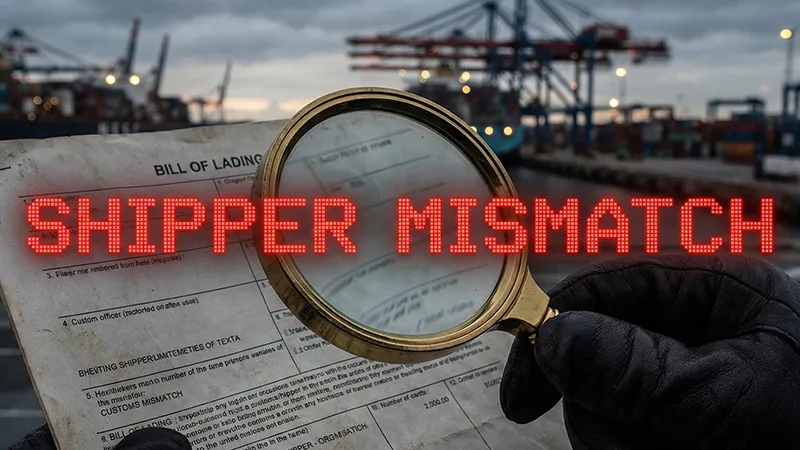
2. US Customs (CBP) Enforces "Shipper Matching"
On the US side, CBP (Customs and Border Protection) is using AI targeting algorithms to detect Shipper Mismatches.
-
Red Flag: If your Commercial Invoice lists "ABC Factory" as the seller, but your Bill of Lading lists "XYZ Trading Co" (a Maidan shell company) as the Shipper.
-
CBP Action: This is flagged as potential fraud or evasion of AD/CVD (Antidumping Duties).
-
Consequences:
-
Intensive Exam: Delays of 2-4 weeks.
-
Exam Fees: You pay $1,000 - $3,000 for the exam.
-
Seizure: Under the False Claims Act, CBP can seize goods with fraudulent documentation.
-
For more on how to avoid CBP holds, read our recent alert: [US Customs Holds 2026: Top Seizure Risks & How to Avoid Them].
Part 4: The Zbao Strategy – "FOB + Nominated Forwarder"
So, FOB is safer and cheaper. But many buyers worry: "If I choose FOB, doesn't the supplier control the shipping? Will they use a bad freight forwarder?"
This is a valid concern. Suppliers often choose the cheapest, slowest forwarder to save money on their end.
The Solution: The "FOB + Nominated Forwarder" Strategy.
This is the standard operating procedure for experienced B2B buyers:
How to Execute This Strategy:
-
Negotiate FOB: You tell the supplier: "I want FOB Shenzhen terms. Please include local fees in your unit price."
-
Nominate Zbao: You tell the supplier: "My freight forwarder is Zbao Logistics. I will provide their contact information. Please book the shipping space through them."
-
Zbao Takes Control:
-
Coordination: We contact your factory to arrange the cargo handover.
-
Document Vetting: We verify that the factory has a valid export license (No Maidan). We ensure the "Shipper" on the Bill of Lading matches the "Seller" on your invoice.
-
Freight Control: We handle the ocean freight and US delivery, giving you full visibility and transparent pricing.
-
Why This is the "Sweet Spot":
-
Cost Efficiency: The factory pays the expensive local charges in China (Trucking/Customs).
-
Control: You control the ocean freight rate and destination delivery. You avoid the "kickbacks" and hidden fees often charged by supplier-recommended forwarders.
-
Compliance: We act as your compliance gatekeeper, ensuring no fraudulent export docs are used.
Part 5: FOB vs. EXW Cost Showdown (Case Study)
Let's look at a real-world comparison for a 5 CBM (Cubic Meter) Shipment of Kitchenware from a factory in Dongguan to an Amazon FBA warehouse in Los Angeles (LGB8).
| Cost Component | Option A: EXW (You Manage) | Option B: FOB (Zbao Manages) |
| Product Cost | $10,000 ($5.00/unit) | $10,400 ($5.20/unit) |
| China Trucking | $350.00 | $0.00 (Supplier pays) |
| China Export Docs | $150.00 | $0.00 (Supplier pays) |
| Origin CFS Fees | $250.00 | $0.00 (Supplier pays) |
| Customs Broker | $100.00 | $0.00 (Supplier pays) |
| Ocean Freight | $400.00 | $400.00 |
| US Destination Charges | $500.00 | $500.00 |
| TOTAL LANDED COST | $11,750.00 | $11,300.00 |
| Risk Level | 🔴 High (Maidan Risk) | ✅ Low (Compliant) |
The Verdict:
By choosing FOB, you save $450.00 on the total landed cost, despite paying a higher unit price. More importantly, you avoid the risk of your goods being seized for export violations. If you are consolidating enough volume for a full container, deciding how to load it is your next big saving opportunity. Read: Floor Loaded vs. Palletized: Best Amazon FBA Strategy 2026
Part 6: When Should You Use EXW?
Is EXW ever the right choice? Yes, but only in two specific scenarios where the "FOB advantages" don't apply.
1. Express Courier (Small Shipments)
If you are shipping a sample order or a very small batch (less than 150kg) via DHL, UPS, or FedEx.
-
Why: Courier companies offer "door-to-door" service that includes pickup. The complexity of formal export declaration is often skipped or handled automatically by the courier.
-
Zbao Role: We can provide you with a corporate courier account (Zbao Express) to get 60% off public rates, even on EXW terms.
2. Consolidation (Mixed Suppliers)
If you are buying from 5 different factories and want to combine them into one container (Buyer's Consolidation).
-
Why: It is difficult to ask 5 factories to split FOB charges for one container.
-
The Strategy: Ask all 5 factories for EXW quotes. Have them send the goods to Zbao's China Warehouse (Shenzhen/Yiwu).
-
Zbao Role: We receive the cargo, consolidate it, and handle one unified export declaration (or 5 separate ones, depending on tax needs). This saves you massive destination fees compared to shipping 5 separate LCL loads.
FAQ: Negotiating Logistics Like a Pro
Q: My supplier says they don't have an export license. Must I use EXW?
A: Not necessarily. You can ask them to use a legitimate Export Trading Company (Agent) to handle the export legally.
-
Crucial: Ensure the Trading Company is listed as the "Shipper" on both the Bill of Lading and the Commercial Invoice to avoid the "Shipper Mismatch" red flag with US Customs.
Q: Does FOB include insurance?
A: No. FOB only covers the goods until they cross the ship's rail in China. Once the crane lifts the container onto the vessel, the risk transfers to you.
-
Recommendation: Always add Cargo Insurance. It typically costs only 0.3% of the invoice value but protects you from General Average and total loss. Read our guide on [General Average: Why You Need Marine Insurance].
Q: Can Zbao help me calculate the true landed cost before I order?
A: Yes. Before you sign the PO, forward us your EXW and FOB quotes. Our team will run a Landed Cost Analysis to reveal the hidden local fees and help you choose the most profitable option.
Conclusion: Don't Step Over Dollars to Pick Up Pennies
In the high-stakes world of 2026 logistics, the "lower unit price" of EXW is often a trap. It lures you in with cheap product costs, only to hit you with high local fees and dangerous compliance risks.
The Smart Move for 2026:
-
Leverage the factory's 13% Tax Rebate by negotiating FOB terms.
-
Avoid the Maidan Crackdown by ensuring legal export compliance.
-
Control your supply chain by nominating Zbao Logistics as your forwarder.
Ready to negotiate smarter?
Don't let hidden fees destroy your margins. [Contact Us] today for a free consultation on your next Purchase Order negotiation.


