Amazon FBA Removal Fees 2026: Updated Rates, Per-Unit Billing Change, and How to Recover Dead Stock Value
If you are an Amazon seller, your billing statement is about to look very different.
Effective February 15, 2026, Amazon is changing how it charges FBA removal fees and disposal fees. Instead of a single lump-sum charge after an order is complete, you will now see per-unit billing—charges hitting your account daily as each item is processed.
While some competitors might tell you "no action is required" because the rates haven't changed, at Zbao Logistics, we see this as a critical financial wake-up call.
Why? Because seeing amazon fba shipping fees for removals tick up daily highlights a painful truth: keeping dead stock in FBA is bleeding your cash flow. In this guide, we break down the update, the hidden opportunities (including a Jan 15 rate drop!), and how to use a 3PL strategy to turn losses into recovery.
What is Changing? (The Feb 15 Update)
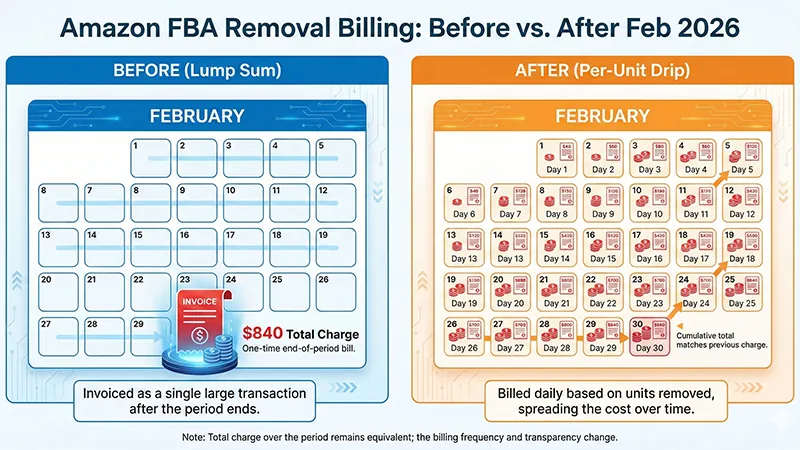
Amazon is shifting from "Order-Level Billing" to "Unit-Level Billing."
| Feature | Old Method (Pre-Feb 15) | New Method (Post-Feb 15) |
| Billing Timing | Lump sum after order completion. | Real-time as units are picked/packed. |
| Visibility | Hard to track until the end. | Granular visibility in Transaction View. |
| Fee Rate | No Change. | No Change. |
The Impact:
Imagine removing 1,000 units.
-
Before: You pay $0 after 10 days, then get hit with an $840 bill on Day 30.
-
Now: You see charges of $40, $60, $100 appearing daily on your Payment Dashboard.
-
The Psychological Shift: This constant "drip" of fees makes the cost of inventory management much more visible—and painful—if not managed correctly.
The Good News: Did You Miss the Price Drop?
Many sellers missed a crucial detail. While the timing changes in February, the rates actually improved for some items earlier in the year.
Effective January 15, 2026, removal fees for Standard-Size items (0-0.5 lb) dropped by **$0.20 per unit** (from ~$1.04 down to ~$0.84).
Zbao Insight: Amazon is incentivizing you to clear out small, cheap items. If you have lightweight dead stock, remove it now before Long-Term Storage Fees (LTSF) eat your margins.
The Math: Disposal vs. 3PL Removal
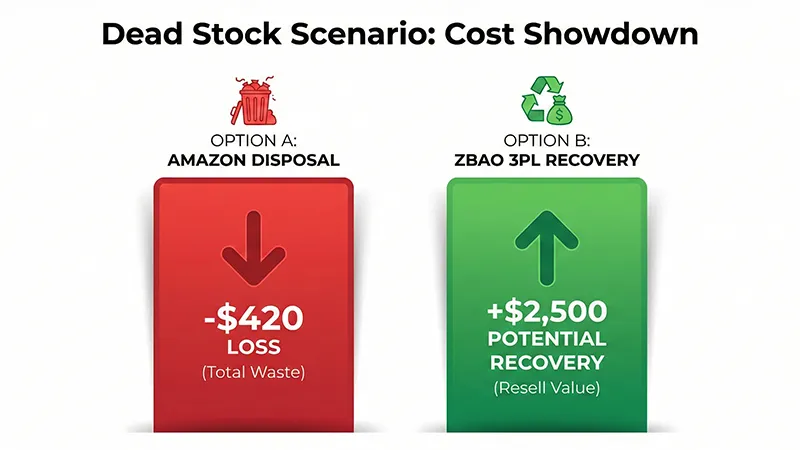
When you face dead stock, you have three choices: Dispose, Liquidate, or Remove to a 3PL (Third-Party Logistics).
Most sellers choose "Disposal" ($0.84/unit) because it seems easiest. But is it the cheapest?
Scenario: You have 500 units of seasonal inventory (Standard Size) that didn't sell.
-
Option A: Amazon Disposal
-
Cost: 500 x $0.84 = **$420 Cost**.
-
Result: Inventory destroyed. $0 Recovery.
-
-
Option B: Move to Zbao 3PL (Overseas Warehouse)
-
Cost: 500 x $0.84 (Removal) + 3PL Handling.
-
Action: We receive the stock, inspect it, and re-label it for next season or a different platform (TikTok Shop/eBay).
-
Result: You keep the asset. If you resell for even $5/unit, you recover **$2,500**.
-
Verdict: Disposal guarantees a loss. Removal to a 3PL preserves optionality.
Why "Per-Unit Billing" Requires a 3PL Strategy
With the new per-unit billing, cash flow management becomes critical. You cannot afford to let removal orders drag on for weeks while fees accumulate daily.
Here is how partnering with Zbao Logistics helps you navigate this:
-
Faster Inventory Cycling: Instead of paying Amazon's high long-term storage fees, move slow-moving goods to our warehouse. Our storage rates are typically 30-50% lower than amazon fba shipping cost for storage.
-
The "Fix-it" Strategy: Amazon will dispose of returns that are "Unfulfillable." Zbao can receive these removals, inspect them, and restore them to sellable status. Our overseas warehouse network supports relabeling, resale prep, and multi-channel fulfillment across the US and EU.
-
Audit Your Bills: With the new granular billing, errors can happen. Zbao helps you reconcile your removal orders against what actually arrived at our warehouse, ensuring Amazon didn't overcharge you.
Seller Checklist: Action Items Before Feb 15
Don't just sit back. Use this update to audit your inventory health:
-
Identify Dead Stock: Download your Inventory Health Report. Any SKU older than 180 days is a liability.
-
Calculate the "Burn Rate": Compare the cost of removal ($0.84) vs. holding it for another 6 months (Aged Inventory Surcharge).
-
Update Your Accounting: Warn your finance team that amazon fulfillment services cost and removal fees will now appear as daily line items, not monthly lumps.
Frequently Asked Questions (FAQ)
Does Amazon charge shipping on FBA removals?
No, Amazon does not charge a separate "shipping fee" for removals. The per-unit removal fee (e.g., $0.84 for standard size) covers the cost of picking, packing, and shipping the inventory back to you or your 3PL.
How long does Amazon FBA removal take in 2026?
Typically, removal orders take 14 to 30 business days to arrive at a 3PL address. However, during peak seasons (Q4) or February cleanouts, this can extend to 30+ days. The new per-unit billing allows you to track progress daily rather than waiting for completion.
How to avoid FBA disposal fees?
The best way to avoid disposal fees is to remove inventory before it becomes unsellable or subject to long-term storage fees. Moving stock to a 3PL allows you to fix issues or sell on other channels instead of paying Amazon to destroy it.
Is it cheaper to liquidate or remove FBA inventory?
It depends on value. Liquidation recovers only 5-10% of value. If your product can be sold for a profit elsewhere, removing it to a 3PL is often the smarter financial move.
Conclusion: Turn a Fee Update into a Profit Strategy
Amazon's 2026 update is more than just an accounting tweak—it is a reminder that inventory flow is the lifeblood of your business.
Don't let per-unit fees drain your account balance. Whether you need to liquidate, re-label, or store inventory cheaply, Zbao Logistics offers the infrastructure you need to handle removals efficiently.
Stuck with unmovable FBA inventory?


