China to USA DDP & DDU Door-to-Door Shipping Guide
The price of your goods from China isn't what keeps experienced importers up at night. It's everything that happens after the cargo leaves the factory: customs holds, CBP exam flags, demurrage clocks ticking at $300 a day, and FBA inbound shipments expiring while your container sits at the Port of Los Angeles waiting for a document review that nobody told you was happening.
This guide is written by full-chain China-to-USA logistics specialists with hands-on experience managing hundreds of FCL and LCL shipments every year. We cover the entire journey from supplier warehouse to your final U.S. destination, including the DDP vs. DDU decision framework, a complete breakdown of port and customs costs, and a deep dive into CBP hold codes 5H and 9H: what they mean in the current 2026 ACE system environment, why their frequency is rising, and exactly what steps to take in the first 72 hours to stop a minor clearance issue from turning into a five-figure bill.
What Is Door-to-Door Shipping from China to the USA?
Put simply, door-to-door shipping means your cargo moves from a Chinese factory or warehouse to your designated U.S. address under a single freight forwarder's management. That address might be an Amazon FBA fulfillment center, a commercial warehouse, or a residential delivery point. You hand over the goods at origin. We deliver them at destination.
The full service spans seven operational stages: domestic trucking in China, booking and export customs clearance, international ocean or air freight from China to USA, AMS and ISF filing with U.S. CBP, customs clearance at the U.S. port of entry, drayage and port handling, and last-mile delivery.
More Amazon FBA sellers and B2B importers are moving toward door-to-door arrangements for practical reasons. There is a single point of accountability when something goes wrong, rather than three vendors blaming each other. Total cost is predictable, especially under DDP where all fees are quoted upfront in one number. And there is no need to manage ISF filings, Customs Bond, Importer of Record registration, or HTS classification independently.
The comparison with EXW or FOB terms is worth stating plainly. Buying on EXW or FOB looks cheaper at the quote stage, but it transfers significant operational complexity and financial risk to the buyer the moment cargo leaves the factory gate or the vessel rail. That "savings" often disappears by the time the shipment clears customs.
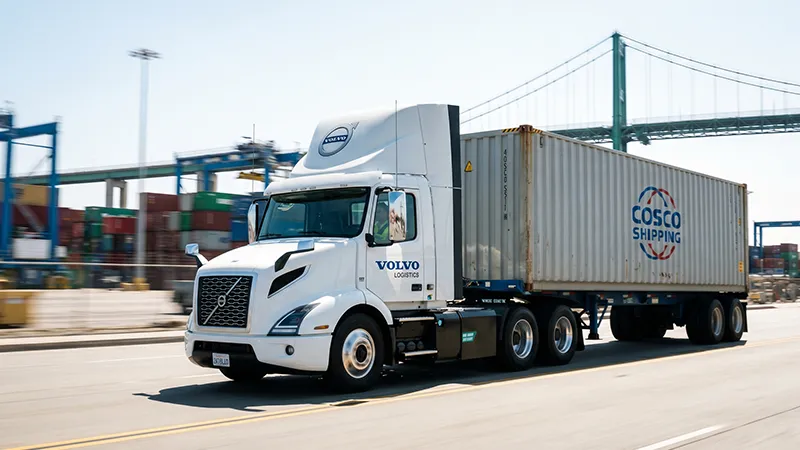
The Full Shipping Process, Step by Step
Understanding each stage of the shipment lifecycle is the best preparation for anticipating where costs and delays originate. Here is the complete operational flow from a buyer's perspective.
Step 1: Cargo Pickup in China
Goods are either collected from the factory by our domestic trucking team or delivered by the supplier to our nominated consolidation warehouse. At this point, cargo quantity, packaging integrity, and shipping marks are verified against the packing list before anything moves.
Step 2: Booking and Export Customs Clearance
We book space with our carrier partners, including COSCO, Evergreen (EMC), OOCL, ZIM, and ONE, selecting the appropriate sailing based on your delivery deadline and budget. China export customs declaration is filed and export release obtained before loading begins.
Step 3: Critical Shipping Documents
The complete document set is assembled here: Shipping Order, House Bill of Lading (HBL) and Master Bill of Lading (MBL), Commercial Invoice, Packing List, and Certificate of Origin. Every data point across all documents must be identical. Discrepancies between these documents are the single most common trigger for a CBP 5H hold at destination, and we will return to that point in detail later in this guide.
Step 4: AMS Filing
The Automated Manifest System (AMS) filing is submitted to CBP at least 24 hours before the vessel departs the foreign port. A late or inaccurate AMS filing can result in a "Do Not Load" instruction from CBP before the vessel has even sailed.
Step 5: ISF Filing
The Importer Security Filing (ISF Filing 10+2) must reach CBP at least 24 hours before vessel departure. The filing requires ten mandatory data elements: Importer of Record EIN, consignee name and address, seller and buyer information, ship-to party (the actual U.S. delivery address), manufacturer name and address, country of origin, 6-digit HTS commodity code, and the container stuffing location and consolidator details. Missing or inaccurate ISF data carries a civil penalty of up to $5,000 per violation. Under our DDP and DDU service, we file and verify all ISF data on your behalf.
Step 6: Ocean Transit
Approximate transit times from China's main export hubs:
- Yantian (Shenzhen), Shanghai, or Ningbo to Los Angeles / Long Beach: 22 to 28 days
- The same origins to New York / New Jersey: 28 to 35 days
- To Savannah, Georgia: 30 to 36 days
Step 7: Arrival Notice and Customs Entry
Upon vessel arrival, an Arrival Notice is issued. Our licensed customs broker submits the formal entry into CBP's ACE (Automated Commercial Environment) system, triggering the classification review. CBP may issue a hold code at this stage. The two codes that affect China-origin shipments most frequently in 2026 are 5H and 9H, both of which have their own dedicated section below.
Step 8: Port Charges and Drayage
Once CBP grants customs release, a Delivery Order (DO) is issued. Our drayage team picks up the container from the terminal, navigating port-specific surcharges including Chassis Fee, Pier Pass and CTF at LA/LB, Pre-Pull charges, and potential Demurrage and Detention fees when holds have extended the port dwell time beyond the free time window.
Step 9: Last-Mile Delivery and POD
The container is delivered to your designated address. A Proof of Delivery (POD) is provided upon successful receipt, formally closing the shipment.
DDP vs. DDU: Which Model Is Right for You?
A Note on Terminology: DDU and DAP Under Incoterms 2020
For importers who work with formal trade contracts, this distinction is worth knowing. Under the International Chamber of Commerce (ICC) Incoterms 2020 rules, DDU (Delivered Duty Unpaid) has been officially replaced by DAP (Delivered at Place). The core obligation is the same: the seller or freight forwarder delivers goods to the named destination, with import duties remaining the buyer's responsibility. The terminology changed; the risk allocation did not.
That said, DDU remains the dominant term in day-to-day U.S. freight industry practice. You will still see it in forwarder quotes, logistics contracts, and e-commerce platform settings. We use "DDU" throughout this guide to reflect how the industry actually communicates, while recognizing DAP as its formal Incoterms 2020 equivalent. If your trade documents reference DAP and your freight partner says DDU, they are describing the same commercial arrangement.
Comparing DDP and DDU
| Feature | DDP (Delivered Duty Paid) | DDU / DAP (Delivered Duty Unpaid) |
|---|---|---|
| Import Duties | Forwarder prepays; included in all-in quote | Actual duties billed to buyer at cost |
| Customs Responsibility | Forwarder manages entirely, including Bond and IOR | Forwarder handles operations; buyer bears duty liability |
| IOR (Importer of Record) | Forwarder can act as IOR | Buyer must provide own EIN and IOR |
| Price Predictability | Very high — single all-in price | High — freight fixed, duties variable |
| Customs Bond | Included in our service | Buyer must maintain own Bond |
| Best For | New importers, FBA sellers, buyers without EIN | Experienced importers with own IOR; buyers with deep HTS knowledge |
Our service commitment under both models:
- Under DDP Full Service, from your supplier's warehouse to Amazon FBA Shipping, commercial warehouse, or residential address, there is one contact person, one invoice, and no customs involvement required from you at any stage.
- Under DDU Full Service, we provide identical full-chain operations. Import duties are billed at actual cost, with every dollar backed by the official CBP entry summary and duty statement. No estimates, no markups, no guesses.
Key Costs You Need to Know
U.S. Import Customs Fees
| Fee Item | Reference Price | Notes |
|---|---|---|
| AMS Filing | $35 per BL | Per shipment |
| ISF Filing | $35 per BL | Late filing penalty: $5,000+ |
| Customs Clearance | $100 to $120 per BL | Licensed customs broker fee |
| HTS Classification | $20 per line | Per tariff line item |
| Handling Fee | $25 per BL | Terminal coordination |
| PGA Filing (FDA, USDA, FCC, etc.) | $35 and up | Applicable by cargo category |
| Importer Service Charge | $80 per shipment | ISF and shipper coordination |
Customs Bond: Professional Guidance for DDU Clients
A U.S. Customs Bond is a federal legal requirement for all commercial imports entering the United States. It is a financial guarantee to CBP that all applicable duties, taxes, and fees will be paid. Two structures are available.
| Structure | Single Entry Bond | Continuous Bond |
|---|---|---|
| Coverage | One shipment, one entry | All U.S. entries for 12 months |
| Reference Cost | $50 to $150 per shipment | $400 to $600 per year (starting rate) |
| Best For | 1 to 3 shipments per year | 4 or more shipments per year |
| Process | Applied per shipment | Applied once; auto-renews annually |
The practical guidance here is straightforward. If you plan to import more than three shipments in any 12-month period, a Continuous Bond will almost always cost less in aggregate. A Continuous Bond covering $50,000 in import value typically runs $400 to $600 per year, roughly equivalent to the cost of three or four Single Entry Bonds, but covering unlimited entries for the full year. Beyond the cost savings, a Continuous Bond also simplifies each entry, since CBP does not need to verify a new bond for every shipment. Our team provides complimentary Bond structure advice before your first shipment clears.
Destination Port Surcharges: LA/LB and NY/NJ
| Fee Item | LA/LB | NY/NJ |
|---|---|---|
| Chassis Fee | $45/day (3-day minimum) | $45/day (3-day minimum) |
| Pier Pass / CTF | $85 to $90 per 40HQ | Not applicable |
| Port Congestion | Variable | ~$150 per shipment |
| Pre-Pull | ~$150 if required | ~$100 if required |
| Chassis Split | $75 to $150 per occurrence | $150 to $350 per occurrence |
| Waiting Fee | $100/hr (1 hr free) | $100/hr (1 hr free) |
| Toll Fee | Variable | ~$200 per trip |
Demurrage and Detention: The Hidden Cost That Catches Most Importers Off Guard
At the Port of Los Angeles and Long Beach, the largest container gateway in the United States, demurrage fees escalate on a steep daily curve once a container exceeds its free time window. The standard free time at most LA/LB terminals is four working days from the first available date. After that, the charges begin:
| Days Over Free Time (40HQ) | Daily Demurrage Rate |
|---|---|
| Days 1 to 4 | $200 to $300 per day |
| Days 5 to 9 | $300 to $450 per day |
| Day 10 onwards | $500 to $800 per day |
A 40HQ container sitting at a LA/LB terminal for ten days past free time can accumulate $3,000 to $6,000 in demurrage alone, before a single delivery move has been made. Add chassis fees at $45 per day, potential CES examination fees of $300 to $3,000 or more, and drayage costs, and the total can easily approach the freight value itself on smaller shipments.
One point that surprises many importers: these fees accrue regardless of whether CBP ultimately finds any problem with the cargo. A container placed on a 5H hold while CBP reviews your documents still accumulates demurrage from Day 1 of port availability. The clock does not pause for the customs review.
How our DDP service protects you on this specific issue: We operate our own drayage trucks at both LA/LB and NY/NJ. When CBP releases a container, we schedule the pickup immediately, not when a third-party carrier has a truck available. Our team monitors ACE entry status in real time and positions equipment at the terminal at the earliest available slot. For DDP clients, demurrage and detention exposure is our operational problem, not yours. There are no surprise port invoices issued after delivery.
U.S. Customs Exam Codes: What Are CBP 5H and 9H Holds?
Most freight forwarder blogs, including those published by several well-known technology platforms, do not cover this topic with sufficient depth or current accuracy. Following CBP's significant ACE system upgrades in late 2025, 5H holds have become the most disruptive customs event for Amazon FBA sellers and B2B importers shipping from China. Understanding the mechanism, the legal timeline, and the response protocol is no longer optional knowledge for anyone moving cargo at meaningful volume.
The 5H Hold: Entry Processing Hold
In CBP's ACE system, a 5H (Entry Processing Hold) is triggered when the automated entry review detects anomalies in the submitted import documentation. The entry is suspended and routed to CBP's Fast Doc Review team, a specialized unit that includes Mandarin-speaking personnel and operates under a strict zero-tolerance documentation standard.
Common triggers include:
- Declared cargo value diverges from CBP's internal benchmark pricing data, which is sourced from comparable import entries in the ACE database
- Any data mismatch between the ISF, AMS manifest, Commercial Invoice, and Packing List — including weight discrepancies, quantity differences, or inconsistent party names and addresses
- Importer of Record information or Customs Bond status flagged as irregular
- HTS classification that does not align logically with the cargo description
- Cargo described with broad, non-specific language such as "household goods," "general merchandise," or "miscellaneous items"
The zero-tolerance standard, and why correcting documents after the fact does not work: CBP's Fast Doc Review team reviews only the original documents submitted at the time of entry. No supplemental explanations, revised invoices, or clarification letters submitted after the hold is triggered are considered. If the original documentation contains any discrepancy, the entry escalates to physical examination or, in serious cases, the 30-day forced return clock begins.
This is fundamentally different from how most importers assume customs works. The window for correction is before the entry is submitted, not after the hold appears in the system.
The 5H status pathway:
Entry submitted → ACE automated review detects anomaly → 5H Hold issued → Fast Doc Review (zero-tolerance)
From there, two outcomes are possible. If all documents are fully consistent, the entry receives a 5I (Release). If any document discrepancy is found, the shipment moves to physical examination: VACIS/X-Ray (1 to 3 days), Tailgate Exam (3 to 7 days), or Intensive Exam at a Container Examination Station, which can run 5 to 14 days. If the examination fails or documents cannot be reconciled, the 30-day forced return clock is initiated.
The 30-day legal deadline: Title 19 U.S.C. § 1499. Under U.S. federal law, if CBP does not issue a final determination on detained merchandise within 30 calendar days of the detention notice, the goods are automatically deemed excluded from entry. They must then be exported back to their country of origin or destroyed under CBP supervision. All port storage fees, re-export freight costs, and associated charges fall entirely on the importer. For Amazon FBA sellers, the damage extends beyond the financial: inbound shipments that cannot be delivered within Amazon's validity window result in closed shipments, lost appointment slots, and potential IPI score impacts.
The 9H Hold: Partner Government Agency Hold
A 9H (PGA Multi-Agency Hold) is issued when a U.S. federal agency other than CBP — acting through the ACE system's Partner Government Agency framework — flags a shipment for regulatory compliance review. CBP executes the physical hold on the agency's behalf, but CBP itself cannot release a 9H. Only the issuing PGA can authorize release within ACE.
| Issuing Agency | Typical Cargo Categories | Key Compliance Documents |
|---|---|---|
| FDA | Food products, supplements, cosmetics, medical devices | FDA Prior Notice, 510(k) clearance, facility registration |
| USDA APHIS | Wooden furniture and packaging, pet food, agricultural products | ISPM-15 fumigation certificate, phytosanitary certificate |
| CPSC | Children's toys, juvenile products, household electrical appliances | Third-party test reports (ASTM F963, UL standards), GCC |
| FCC | Bluetooth devices, wireless products, RF-emitting electronics | FCC ID certification, Declaration of Conformity |
| EPA | Engines, pesticides, certain chemical products | EPA registration, compliance certification |
Comparing 5H and 9H response strategy:
| Feature | 5H Hold | 9H Hold |
|---|---|---|
| Release Authority | CBP Fast Doc Review team | Issuing PGA agency (in ACE) |
| Can Forwarder Resolve Independently? | Yes, with a licensed customs broker | No — requires PGA agency action |
| Typical Resolution Timeline | 3 to 7 business days | 5 to 15 business days |
| Primary Risk Factor | Original document discrepancy | Missing pre-import compliance documentation |
The 72-Hour Action Protocol
CBP will not call you. CBP will not send you an email. The hold status appears in the ACE system, and it is your licensed customs broker's responsibility to monitor it and act. Every hour of delay is another hour of demurrage accumulating at the terminal.
Hours 0 to 24: Confirm hold type and root cause. Your customs broker retrieves the ACE entry status and the formal hold notice. The first determination is whether the hold is 5H (document issue) or 9H (PGA issue), and which specific agency or data field has triggered the flag. You should receive a plain-language summary of the findings within 24 hours of the hold appearing — not a reassurance that "we're working on it."
Hours 24 to 48: Document response for 5H. Assemble the corrected complete document package — revised Commercial Invoice, Packing List, HBL copy, and IOR documentation — and verify that every data field achieves exact consistency across all documents. Your licensed customs broker (not a freight agent, a licensed broker with CBP credentials) submits the response formally through ACE. Attempting to contact CBP directly by email or phone outside the ACE submission process will not accelerate the review and may complicate the case record.
Hours 24 to 72: PGA coordination for 9H. Identify the specific PGA agency from the hold notice. Prepare the corresponding compliance documentation — FDA Prior Notice, USDA fumigation certificate, CPSC test reports, FCC ID documentation — and submit through the appropriate agency portal via your licensed broker's established agency relationship. Follow up directly with the PGA; they operate on their own timeline, independently of CBP.
Throughout the hold period: The legal clock runs from Day 1. Your broker must check ACE status every business day and provide written updates. The five business day CBP decision window and the 30 calendar day forced return deadline are hard legal limits with no informal grace periods.
How to Prevent 5H and 9H Holds Before They Happen
The most effective hold management strategy is prevention. Our pre-shipment protocol covers the following on every DDP and DDU shipment:
- HTS Code pre-confirmation. For new product categories or ambiguous classifications, we reference CBP's CROSS Ruling database or apply for an Advance Binding Ruling before cargo is loaded.
- Document triangle verification. Commercial Invoice, Packing List, and HBL are cross-checked against each other and against the ISF data already on file. Every data field must be identical across all documents: party names, EIN numbers, addresses, cargo descriptions, weights, quantities, and unit values.
- ISF ten-point completeness check. All ten mandatory ISF fields are verified before submission, with particular attention to the Importer of Record EIN, the Ship-to Party address, and the 6-digit HTS code.
- Value declaration review. We assess whether the declared invoice value aligns with CBP's benchmark pricing for the commodity. Significantly undervalued declarations are a primary 5H trigger in 2025 and 2026, particularly for furniture, electronics, and textiles from China.
- PGA compliance pre-check. For cargo categories with PGA exposure, we provide a compliance document checklist before production is finalized: FDA Prior Notice readiness, ISPM-15 requirements for wooden components, FCC ID verification for electronics, and CPSC test report requirements for consumer products.
Tariff and HTS Codes: What Every Importer Must Know in 2026
The Harmonized Tariff Schedule (HTS) is the classification system that determines the applicable duty rate for every product entering the United States. Commodity codes are harmonized internationally to 6 digits under the World Customs Organization HS system, and the United States extends these to 10 digits. The additional digits determine specific duty rates, quota eligibility, and trade remedy applicability.
An incorrect HTS code is not only a compliance violation. It is one of the most reliable triggers for a CBP 5H hold, because ACE flags entries where the declared HTS code does not align logically with the cargo description on the Commercial Invoice.
The 2026 tariff structure for China-origin goods operates in layers:
| Tariff Layer | Applicable Rate | Authority |
|---|---|---|
| MFN (Most Favored Nation) Base Rate | Varies by HTS, typically 0 to 20% | Normal Trade Relations |
| Section 301 Trade Remedy Tariff | 7.5% to 145% depending on category | USTR Section 301 Action |
| Additional Tariff (2025 Executive Action) | Up to an additional 10 to 34% | Presidential Executive Orders |
For many categories of Chinese-origin goods — furniture, consumer electronics, textiles, tools — the effective combined duty rate can exceed 50 to 70% when all applicable layers are added together. Accurate pre-purchase duty estimation is not a planning exercise; it is fundamental to margin analysis.
Under our DDP service, we calculate the full landed duty liability at the quote stage. Under DDU, every duty invoice is backed by the official CBP Entry Summary (CBP Form 7501) — no estimates, no rounding, no surcharges.
Who Should Choose Our Door-to-Door Service?
DDP is typically the better fit if:
- You are an Amazon FBA seller who needs goods delivered to fulfillment centers on schedule without managing any customs process.
- You are importing from China for the first time and do not have a U.S. EIN, IOR registration, or Customs Bond in place.
- You want a single invoice covering everything from the Chinese warehouse to the U.S. delivery point.
- Your cargo involves product categories with meaningful PGA risk — electronics, furniture, consumer goods — where pre-import compliance requires specialist management.
DDU tends to work better if:
- You already have your own U.S. EIN, established IOR status, and a Continuous Bond.
- You have deep familiarity with HTS classification for your product category and prefer to control the customs entry process directly.
- You import at high frequency and your customs broker relationship is already optimized for your cargo profile.
Both DDP and DDU are available for LCL and FCL shipments. We handle 20GP, 40GP, 40HQ, and 45HC configurations, with no minimum cargo volume for LCL door-to-door service.
Why Work With Us?
| Your Pain Point | How We Address It |
|---|---|
| Worried about a 5H hold disrupting your timeline | Our licensed brokers run document triangle verification on every entry before submission |
| Need to know your total landed cost before committing | DDP: one all-in price at booking. No post-delivery invoices |
| Demurrage building while the container waits | Own drayage trucks at LA/LB and NY/NJ: we move on CBP release, not carrier availability |
| Direct delivery to Amazon FBA warehouses | Full FBA inbound experience: appointment scheduling, label compliance, receiving coordination |
| Don't know which Customs Bond structure to choose | Free Bond structure advice before your first shipment clears |
| Electronics, furniture, or consumer goods with PGA exposure | Pre-production PGA compliance checklist: FCC, CPSC, ISPM-15, FDA Prior Notice |
| Had poor communication with a previous forwarder | Dedicated account manager per DDP shipment; ACE status updates within 24 hours of any hold |
Port coverage:
- U.S. West Coast: Los Angeles / Long Beach (LA/LB) and Oakland
- U.S. East Coast: New York / New Jersey, Savannah (GA)
- Delivery destinations: Amazon FBA fulfillment centers, FBM warehouses, commercial warehouses, residential addresses
Frequently Asked Questions
What documents do I need to provide for DDP or DDU shipping from China to the USA?
For most commercial shipments, the core documents are a Commercial Invoice with full party details, per-unit values, and 10-digit HTS codes, along with a Packing List showing quantities, weights, and carton dimensions. For DDP shipments, we also coordinate directly with your supplier to obtain the Shipping Order and export documentation. For cargo categories subject to PGA review — electronics, furniture with wooden components, food-related products — additional compliance documents are required, and we specify those at the booking stage.
How long does door-to-door shipping from China take?
Ocean freight from China's main ports to LA/LB runs approximately 22 to 28 days. To New York/New Jersey or Savannah, expect 28 to 36 days. Air freight is 5 to 10 business days depending on origin city and service level. Add 2 to 5 business days for domestic pickup in China and 2 to 7 business days for last-mile delivery in the U.S. A clean customs clearance with no holds typically adds 1 to 3 business days. A 5H hold adds a minimum of 3 to 7 business days; a 9H hold, 5 to 15 business days.
What is a 5H hold and what happens next if my shipment gets one?
A 5H is a CBP Entry Processing Hold, triggered when ACE's automated review detects documentation anomalies. The most common cause is a mismatch between the ISF filing, Commercial Invoice, and Bill of Lading, or a declared value that diverges from CBP's benchmark data. The critical point most importers miss: CBP will not contact you. Your licensed customs broker must actively monitor ACE and submit a response through the system. Under our DDP service, we handle all 5H response procedures as part of the service, at no additional charge.
Can you deliver directly to Amazon FBA fulfillment centers under DDP?
Yes. FBA direct delivery is one of our core service offerings. We manage the complete inbound process: creating the inbound shipment plan, applying FBA box labels, booking delivery appointments through Amazon's Carrier Central, and coordinating with the fulfillment center receiving team. We are familiar with the receiving requirements across major FBA hubs on both coasts.
What is the difference between a Single Entry Bond and a Continuous Bond?
A Single Entry Bond covers one shipment. A Continuous Bond covers all your U.S. entries for a rolling 12 months. The break-even point is roughly three to four shipments per year. If you are importing more frequently, the Continuous Bond almost always saves money and simplifies operations. Our team will advise on the right structure and bond value before your first shipment.
Under DDU, am I responsible for duties if the goods are held or rejected at customs?
Under DDU and DAP terms, the import duty liability and customs risk sit with the buyer as the Importer of Record. If goods are held and ultimately fail examination, you remain liable for all anticipated duties plus all port storage, examination, and re-export costs accumulated during the hold period. This is a key reason we recommend DDP for first-time importers, buyers without established compliance documentation, and FBA sellers shipping product categories with elevated CBP or PGA risk profiles.
Ready to Ship from China to the USA?
Whether you need a full DDP all-inclusive arrangement or a transparent DDU service backed by official CBP entry documentation, our team covers the complete chain from your supplier's warehouse to your final destination — FBA fulfillment center, commercial warehouse, or residential address.
We bring licensed customs broker expertise, our own drayage fleet at LA/LB and NY/NJ, and the operational experience of thousands of China-to-USA shipments across LCL consolidations, FCL direct loads, and FBA direct delivery.
Share your cargo details — weight, volume, origin city, destination, and product type and we will have a DDP or DDU all-in quote back to you within 24 business hours.


