How to Read CBP Form 7501 and Calculate Your True Import Costs from China (2026)
Your shipment clears customs. Then the invoice arrives from your broker — and the landed cost is $4,000 more than you budgeted. This scenario happens constantly to B2B buyers and Amazon sellers sourcing from China who do not scrutinize their entry paperwork.
The CBP Form 7501 is arguably the most overlooked yet critical document in the US import process. It dictates your exact tax liabilities, reveals hidden processing fees, and exposes your business to severe compliance audits if mishandled. At Zbao Logistics, our licensed customs brokers review these summaries daily. We understand that in 2026, the stacking of Section 301, 232, and 122 tariffs requires absolute precision.
This guide breaks down every line of the Form 7501, provides exact formulas to calculate your landed cost, and exposes the top four compliance mistakes importers make.
What Is CBP Form 7501 and Why Every Importer Must Understand It
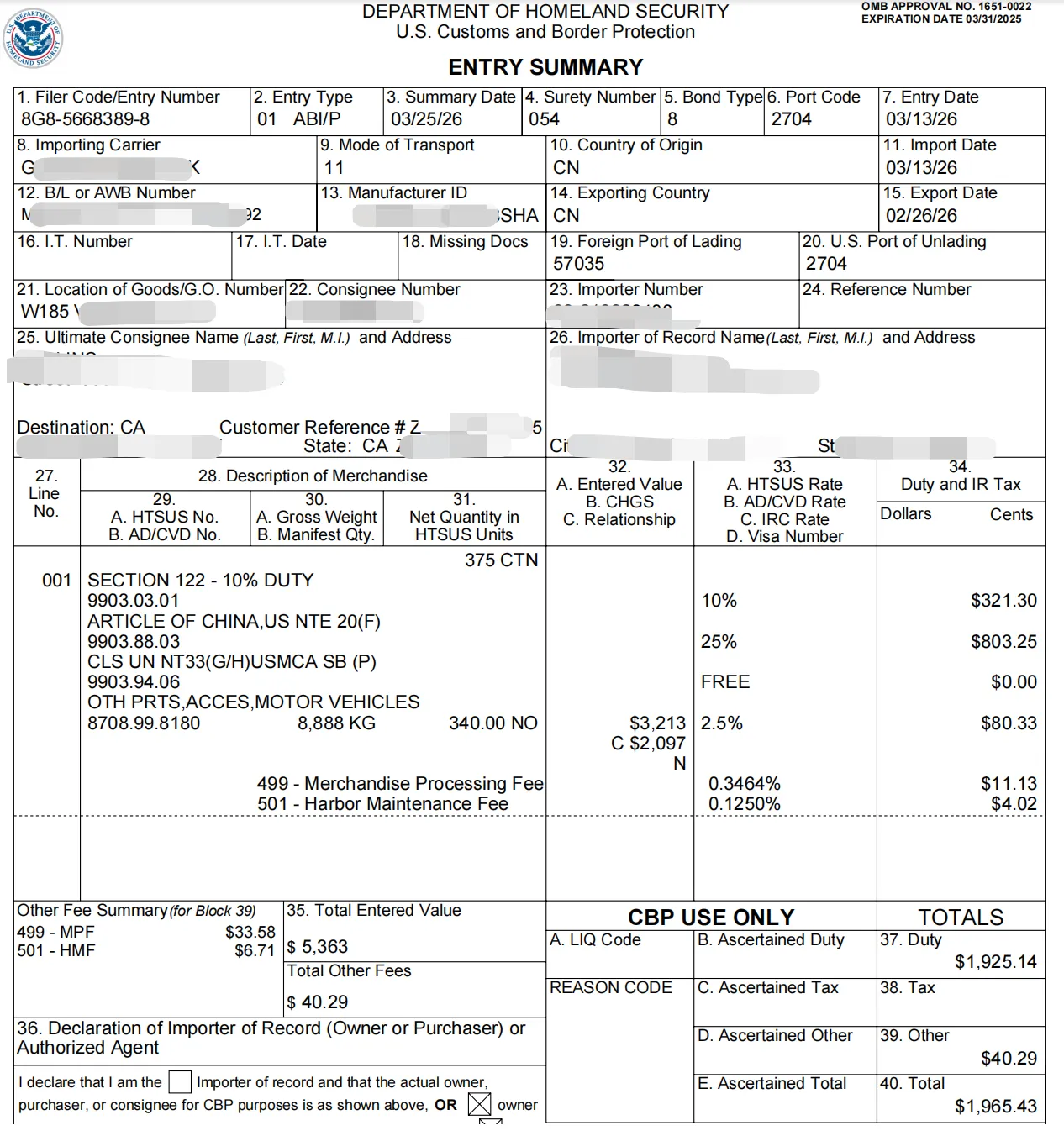
The Official Definition
The Entry Summary, designated as CBP Form 7501, is the official tax declaration document for goods entering US commercial circulation. It assesses the duties, taxes, and fees owed to the federal government.
- Filing Entity: It must be filed by the Importer of Record (IOR) or their authorized, licensed customs broker.
- Filing Deadline: The summary must be submitted and duties paid within 10 working days after the cargo is released (19 C.F.R. §142.12).
- Recordkeeping: Importers are legally required to retain the Form 7501 and related documents for 5 years (19 C.F.R. §163.4).
Form 7501 vs. Form 3461: What is the Difference?
Importers frequently confuse the Entry with the Entry Summary. They serve distinct legal purposes.
| Feature | Form 3461 (Entry) | Form 7501 (Entry Summary) |
|---|---|---|
| Purpose | Application for immediate cargo release | Final tax assessment and statistical record |
| Timing | Submitted upon cargo arrival at the port | Submitted within 10 working days of release |
| Legal Status | Temporary authorization | Official tax liability document |
The 5 Key Blocks You Must Verify on Every Entry
[Image: A clean diagram of CBP Form 7501, highlighting blocks 1, 29, 33, 35, and 39]
When reviewing an entry summary, immediately audit these five fields:
- Block 1: Entry Type Code (e.g., "01" indicates a standard consumption entry).
- Block 29: HTSUS Number (The precise 10-digit tariff code determining your base rate).
- Block 33: Country of Origin (Crucial for determining punitive tariffs).
- Block 35: Entered Value (The commercial value based on your invoice, minus exempt freight costs).
- Block 39: Duty / Tax / Fee (The consolidation area for MPF, HMF, and specific overlays).
Every Fee That Appears on Your 7501 — FY2026 Rates
Rates effective October 1, 2025, per official CBP GovDelivery guidelines.
① Base HTSUS Customs Duty
Calculated as: Entered Value × Duty Rate. You must use the 10-digit US code found at hts.usitc.gov. Do not assume the 6-digit HS code provided by your Chinese supplier is accurate for US clearance.
② Merchandise Processing Fee (MPF)
An ad valorem fee (HTSUS Code 9903.00.00) collected to offset CBP's processing costs.
- Rate: 0.3464% of the Entered Value.
- FY2026 Limits: Minimum $33.58. Maximum $651.50 per entry.
③ Harbor Maintenance Fee (HMF)
A fee assessed to maintain US ports. It is calculated as CIF Value × 0.125%. There is no maximum cap. Importantly, this fee applies strictly to ocean freight; air freight and courier shipments are completely exempt.
④ Section 301 Tariffs on Chinese Goods
These are punitive tariffs layered on top of your base duty. They appear in Chapter 99 of the HTSUS.
| Classification | HTSUS Chapter 99 | Rate | Common Commodities |
|---|---|---|---|
| List 1 | 9903.88.01 | 25% | Industrial machinery, aerospace components |
| List 3 | 9903.88.03 | 25% | Furniture, consumer electronics, auto parts |
| List 4A | 9903.88.15 | 7.5% | Apparel, footwear, toys |
| Semiconductors | 9903.88.18 | 50% | Microchips (Effective Jan 1, 2025) |
| Photovoltaics | 9903.88.20 | 50% | Solar panels (Effective Sep 27, 2024) |
| Electric Vehicles | 9903.88.16 | 100% | EVs assembled in China |
Note: Section 301 is an overlay tariff. It does not replace your base duty; it adds to it.
⑤ The 2025 Fentanyl Surcharge — 10% (New)
Effective March 4, 2025, a broad 10% surcharge applies to imports from China under code 9903.03.01. Certain commodities, such as specific steel and aluminum products, receive an exemption under code 9903.03.06.
⑥ Section 232 Steel & Aluminum (2025 Update)
Following Proclamation 10896 (February 2025), CBP expanded Section 232 enforcement. Steel derivative products now fall under 9903.81.90, carrying a 50% tariff assessed on the steel content value. This is why Block 31 (Net Quantity) must be highly accurate.
Free Import Duty Calculator — Estimate Your Landed Cost Instantly
Enter your goods value and applicable rates below. The calculator automatically applies FY2026 MPF rules, HMF (for ocean), Section 301, and the 2025 Fentanyl surcharge. Results are estimates—final duties are assessed by CBP at the time of entry.
2026 US Import Duty & Tax Calculator
Want to avoid the calculation and classification risks entirely?
Get a Firm DDP Landed Cost QuoteThe Real-World Formula: How to Manually Calculate Your Total Import Cost
Step-by-Step Example
Let us examine a real scenario: A formal ocean import of Chinese-manufactured furniture (List 3) with an entered value of $10,000.
The "Effective Rate Rule of Thumb"
Divide Block 37 (Total Duty) by Block 35 (Entered Value). If the result deviates by more than 5 percentage points from your pre-purchase estimate, call your broker immediately before issuing payment. You may need to file a Post-Summary Correction within the 300-day window.
Top 4 Compliance Mistakes That Trigger CBP Penalties
Mistake #1: Missing Chapter 99 Overlay Codes
Filing only the 8-digit base code and omitting the 9903.88.XX code constitutes negligence. Under 19 U.S.C. §1592, CBP can assess penalties up to four times the value of the underpaid duty.
Mistake #2: HTS Misclassification
Using the 6-digit HS code provided by your Chinese supplier is insufficient for US customs. It leads to duty discrepancies and potential Anti-Dumping/Countervailing Duty (AD/CVD) entanglement.
Mistake #3: Undervaluing Entered Value
Requesting suppliers to lower the invoice value is classified as customs fraud. CBP routinely issues CF-29 notices to launch valuation investigations, levying penalties up to twice the declared cargo value.
Mistake #4: IOR Compliance Failure (Critical in 2026)
Effective March 20, 2026, CBP has enforced rigorous identity verification. Borrowing an IOR number or failing to complete Form 5106 correctly results in immediate cargo seizure.
Hidden Costs & Port-Specific Nuances Importers Miss
The FBA Multi-Entry MPF Trap
If you break down a single FCL container into 10 separate entries to dispatch to various Amazon fulfillment centers, the MPF minimum of $33.58 is triggered ten times, costing $335.80. Consolidating the entry and sorting the cargo at a local warehouse mitigates this.
LA/LB vs. NY/NJ — How Port Choice Affects Your Timeline
| Dimension | Los Angeles / Long Beach | New York / New Jersey |
|---|---|---|
| Average Exam Rate | ~3-5% | ~5-8% |
| Exam Type | Primarily X-Ray (NII) | Higher ratio of physical exams |
| Free Storage Days | 4-5 Working Days | 4 Working Days |
| Port Surcharges | Pier Pass / Clean Truck Fee | NYCT Terminal Handling |
UFLPA Supply Chain Risk
The Uyghur Forced Labor Prevention Act operates on a presumption of guilt. The burden of proof rests entirely on the importer. Buyers sourcing cotton, polysilicon, or tomatoes must maintain rigorous supply chain traceability documentation to release holds.
Related-Party Transactions (Block 32C)
If the buyer and seller share common ownership, CBP may question the validity of the entered value. Transfer pricing documentation is often required, which increases clearance time.
DDP vs. DDU Shipping from China — Which Is Right for You?
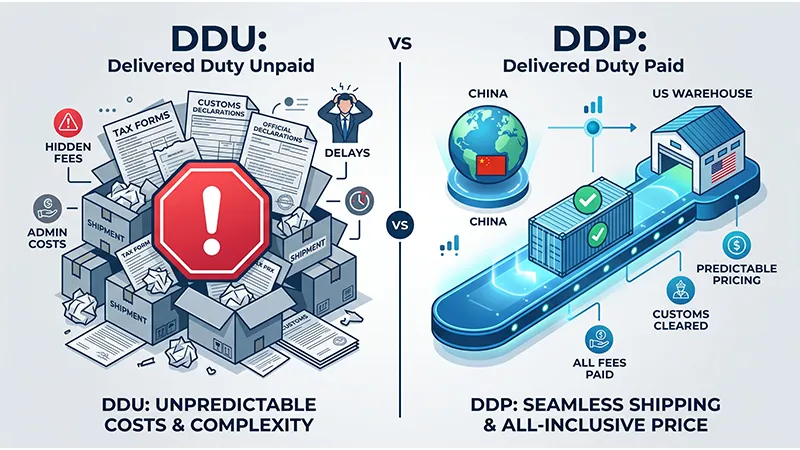
Once you have seen what a fully-loaded 7501 looks like, the next question is who should be managing it. Your chosen Incoterm dictates your financial exposure.
What Is DDP Shipping (Delivered Duty Paid)?
Under DDP, we handle the export clearance, international freight, US customs clearance, duty payment, and final delivery to the warehouse or private address. The core advantage is a single, fixed landed cost with zero hidden invoices.
What Is DDU Shipping (Duties Unpaid)?
We manage the entire logistics chain exactly like DDP, but customs duties and taxes are billed back to you at their exact CBP-assessed cost. The core advantage is total transparency, providing the original CBP Form 7501 for your accounting.
DDP vs. DDU Side-by-Side Comparison
| Feature | DDP Service | DDU Service |
|---|---|---|
| Who Pays Customs | Included in the quote | Billed at cost |
| Cost Predictability | Locked-in rate | Based on CBP assessment |
| Transparency | Bundled pricing | Line-item breakdown |
| IOR Service | Included | Included |
| FBA Direct Delivery | Included | Included |
| Best Suited For | Brands, FBA sellers, procurement managers needing fixed costs | High-value B2B importers, companies requiring strict tax trails |
Which Should You Choose?
We recommend DDP for Amazon sellers and brands operating on strict purchasing budgets. We recommend DDU for importers moving high-value machinery or commodities with volatile tariff profiles.
Stop Calculating. Start Shipping.
Tell us: Origin city · Cargo details · US destination. We will send a complete DDP or DDU landed cost quote within 24 hours.
- ✓ Licensed Customs Broker on every entry
- ✓ IOR-as-a-Service included
- ✓ CBP Form 7501 provided on every shipment
The PSC 300-Day Window — Your Safety Net After Filing
What Is a Post-Summary Correction?
A Post-Summary Correction (PSC) allows you to amend errors before the entry liquidates. Importers have up to 300 days from the entry date (but no later than 15 days before scheduled liquidation) to submit a PSC free of charge. It is used to correct tariff rates, HTS codes, or cargo values.
The Expert Rule of Thumb
Review your 7501 within 30 days of receipt—not 300. Waiting means documentation fades, broker memory fades, and corrections become harder to prove. Thirty days is your operational window.
PSC Trigger Warning
Submitting a PSC triggers CBP to re-review the entire entry. Before filing, ensure all fields are flawless. Correcting one minor value error might expose a larger misclassification liability.
Frequently Asked Questions
What is the minimum MPF for 2026?
The FY2026 MPF minimum is $33.58, effective October 1, 2025. The maximum is $651.50 at a rate of 0.3464% of the entered value.
Does Section 301 apply to goods made in Vietnam?
No. Section 301 tariffs apply exclusively to goods of Chinese origin (HTS Chapter 99, 9903.88.XX). Vietnamese-origin goods are subject to standard HTSUS rates only.
Is HMF charged on air freight shipments?
No. The Harbor Maintenance Fee (0.125%) applies only to ocean/sea imports. Air freight and express courier shipments are fully exempt.
What does DDP mean in shipping from China to USA?
DDP (Delivered Duty Paid) means the shipper or freight forwarder handles all costs including export clearance, international freight, US customs clearance, duty payment, and delivery to the final destination — the buyer pays one fixed price with no surprises.
What is the difference between DDP and DDU shipping?
Under DDU (Duties Unpaid), the freight forwarder manages the entire logistics chain but passes customs duties through at the exact CBP-assessed amount, giving buyers full transparency. DDP bundles duties into the freight quote for cost certainty.
How do I look up my HTS code?
Use the official USITC tariff schedule at hts.usitc.gov. Enter your product description to find the 10-digit HTSUS code and applicable duty rate.
The Bottom Line: Know Your 7501, Control Your Costs
CBP Form 7501 is not bureaucratic paperwork. It is a financial statement that directly determines your landed cost, your compliance risk, and your profit margin on every shipment from China. The importers who master it save thousands. The ones who ignore it get surprised by penalties, PSC filings, and audits. Use the calculator above to model your next shipment. And if the numbers look complex, that is exactly what our DDP and DDU services are built for.
Ready to ship without the complexity?
Our team handles 7501 compliance, IOR registration, HTS classification, and door-to-door delivery — China factory to US destination.
Get a Free DDP/DDU Quote — 24-Hour Response

