Amazon FBA Inbound Placement Fees 2026: Rates, Waiver Options, and the Break-Even Rule Explained
For Amazon sellers operating in North America and Europe, the logistics landscape is shifting beneath your feet. As we move into 2026, the era of simple, low-cost inbound shipping is officially over.
The introduction of the new Amazon FBA Inbound Placement Fees for the US market, combined with complex adjustments in the European FBA network, has created a "perfect storm" for brands importing from China. Sellers are now facing a brutal reality: "Free" shipping options often come with hidden costs, while paid options might actually save you money.
At ZBAO Logistics, as an official Amazon SPN (Service Provider Network) partner and an Amazon ShipTrack carrier, we see thousands of shipments every month. We have noticed a worrying trend: brands are overpaying by thousands of dollars because they misunderstand the new 2026 fee environment.
This guide is your playbook. We will break down exactly how the 2026 fees work for both US and EU sellers, provide you with a simple "Break-Even Rule" to make profitable decisions, and show you how 3PL cross-docking is the cheapest way to ship to Amazon FBA in this new era.
1. Introduction: Why 2026 FBA Inbound Costs Are Catching Sellers Off Guard
The 2026 fee environment for US and EU FBA is defined by one word: Decentralization. Amazon wants inventory closer to the customer, and they are using fees to force sellers to comply.
The New Cost Reality
Whether you are selling in the United States, Canada, the UK, or Germany, you are likely facing three concurrent financial pressures:
-
Inbound Placement Fees: Direct charges for sending inventory to a single location (Minimal Splits).
-
Higher Inland Shipping Costs: The hidden cost of sending small LTL (Less-Than-Truckload) shipments to 4 or 5 different Fulfillment Centers (FCs) to avoid placement fees.
-
Low-Inventory-Level Fees: Penalties for keeping stock too lean, forcing sellers to balance between overstocking and stockouts.
Typical Pain Points for US & EU Brands
We speak to sellers every day who are caught in the "Optimization Trap."
-
The "Free" Illusion: Many sellers choose "Amazon-Optimized Splits" to avoid the placement fee, only to realize that shipping three pallets to Florida, two to Texas, and four to Illinois costs double what it would cost to ship a full container to Los Angeles.
-
The Breakeven Confusion: Sellers struggle to calculate when it makes sense to pay the fee versus when to split the shipment.
As a professional Freight Forwarder from China, ZBAO Logistics helps you navigate these complexities. We don't just move boxes; we optimize your entire supply chain to protect your margins.
2. Inbound Placement Fees 2026: What North American & European Sellers Need to Know
To stop overpaying, you must first understand the mechanics of the fees. While the US and EU markets operate differently, the core principle is the same: Amazon penalizes inefficiency.
2.1 How the US 2026 FBA Inbound Placement Fee Works
In the US market, Amazon has effectively removed the "middle ground" (Partial Splits) for standard-sized items. You are now presented with two distinct paths:
-
Option A: Minimal Shipment Splits (Paid)
-
How it works: You ship your inventory to 1 location (usually a West Coast hub like LGB8 or LAX9 if shipping from China).
-
The Cost: You pay a per-unit Amazon FBA Inbound Placement Fee.
-
Typical Rates: For standard items (1-5 lbs), fees can range from $0.30 to $0.40 per unit. For heavier items (5-20 lbs), fees can climb to $0.72+ per unit.
-
The Benefit: Your ocean freight and inland trucking are simple and cheap because you are shipping in bulk to one destination.
-
-
Option B: Amazon-Optimized Shipment Splits (No Placement Fee)
-
How it works: Amazon directs you to ship your inventory to 4+ locations across the country (e.g., West, Central, East, South).
-
The Cost: $0 placement fee.
-
The Hidden Cost: You lose bulk shipping discounts. You must manage 4 separate inland shipments, often paying premium LTL rates for smaller volumes.
-
For the most accurate and up-to-date fee schedules, always refer to the official Amazon Seller Central Fee Changes
2.2 Key Differences for Europe (UK + EU FBA & Pan-EU)
If you are selling in Europe, the 2026 updates are slightly different but equally impactful.
-
Pan-EU Distribution: Amazon incentivizes sellers to enable inventory placement across Germany, France, Italy, Spain, and Poland.
-
The Constraint: To utilize Pan-EU FBA efficiently, you need VAT numbers in multiple countries. If you restrict inventory to just one country (e.g., Germany) to save on VAT compliance, you may face higher cross-border fulfillment surcharges.
ZBAO Logistics Note: Whether you are shipping to major US hubs or EU gateways, our strategy applies. For detailed information on specific warehouse codes, check our 2025 Guide to Amazon Fulfillment Center Locations & Logistics
3. A Simple Breakeven Rule: When Does Minimal Split Beat “Free” Amazon Splits?
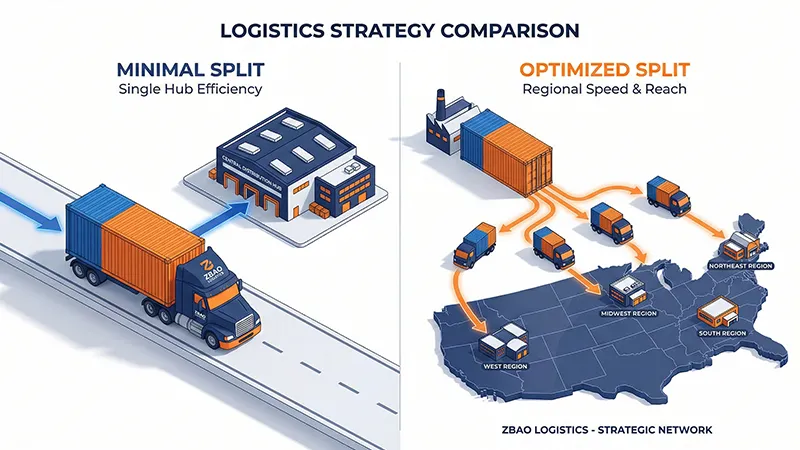
This is the most important section of this guide. You do not need complex software to make the right decision. You just need the ZBAO Break-Even Rule.
3.1 The One-Line Decision Rule
Memorize this logic:
If the extra cost of inland shipping to multiple warehouses is higher than the total placement fees, you should choose Minimal Split.
3.2 The Math (Easy Enough To Run On a Notepad)
Let's define the variables:
-
$S_{multi}$: Per-unit inland shipping cost with multi-split (4+ FCs).
-
$S_{single}$: Per-unit inland shipping cost with single FC (Minimal Split).
-
$P$: Per-unit Amazon FBA Inbound Placement Fee.
-
$U$: Total units in the shipment.
The Decision:
IF $(S_{multi} - S_{single}) > P$ → Choose Minimal Split (Pay the Fee).
3.3 Real-World Example: 1,000 Yoga Mats Into US FBA
Let's look at a real scenario for a ZBAO client shipping standard-size Yoga Mats (approx. 3 lbs) via Shipping from China to the USA
-
Shipment: 1,000 units.
-
Placement Fee ($P$): $0.35 per unit. Total Fee = **$350**.
Scenario A (Amazon Optimized / Free Split):
To avoid the fee, Amazon requires shipping to 4 locations. The LTL cost is high because the volume is split.
-
Inland Cost ($S_{multi}$): $1.75 per unit.
-
Total Inland Cost: $1,750.
Scenario B (Minimal Split / Paid):
The client ships to a single West Coast FC using ZBAO Logistics direct trucking.
-
Inland Cost ($S_{single}$): $0.70 per unit.
-
Total Inland Cost: $700.
The Comparison:
-
Extra Shipping Cost: $1,750 - $700 = **$1,050**.
-
Total Placement Fee: $350.
The Verdict:
Because $1,050 > $350, the Minimal Split option wins. By paying the $350 fee, the seller saves $700 in net profit on a single shipment.
4. The Hidden Cost Drivers in 2026: It’s Not Just the Placement Fee
Focusing only on the placement fee is a mistake. In 2026, other hidden costs can erode your margins if you aren't careful.
4.1 US Case: Inland Freight and Low-Inventory Fees
When you choose "Amazon-Optimized Splits," you aren't just paying for freight; you are paying for complexity.
-
Zone Complexity: Shipping from the Port of Los Angeles to a warehouse in Pennsylvania or Florida is significantly more expensive than shipping to a local California warehouse.
-
Low-Inventory Risks: 2026 introduces strict Low-Inventory-Level Fees. If your goods are stuck in transit because you are managing 5 different LTL shipments, you risk stockouts.
4.2 EU/UK Case: Pan-EU Distribution
In Europe, the hidden cost is often related to stock availability. Without a buffer strategy, sending everything straight into the EU FBA network leaves you vulnerable to stock limits. To mitigate this, consider using DDP terms to simplify the process. Read more in our article: What is DDP? Understanding DDP Shipping, Meaning, and Benefits
5. Three Inbound Strategies: Direct FBA vs. Minimal Split vs. ZBAO 3PL Cross-Dock
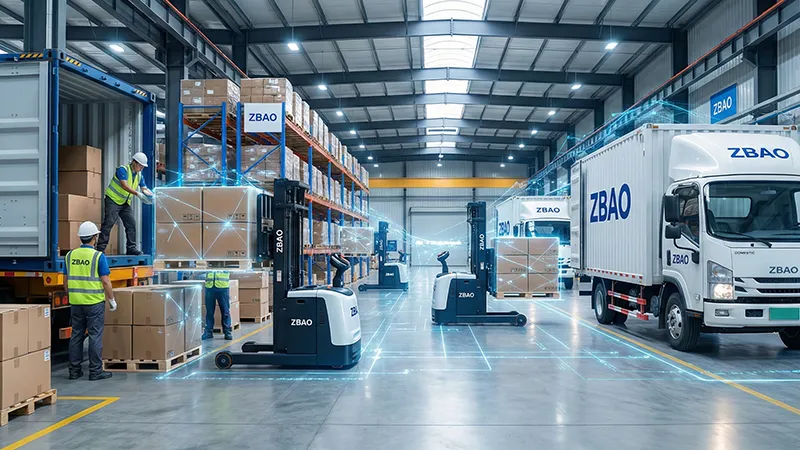
Now that we understand the math, let's compare the three main logistics strategies available to you in 2026.
5.1 Scenario A – Direct to FBA With Amazon-Optimized Splits
-
Pros: No placement fee line item on your invoice.
-
Cons: Inland freight is the "margin killer." Very little control over where your inventory lands.
5.2 Scenario B – Minimal Split to a Single FC
-
Pros: Keeps inland trucking simple and cheap. Often the lowest total landed cost for medium items.
-
Cons: You must pay the placement fee.
5.3 Scenario C – ZBAO 3PL Cross-Dock + Smart Splits (US & EU)
-
The Strategy: Factory in China → ZBAO West Coast or EU-Gateway Warehouse → Cross-dock/Buffer → Amazon FCs.
-
Benefits:
-
Waive Fees Legitimately: We can execute 3PL cross-docking to split shipments into 4 locations using our volume trucking rates, satisfying Amazon's requirements for the $0 fee while keeping freight costs low.
-
Control: Inland freight is optimized by zone, not dictated blindly by an algorithm.
-
This is especially effective for Shipping Oversize Cargo from China, where placement fees are significantly higher.
6. Three Advanced 3PL Tactics for 2026: Zone Skipping, Buffering, Consolidation
As an advanced ZBAO Logistics client, you have access to tactics that standard freight forwarders cannot offer.
6.1 Zone Skipping (US & EU)
Zone Skipping is the art of injecting inventory directly into the region where it is needed. Instead of letting Amazon transfer your goods from California to New York (taking 2 weeks), we land your goods on the West Coast and use our dedicated rail or truck network to "skip" zones.
6.2 Inventory Buffering to Avoid Low-Inventory Fees
With the new 2026 fees, running out of stock is expensive.
-
US Strategy: Keep 30% of your stock in a Zbao Logistics 3PL warehouse. Drip-feed inventory into FBA only when needed.
-
EU Strategy: Use ZBAO’s EU-facing warehouse as a buffer before pushing stock into the strict EU FBA network.
6.3 Consolidation: Turning Many Small Shipments Into One Profitable Flow
If you have multiple suppliers, do not ship them as separate LCL shipments. We combine multiple Purchase Orders (POs) into one Full Container Load (FCL). This is crucial for reducing your overall Amazon FBA shipping cost.
7. How ZBAO Logistics Fits In: SPN + ShipTrack Support for US & EU Sellers
You might be asking, "Why choose ZBAO Logistics over a standard forwarder?" The answer lies in our integration with Amazon.
7.1 Who We Serve
We are the logistics engine for North American and European brands, including 7-figure Private Label sellers and aggregators.
7.2 What Our SPN + ShipTrack Status Means for You
ZBAO Logistics is a vetted Amazon SPN (Service Provider Network) partner.
-
Trust: We are vetted by Amazon for FBA freight, prep, and warehousing standards.
-
Visibility: As an Amazon ShipTrack carrier, we have direct integration for shipment visibility. We ensure smoother appointment bookings and faster check-ins at Fulfillment Centers.
8. How to Run the Breakeven Check Without Any Tools
You don't need fancy software to start saving money today. Use this 5-step checklist.
-
Check the Fee: Note your 2026 Amazon FBA Inbound Placement Fee.
-
Ask for Multi-FC Quote: Ask your forwarder for the cost to split to 4+ locations.
-
Ask for Single-FC Quote: Ask for the cost to a single hub.
-
Compare: If (Extra Shipping Cost) > (Placement Fee) → Choose Minimal Split.
-
Multiply: Multiply the saving by your annual unit volume to see the real impact.
9. CTA: Get a Custom Inbound Cost & Placement Fee Review
Stop guessing. Let the experts at ZBAO Logistics run the numbers for you.
Our Offer to You
We invite you to send us:
-
2–3 of your key SKUs.
-
Your typical shipment size.
-
Your target marketplaces (US, CA, UK, DE, FR).
We will provide a simple, one-page comparison showing:
-
Cost of Amazon-Optimized Splits.
-
Cost of Minimal Split.
-
Cost of ZBAO 3PL Cross-Dock Solution.
Take the Next Step
Don't let 2026 fees eat your margins.
👉 [Contact Zbao Logistics Today] to map your 2026 US & EU inbound strategy with a ZBAO expert.
Disclaimer: Amazon fees and policies are subject to change. Please consult the official Amazon Seller Central help pages for the most current rate cards.


