Shipping Quote from China to USA: What Is Included?
A shipping quote from China to USA is comparable only when it uses the same cargo details, origin handover point, final destination, charging basis and responsibility scope. A lower headline price is not necessarily the lower payable total if it stops at a port, uses a different billing weight or leaves destination work outside the quotation.
Before approving a quote, record what is included, excluded or still to be confirmed. Also check the currency, validity date, planning-time definition and the conditions that can change the amount. When importers compare shipping quotes from China to USA, each China to USA freight quote should reference the same shipment brief.
Before You Compare Any China-to-USA Shipping Quote
Check eight fields before ranking prices. If one field differs or is missing, ask for clarification or a revised quotation instead of treating the totals as alternatives.
| Check | What must match | Question if unclear |
|---|---|---|
| 1. Cargo revision | Commodity, carton or pallet count, dimensions, gross weight and stackability | Which cargo data did you price? |
| 2. Origin handover | Factory pickup, China warehouse handover or named port/airport | Where does your responsibility begin? |
| 3. Delivery endpoint | U.S. port, terminal, pickup warehouse or exact final address | Where does the quoted service end? |
| 4. Mode and service | Air, ocean consolidation, LCL or FCL; route and delivery type | What service and route are being priced? |
| 5. Charging basis | Chargeable kg, CBM, weight/measurement, container or shipment total | What quantity will the rate multiply? |
| 6. Written scope | Origin, main carriage, destination, clearance and final delivery items | Which items are included, excluded or unconfirmed? |
| 7. Conditions | Cargo, address, inspection, storage, waiting and redelivery triggers | What event can change the quoted amount? |
| 8. Validity | Currency, valid-until date, cargo-ready date and availability conditions | When must this quote be reconfirmed? |
Treat these eight checks as a freight quote checklist and verify every item against the written quotation.
If the route or delivery model is still open, review the China to USA shipping options. If several modes could work, first compare shipping costs for your cargo.
What Should a Freight Quote Include?
A useful freight quote should identify the service boundaries, charging basis and responsibility for every material stage. The exact inclusions vary by service, so mark each line as included, excluded or requiring confirmation. List origin and destination charges separately. This is also the right way to compare base ocean freight vs total shipping cost: the base ocean line is one layer, while the complete quote reflects the agreed service scope.
Origin and Handover Charges
The origin section should say whether the quotation starts at the factory, a China consolidation warehouse or a named port or airport. Pickup, supplier coordination, export handling, documents and terminal or warehouse work cannot be assumed from the route name alone.
Main Carriage and Charging Basis
The main-carriage line should name the transport service and billing unit. For air or channel services, request the chargeable weight and any minimum. For consolidated ocean cargo, request the rated CBM or weight/measurement basis. For FCL, confirm the container type and whether the amount is only the ocean leg or a wider service.
Destination, Clearance and Final Delivery
The destination section should distinguish terminal or warehouse handling, release, customs-service scope and final delivery. A port or warehouse endpoint is different from delivery to a business, residence, Amazon facility or 3PL.
Conditional Charges and Exceptions
Conditional charges need a written trigger. Examples include changed cargo data, non-stackable freight, inspection, storage, waiting, special delivery equipment or a failed delivery attempt. Record quote exclusions and conditional shipping charges separately so the trigger and payer remain visible.
| Cost layer | Line to check | Status | Responsibility or trigger to record |
|---|---|---|---|
| Origin | Factory pickup or China warehouse handover | □ Included □ Excluded □ Confirm | Named pickup point, access and waiting terms |
| Origin | Export handling, documents and terminal/warehouse work | □ Included □ Excluded □ Confirm | Which documents and handling steps are covered? |
| Main carriage | Air or ocean transport | □ Included □ Excluded □ Confirm | Mode, route, equipment and billing unit |
| Destination | Terminal, CFS or destination warehouse handling | □ Included □ Excluded □ Confirm | Named release or pickup point |
| Import | Customs-service coordination and filing scope | □ Included □ Excluded □ Confirm | Importer role, broker role and documents |
| Import | Duty and tax responsibility | □ Included □ Excluded □ Confirm | Who calculates, advances and ultimately bears the amount? |
| Delivery | Final delivery to the named U.S. address | □ Included □ Excluded □ Confirm | ZIP, warehouse code, delivery type and unloading |
| Delivery | Appointment, liftgate, limited access or residential service | □ Included □ Excluded □ Confirm | Which address condition activates the charge? |
| Risk scope | Cargo insurance | □ Included □ Excluded □ Confirm | Coverage basis, declared value and exclusions |
| Conditional | Inspection, storage, waiting, demurrage/detention or redelivery | □ Included □ Excluded □ Confirm | Trigger, payer and supporting notice or invoice |
For ocean shipments, U.S. detention and demurrage invoices are subject to specific billing rules. The Federal Maritime Commission explains the billing framework. A quotation should still identify the operational trigger and commercial responsibility rather than imply that every possible event is prepaid.
How to Compare Two Freight Quotes Side by Side
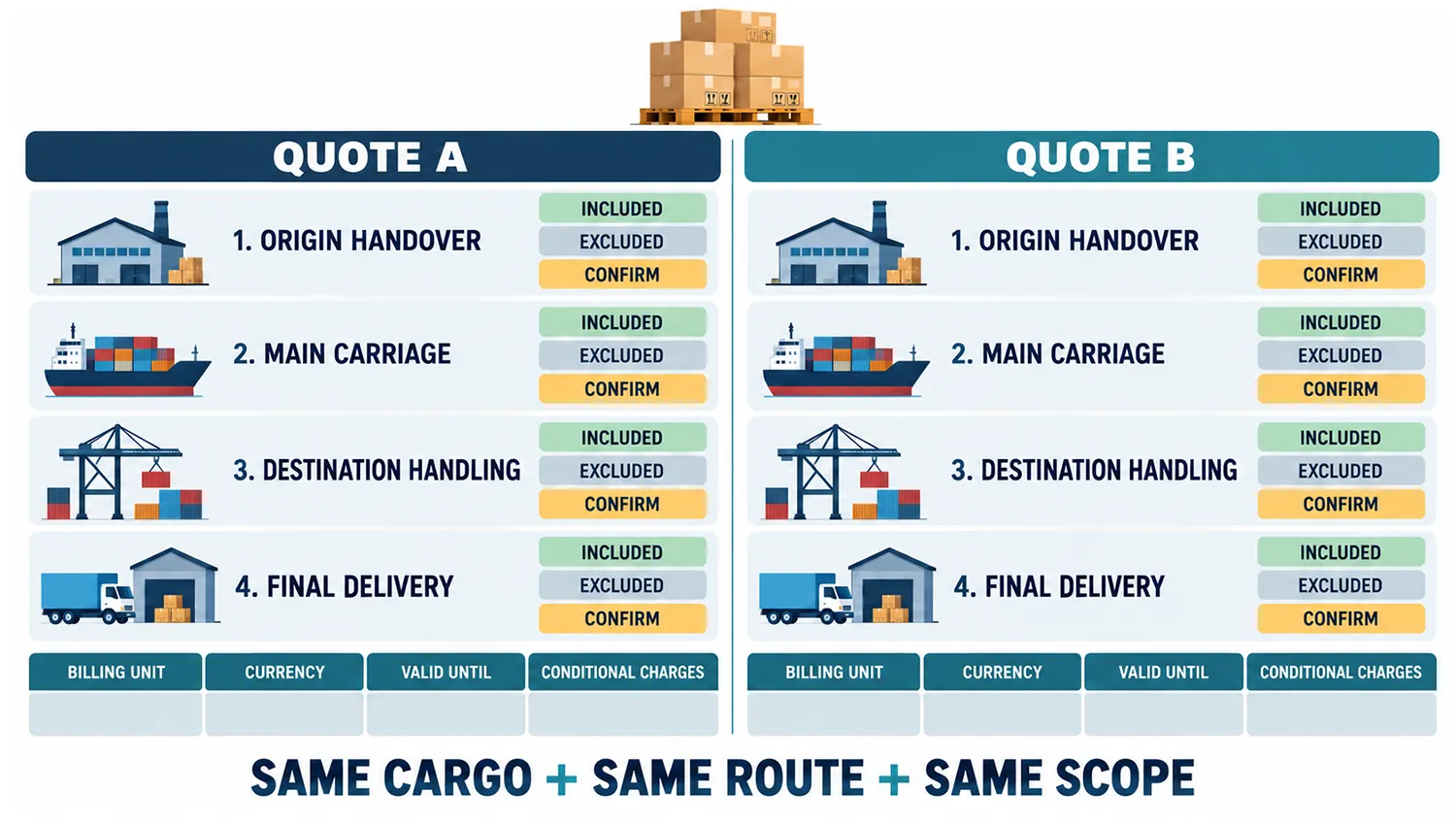
Normalize both quotations into one worksheet, then compare the declared totals only after every material row matches or has a written explanation.
Use the Same Cargo Revision
Label the shipment input with a date or revision number. When carton count, dimensions or weight changes, do not mix the earlier quotation with the final cargo data.
Match the Same Origin and Delivery Endpoint
A China warehouse-to-U.S. port quotation and a factory-to-door quotation are different purchases. Write the handover and final delivery points in full, including the U.S. ZIP code and receiving type.
Convert Units and Currency Before Ranking Totals
Do not compare a rate per chargeable kilogram with a rate per CBM or a container amount. Calculate each shipment total under its own billing basis, align currencies using the same documented comparison rate, then add only the items that belong to the agreed scope.
| Comparison field | Quote A | Quote B | Match or question |
|---|---|---|---|
| Cargo revision | ________ | ________ | Same cartons, dimensions and weight? |
| Origin / endpoint | ________ | ________ | Same named start and finish? |
| Service / route | ________ | ________ | Same service objective? |
| Billing unit and rated quantity | ________ | ________ | How was the quantity determined? |
| Origin + main carriage | ________ | ________ | Which items sit outside? |
| Destination + final delivery | ________ | ________ | Same address and receiving scope? |
| Clearance / duty and tax responsibility | ________ | ________ | Who performs, advances and bears each item? |
| Conditions / exclusions | ________ | ________ | What can change after approval? |
| Planning time definition | ________ | ________ | Same start, end and day type? |
| Currency / validity / total | ________ | ________ | Valid for the same cargo-ready date? |
Use the planning-time row to identify the promised node, not to rebuild a full schedule here. The shipping time from China to the USA guide explains how to compare timing endpoints and work backward from a required delivery date.
Which Conditions Can Change a Quote?
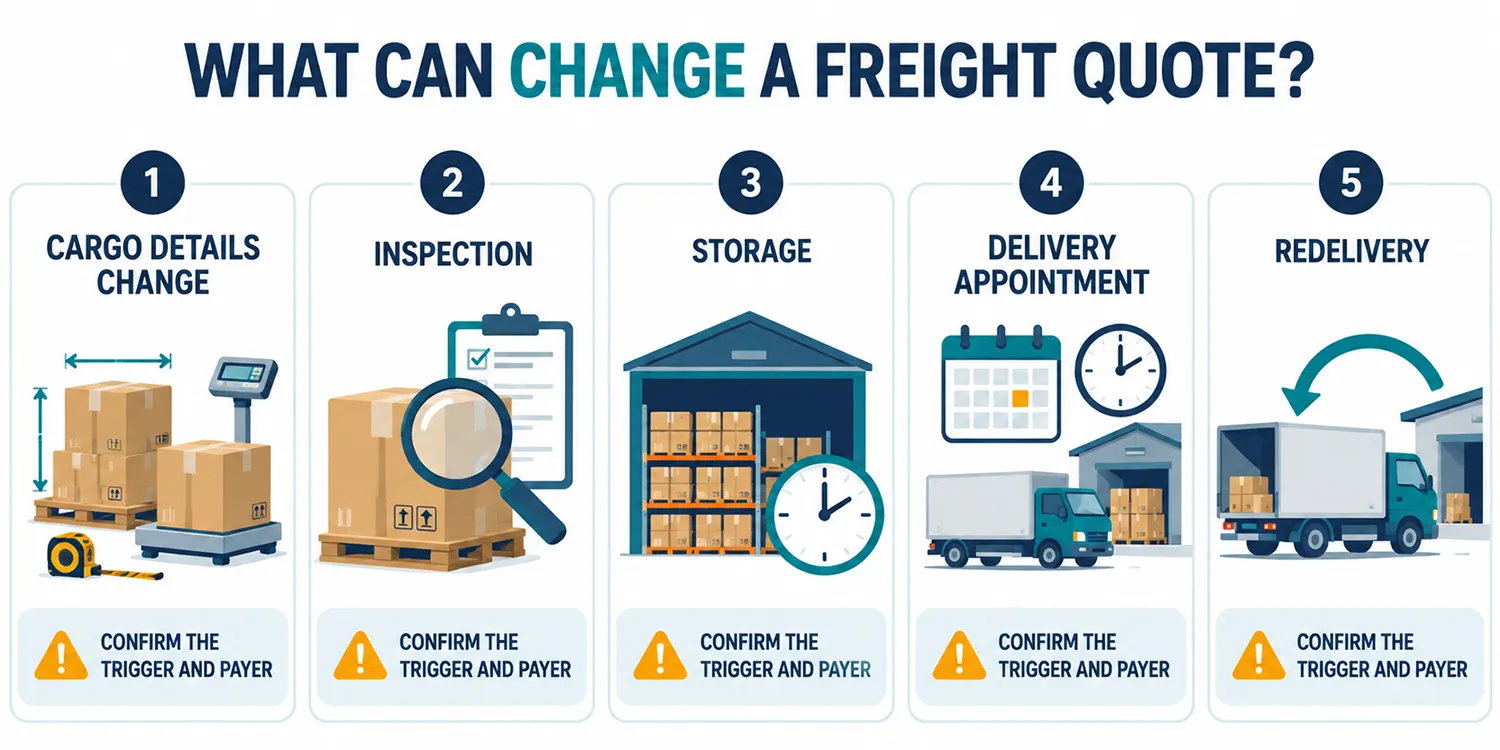
A quotation can change when the shipment facts or execution conditions change. Record the trigger and the responsible party instead of assigning one universal allowance to every shipment.
| Condition | Possible impact | Confirm in writing |
|---|---|---|
| Carton, weight or dimension change | Different billed quantity, equipment or minimum | Which cargo revision controls the price? |
| Non-stackable, fragile or oversized packing | Space, handling or channel review | Acceptance, packing and measurement basis |
| Inspection or document exception | Handling, delay-related or third-party charges | Who coordinates, pays and provides documents? |
| Storage or free-time overrun | Warehouse, terminal or equipment charges | Free-time basis, notice and payer |
| Appointment, waiting or no unloading access | Delivery equipment, waiting or rescheduling | Included allowance and receiving responsibility |
| Residential, limited-access or remote address | Different last-mile service or access condition | Address classification before booking |
| Failed delivery or changed destination | Redelivery, return or re-routing | Approval process and payer |
Quote Validity and Change Triggers
There is no single validity period for every China-to-USA quotation. Shipping quote validity should be stated as a written date and tied to the cargo-ready assumptions used for pricing. Confirm that the space or equipment assumptions and shipment data still match when the booking is made.
A useful validity clause answers three questions: when the quoted amount expires, which assumptions it relies on, and which changes require re-rating. If an offer says only “subject to change,” ask the provider to identify the practical triggers relevant to the service.
“All-In” and DDP: Confirm the Written Scope
“All-in” and DDP labels do not replace a line-by-line scope. An all-in shipping quote is useful only when its written scope names the endpoint and the charges that remain outside the total. Confirm the named delivery point, importer role, customs-service responsibility, duty and tax treatment, final delivery conditions and exceptions in writing.
The International Chamber of Commerce explains that Incoterms® allocate costs, risks and obligations between buyer and seller. They do not by themselves turn a forwarder's quotation into a complete list of charges or resolve every contract, customs or delivery issue.
Freight Cost vs Landed Cost
Freight cost vs landed cost is a comparison between two different budget boundaries. A freight quotation may cover some or all logistics stages, while landed cost can also include product value, import charges and internal business costs.
| Cost bucket | Part of the freight quote? | What to verify |
|---|---|---|
| Product value | Normally outside the logistics quotation | Purchase value and currency used by finance/import records |
| Origin logistics | May be included or excluded | Handover point, pickup and export handling |
| Main freight | Core quoted transport line | Mode, route, billing unit and rated quantity |
| Destination logistics | May be included, bundled or separate | Release, handling, delivery and receiving conditions |
| Customs service and import charges | Depends on responsibility scope | Importer, broker, classification, value and payment responsibility |
| Insurance | Confirm separately | Declared value, coverage basis and exclusions |
| Internal inventory or financing cost | Outside the freight quotation | Company-specific cost and deadline assumptions |
U.S. import treatment depends on the merchandise and entry facts. The U.S. International Trade Commission publishes current HTS resources. Use the applicable classification, value and importer information when confirming the customs portion; do not substitute a generic percentage from another shipment.
For a container-specific comparison, continue to the China to USA container shipping costs guide. For booking and handover steps after selecting an ocean option, use the sea freight planning from China to USA guide.
Details Needed for an Itemized Quote
A complete shipment brief reduces assumptions and lets each option be priced against the same facts. Provide the following information once, then ask every quoting party to reference that version.
| Required input | Example format | Why it matters |
|---|---|---|
| Product | Plain-language commodity; note batteries, liquids, magnets or regulated features | Channel acceptance, documents and handling review |
| Origin | Factory city/address or named China handover warehouse | Pickup and origin scope |
| Destination | Full U.S. address and ZIP, port or warehouse code | Route, delivery and receiving scope |
| Packing | Carton/pallet count, packaging type and stackability | Handling, consolidation and space use |
| Measurements | Dimensions for each package type, total gross weight and CBM | Chargeable quantity and equipment fit |
| Dates | Cargo-ready date and required arrival date | Executable route and quote validity |
| Commercial data | Declared cargo value; current purchase Incoterm and named place | Customs, insurance and responsibility review |
| Requested scope | Named start/end point; freight, clearance, duty/tax and delivery responsibility | Makes separate quotations comparable |
| Receiving conditions | Commercial/residential/FBA/3PL; dock, appointment, liftgate and access | Final-mile equipment and conditions |
Frequently Asked Questions
What should a shipping quote from China to the USA include?
A useful quote should identify the cargo basis, origin handover, final destination, mode or service, charging unit, currency and validity. It should also mark origin, main-carriage, destination, clearance, duty or tax responsibility, final-delivery and conditional items as included, excluded or requiring confirmation.
Why can two freight quotes for the same shipment be different?
The quotations may use different cargo revisions, handover points, delivery endpoints, routes, billing units, responsibility scopes or validity conditions. Put both offers into the same worksheet and ask for a revised quote wherever the fields do not match.
Does an all-in or DDP quote include every possible charge?
No label should replace the written scope. Confirm the named delivery point, importer and customs responsibilities, duty or tax treatment, final-delivery conditions and the handling of inspection, storage, waiting, address exceptions and redelivery.
How long is a China-to-USA shipping quote valid?
There is no universal validity period. Use the valid-until date written on the quotation and confirm that the cargo-ready date, shipment data, route, space or equipment assumptions and service scope still apply when you book.
What information is needed for an itemized freight quote?
Provide the product, China origin or handover point, exact U.S. destination, carton or pallet count, package dimensions, gross weight, CBM, stackability, cargo-ready date, requested arrival date, declared value, purchase Incoterm and named place, requested responsibility scope and receiving conditions.
Request an Itemized China-to-USA Quote
Send one complete cargo input set so ZBAO can review executable options against the same origin, destination and responsibility scope. Include the product, declared value, China handover point, final U.S. address, cargo-ready date, carton or pallet count, dimensions, gross weight, CBM, stackability, current Incoterm and named place, and receiving conditions.
Ask for the billing basis, included services, exclusions, conditional charges, validity and customs or delivery responsibility to be shown separately. That gives your logistics and finance teams a written scope they can review before booking.


