US Customs Bond Maintenance: Renewals, Claims & Status Guide
Your customs bond is the backbone of your import operation. Without an active, sufficient bond on file with CBP, your goods do not clear, your shipments sit at port, and every day of delay racks up storage charges you did not budget for.
But a customs bond is not a set-it-and-forget-it document. It needs customs bond renewal. It needs monitoring. It can be flagged as insufficient overnight, especially with 2025-2026 tariff adjustments pushing importers past their original bond limits. And if you ever need to file a customs bond claim, knowing the process before you need it saves weeks of confusion.
This guide walks through the full customs bond maintenance lifecycle: renewal, insufficiency response, amount recalculation, cancellation recovery, claims filing, and status monitoring. Whether you import twice a year or twice a week, these are the processes that keep your supply chain moving.
How to Renew Your Continuous Customs Bond
Annual Renewal: What Triggers It
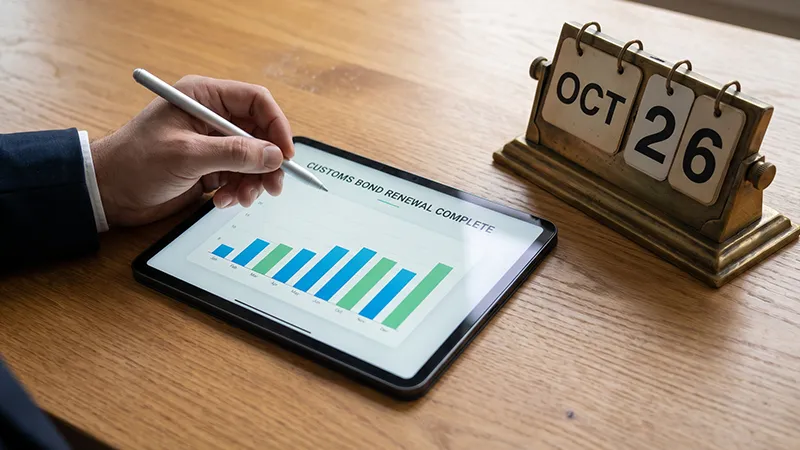
A continuous customs bond covers all your imports for one year from the effective date, not the calendar year. Most sureties send a renewal notice roughly 30 days before expiration. If you miss it, your bond lapses automatically. CBP will not remind you.
The surety company underwrites each continuous customs bond renewal based on your import history and projected volume. If your duties, taxes, and fees have grown since last year, expect both your bond amount requirement and your premium to increase.
Step-by-Step Renewal Process
- Receive renewal notice from your surety company, typically by email 30-45 days before expiration.
- Review your import volume: compare your actual 12-month duties, taxes, and fees against your current bond coverage. If you have expanded your product lines or entered new tariff categories, factor that in.
- Confirm or update the bond amount with your surety or customs broker. Do not simply auto-renew at the old amount if your import profile has changed.
- Pay the annual premium: continuous bond premiums typically run 0.5% to 1.5% of the bond amount, depending on your financials and import history.
- Verify CBP acceptance: your broker or surety files the bond electronically through eBond. Confirm receipt of the CBP bond number before your old bond expires.
How Much Should Your Renewal Bond Cover?
The formula is straightforward: 10% of your total duties, taxes, and fees from the past 12 months, or your projected next 12 months if that number is higher, rounded up to the nearest $10,000, with a $50,000 minimum. For CBP's own explanation of how bond amounts are set, see the official CBP Bonds guidance page. For a deeper breakdown of bond types, amounts, and first-time setup, see our Complete Importer's Guide to US Customs Bond.
What Happens When CBP Flags Your Bond as Insufficient
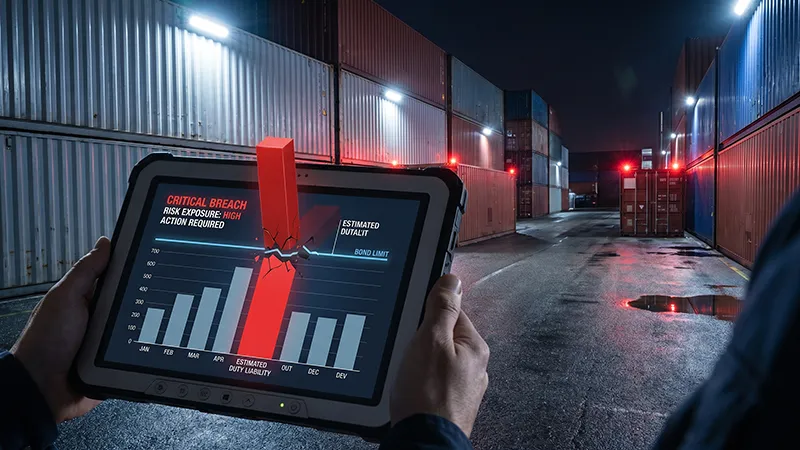
Bond insufficiency is not the same as cancellation. It means your bond is still active, but CBP has determined the coverage amount is too low for your current import volume. This is the most common bond emergency, and it has been happening at record rates in 2025 due to shifting tariff schedules. For context on how CBP's 2026 enforcement campaign has raised the stakes, see our crackdown coverage.
How CBP Detects Bond Insufficiency
CBP runs a rolling 365-day calculation: once your total duties, taxes, and fees hit a level where 10% equals or exceeds your bond amount, the system flags it. You do not need to file a single high-value entry to trigger this. Steady volume growth over several months will do it.
The 30-Day Response Window
When CBP flags your bond as insufficient, they send an official notice letter to the importer of record. From the date of that letter, you have 30 days to fix the problem. The fix is not a quick amendment. CBP requires you to terminate the existing bond and place a new, larger bond on file. Amendment is not allowed. CBP's official guidance on this process is available in their Insufficient Bonds directive.
If the 30-day window closes without a sufficient replacement bond in place, CBP begins stopping your shipments at port. You cannot import until the new bond is active.
What Happens to Shipments in Transit
This is the part most importers do not plan for. If you have containers on the water when CBP suspends your import privileges due to bond insufficiency, those shipments will be held upon arrival. Port storage and demurrage charges start accumulating immediately. Depending on the port, this can run $100-$300 per container per day. Resolving a bond insufficiency while cargo is sitting at terminal is both expensive and time-sensitive.
What to Do If Your Bond Is Cancelled
Bond cancellation is rarer than insufficiency but more disruptive. When a bond is cancelled, you have no bond coverage at all, and no ability to clear goods.
Common Reasons Bond Cancellation Happens
- Surety company withdraws coverage (financial reassessment, claims history, or the surety exiting the market)
- Importer fails to pay the annual premium
- Importer goes out of business or changes entity structure without updating filings
Immediate Steps After Cancellation
- Contact your customs broker immediately to confirm the cancellation reason and effective date.
- Secure a new bond from a different surety if your previous provider refuses to renew.
- Do not attempt to clear new shipments until the new bond is active in CBP's system.
Your Cargo During a Bond Gap
If cargo arrives while you have no bond on file, CBP will not release it. The shipment sits in a bonded warehouse or at terminal, accumulating storage fees daily. For a full walkthrough of what happens when shipments are held or refused by CBP, including your rights, responsibilities, and recovery options, read our guide on US Customs Forced Return and Refused Shipment Handling.
Customs Bond Amount Calculator: When to Recalculate
Recalculating your bond amount is not just a renewal task. It is something you should do quarterly if your import volume fluctuates. Here is the quick reference:
| Annual Duties, Taxes & Fees | Minimum Bond Required | Recommended Bond (with Buffer) |
|---|---|---|
| Under $500,000 | $50,000 | $50,000 |
| $500,000 – $1,000,000 | 10% rounded up to nearest $10K | Add 15-20% buffer |
| $1,000,001 – $5,000,000 | 10% rounded up to nearest $100K | Add 15-20% buffer |
| Over $5,000,000 | 10% rounded up to nearest $100K | Add 20-25% buffer |
Seasonal Import Spikes: The Hidden Risk
Many importers recalculate based on annual averages, and that is exactly where the risk hides. If you bring in 40% of your annual volume during Q4 for holiday inventory, your bond needs to cover that peak, not your monthly average. CBP's sufficiency check is a rolling 12-month window, so a single heavy quarter can push you past your bond limit mid-cycle.
Single Entry Bond vs Continuous Bond: Maintenance Differences
The kind of bond you hold changes what "maintenance" means. Importers using single entry bonds and those on continuous bonds face different renewal rhythms and risk profiles.
Single Entry Bond: Per-Shipment Reality
A single entry bond covers exactly one import transaction. The bond amount equals the entered value of that specific shipment plus estimated duties, taxes, and fees, typically calculated at $3-$5 per $1,000 of shipment value, with a minimum of $100.
Maintenance for single entry bond users means: you buy a new bond for every shipment. There is no renewal cycle, no annual premium, and no sufficiency monitoring. The risk is operational: if your broker forgets to purchase the bond before your shipment arrives, you have a customs hold. Single entry bonds also get expensive fast for frequent importers. If you import more than 3-4 times per year, the cumulative single entry bond cost usually exceeds a continuous bond premium.
Continuous Bond: Annual Cycle
A continuous bond covers all imports for 12 months. Maintenance means:
- Annual renewal with premium payment
- Ongoing sufficiency monitoring (the 10% rule on a rolling basis)
- Updating the bond amount when import volume grows
The continuous bond is the standard choice for Amazon FBA sellers and regular importers. It is cheaper per shipment and eliminates the risk of forgetting to secure coverage.
When to Switch from Single Entry to Continuous
The break-even point is typically around 3-4 shipments per year. If you have been testing the US market with occasional imports and are now scaling up, switching to a continuous bond simplifies your logistics and usually cuts costs. Talk to your customs broker or freight forwarder about the transition. It is a routine filing change, not a disruptive process.
How to File and Track a Customs Bond Claim
Customs bond claims work in two directions. CBP can file a claim against your bond if you fail to meet import obligations (unpaid duties, late ISF filings, or classification errors). At the same time, you can file a claim against another party's bond if they breach their duties to you. Both directions matter, and missing a deadline on either side costs money.
When CBP Files a Claim Against Your Bond
When CBP believes you have violated the conditions of your bond, they initiate the process by issuing CBP Form 5955A (Notice of Penalty or Liquidated Damages). This is not a bill. It is a formal allegation, and you have the right to respond.
The timeline works like this:
- Receive Form 5955A: CBP sends the notice to your listed address of record. Watch for it. Missing the notice does not extend your deadlines.
- 60-day response window: You have 60 days from the date of the notice to file a petition for relief under 19 CFR Part 162. This petition explains why the penalty should be reduced or dismissed.
- Attach evidence: Include documentation that supports your case: corrected filings, proof of payment, records showing reasonable care, or evidence that the violation was beyond your control.
- CBP reviews and decides: CBP Fines, Penalties, and Forfeitures (FP&F) office reviews your petition and issues a decision. This can take several months.
- Appeal if denied: If CBP denies your petition in full or in part, you can protest the decision under 19 USC 1515, typically within 180 days.
When You File a Claim Against Another Party
A bond claim arises when a bonded party fails to meet their obligation and you suffer a financial loss as a result. Common scenarios:
- A carrier damages or loses your cargo and refuses to compensate
- A customs broker makes a filing error that results in penalties or delayed clearance
- A bonded warehouse releases goods without authorization
The claim is filed against the bond that guarantees that party's performance, not your own import bond.
The Claims Process Step by Step
- Document the loss: collect bills of lading, inspection reports, correspondence, and any CBP penalty notices.
- Identify the responsible party's bond: your freight forwarder or customs attorney can help trace the surety and bond number.
- File a written claim with the surety company, including all supporting documentation and a specific dollar amount.
- Follow the surety's investigation timeline: sureties typically have 30-90 days to investigate and respond.
- Escalate if denied: if the surety rejects the claim, the next step is filing a petition under 19 CFR Part 172 with CBP, or pursuing litigation.
Timeline Expectations
Most straightforward claims resolve within 60-90 days. Complex claims involving multiple parties or disputed liability can take 6-12 months. The key variable is documentation: the more complete your paper trail, the faster the process.
How to Check Your Customs Bond Status
You should verify your bond status actively, not just when a problem arises.
Using the ACE Portal
The ACE Secure Data Portal is CBP's online system for importers. Through ACE, you can:
- Confirm your bond is active and on file
- Check the bond amount and effective dates
- View any pending insufficiency flags
If you do not have ACE access, your customs broker can pull this information through their own portal in minutes. Make bond status checks part of your monthly or quarterly compliance routine.
Working with Your Surety Company
Most sureties provide online account access where you can view premium payment status, renewal dates, and bond amounts. Some offer real-time sufficiency monitoring tools that track your rolling 10% calculation against your current bond limit. If your surety does not offer this, ask your broker to run the numbers quarterly.
Red Flags to Watch For
- Premium payment did not clear: your bond may already be in cancellation queue
- Import volume increased 20%+ over last year: your coverage is probably insufficient
- You received a new tariff classification for existing products: re-run the math
- Your surety company merged or was acquired: confirm your bond transferred correctly
Frequently Asked Questions
How long does customs bond renewal take?
A standard renewal processes in 1-3 business days when filed electronically through eBond. The key variable is underwriting. If your import volume or financial situation has changed significantly, the surety may take longer to quote. Submit renewal paperwork at least two weeks before expiration to avoid gaps.
Can I import while my bond renewal is processing?
As long as your current bond has not expired and remains sufficient, yes. If your existing bond expires before the renewal is accepted, you have a coverage gap. CBP will not process entries during a gap. Always renew with a buffer.
What is the minimum bond amount for a new importer?
$50,000 is the minimum continuous bond amount. For first-time importers with no import history, the surety will estimate based on your projected 12-month duties and fees. If your projected 10% figure is below $50,000, the minimum holds.
Does a customs bond cover demurrage charges?
No. Customs bonds guarantee payment of duties, taxes, and fees to CBP. Demurrage is a terminal operator charge for containers sitting at port beyond the free period. It is between you and the shipping line or terminal, not CBP. A bond insufficiency that causes shipment delays can trigger demurrage, but the bond itself does not cover it.
Can I use the same bond for multiple ports of entry?
Yes. A continuous customs bond covers all ports of entry in the United States. You do not need separate bonds for Los Angeles, New York, or Savannah. The bond is tied to your importer of record number, not a specific port.
What happens if my surety company goes out of business?
CBP maintains a list of approved sureties (Treasury Department Circular 570). If your surety fails, CBP will notify you and provide a window to replace the bond. However, do not wait for that notice. If you hear news of surety insolvency, contact your broker immediately to place a new bond with a different provider before CBP flags your coverage gap.
What if CBP requires a cash deposit in addition to my bond?
CBP can require a cash deposit, typically equivalent to the estimated duties on a shipment, for high-risk importers or specific commodity categories. This is separate from your bond and is held by CBP until the entry liquidates. Common triggers include: a history of compliance issues, importing goods subject to antidumping or countervailing duties, or being flagged as a new importer in a high-scrutiny product category. Cash deposits tie up working capital, so work with your broker to understand whether your product categories carry this risk before you ship.
Keep Your Bond Working So Your Shipments Keep Moving
A customs bond is not complicated, but ignoring it is expensive. Renew on time, monitor your sufficiency as your import volume grows, and know the process for claims and status checks before you need them.
If you are importing from China to the US and want a freight forwarder who handles bond management alongside your shipping, contact Zbao Logistics for a quote. Our US customs clearance services include bond management, ISF filing, and full-entry support. For FBA sellers scaling into the US market, our Amazon FBA freight forwarding services include bond consultation as part of your shipment planning.
Published May 2026. Bond regulations and tariff schedules change. Always confirm current requirements with a licensed customs broker.


