US Customs Bond: The Complete Importer’s Guide (2026)
CBP flagged 27,479 bond insufficiencies totaling $3.6 billion last year. Cargo is booked. Your supplier is ready. Then U.S. Customs and Border Protection or your customs broker stops the process because of a customs bond issue. Importers lose time, pay inflated fees, or trigger compliance audits right at this step.
A customs bond is a mandatory financial guarantee filed with the federal government. CBP requires it for commercial imports valued over $2,500 and for highly regulated goods regardless of value. This guide breaks down the exact mechanics of bond types, the mathematical formulas for sizing your coverage, the true cost of underwriting, and how to survive the aggressive 2026 CBP enforcement environment.
What Is a US Customs Bond?
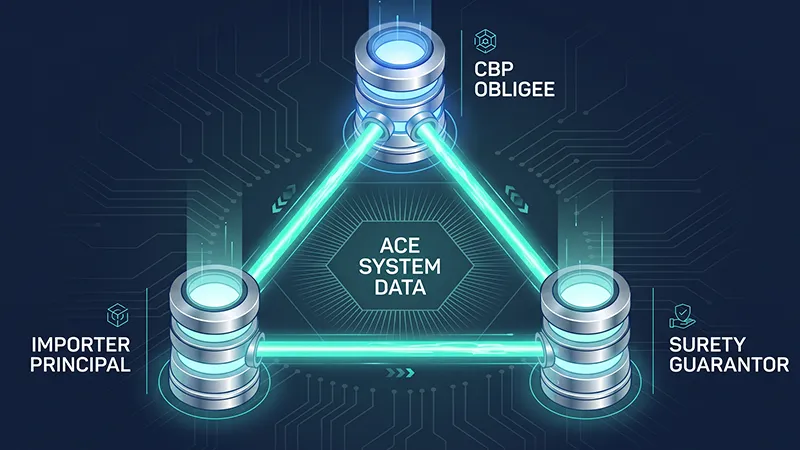
A customs bond operates under the legal authority of 19 U.S.C. § 1623 and is executed officially on CBP Form 301. It is a three-party legal contract. You need to understand the relationship between these three entities to understand why underwriters evaluate you like a credit risk.
- The Principal: This is you, the Importer of Record (IOR). You are making the promise to pay all duties and follow all laws.
- The Obligee: This is U.S. Customs and Border Protection (CBP). They are the beneficiary of the bond.
- The Surety: This is the Treasury-approved underwriting company. They are backing your promise with their own capital.
If you fail to pay your duties, taxes, or regulatory fines, CBP does not wait for you to find the money. CBP files a claim against the bond. The surety company immediately pays the federal government.
The transaction does not end there. Surety companies operate on the legal principle of subrogation. Once they pay CBP, they assume the government's right to collect the debt from you. The surety will deploy legal action, seize assets, and liquidate collateral to recover every dollar they paid on your behalf. This is exactly why the phrase "customs bond insurance" is fundamentally incorrect. Insurance transfers your risk. A bond merely guarantees your payment. You retain 100 percent of the financial liability.
When Is a Customs Bond Required?
CBP enforcement relies on hard triggers. You must secure a bond if your import activity falls into specific regulatory categories. Informal entries generally do not require a bond, but the definition of an informal entry is strict.
| Import Situation | Requirement | Regulatory Context |
|---|---|---|
| Commercial shipment over $2,500 | Mandatory | Value thresholds force a formal entry. Formal entries demand a bond. |
| PGA regulated goods (FDA, USDA, EPA, ATF) | Mandatory | Partner Government Agencies require bonds regardless of commercial value. A $500 shipment of medical devices requires a bond. |
| Ocean freight imports | Mandatory | An Importer Security Filing (ISF) must be transmitted 24 hours before vessel departure. ISF filings require bond coverage. |
| Goods subject to AD/CVD | Mandatory | Anti-Dumping and Countervailing Duties carry massive risk. CBP forces formal bonded entries to guarantee collection. |
Types of US Customs Bonds
Importers must choose a bond structure that matches their operational volume. Choosing the wrong type destroys profit margins through repetitive administrative fees.
Single Entry Bond (SEB)
A Single Entry Bond covers exactly one transaction. It secures one specific shipment clearing through one designated US port.
The required face value for an SEB is generally equal to the total commercial value of the goods plus all estimated duties and taxes. CBP alters this formula aggressively for restricted goods. If you import goods regulated by the FDA or another Partner Government Agency (PGA), CBP mandates the SEB face value be exactly three times the total value of the merchandise.
This bond structure only makes financial sense if you are a one-time importer or running a very small initial product test. You must secure a new SEB for every single container or air freight consolidation you bring in.
Continuous Customs Bond
A Continuous Bond operates as an annual blanket policy. It covers all import entries made by the Importer of Record across all US ports for a rolling 12-month period.
The absolute minimum face value permitted by CBP is $50,000. For mid-market and enterprise importers, the face value scales up based on duty volume.
The continuous bond provides a massive logistical advantage: it automatically fulfills the bond requirement for ocean freight Importer Security Filings (ISF). You do not need to buy separate ISF bonds. Regular importers, Amazon FBA sellers, wholesale distributors, and scaled B2B operations rely entirely on continuous bonds to avoid per-shipment clearance friction.
Other Specialized Bond Types
Depending on your position in the supply chain, CBP Activity Codes dictate different bond requirements.
- ISF Customs Bond (Activity Code 16): A standalone bond used strictly to cover the $5,000 penalty exposure for late or inaccurate ocean freight data transmission. Importers using single entry bonds for ocean freight must buy this separately.
- Airport Security Bond (Activity Code 113): Required for air carriers, warehouse operators, and third-party logistics handlers accessing secure, unreleased customs areas at US airports.
- Drawback Bond (Activity Code 1A): Utilized when an importer claims a refund of duties paid on goods that are subsequently exported or destroyed. It guarantees CBP can recover the funds if the drawback claim is later invalidated during an audit.
- Foreign Trade Zone Bond (Activity Code 4): Required for operators managing FTZ facilities where goods sit duty-free pending domestic entry or re-export.
How Much Does a US Customs Bond Cost?
Importers routinely confuse the bond amount with the bond cost. The bond amount is the financial liability limit filed with CBP. The bond cost is the premium you pay the surety company to underwrite that liability.
Continuous Bond Pricing
Surety companies price continuous bonds based on risk assessment. They evaluate your corporate entity, your import history, the commodities you move, and your country of origin.
For a standard, low-risk US-based importer moving benign commodities, a baseline $50,000 continuous customs bond costs between $325 and $500 per year.
In the 2026 enforcement environment, non-resident importers and offshore ecommerce sellers face severe underwriting scrutiny. Sureties view foreign entities as flight risks. Annual premiums for offshore corporations frequently land between $750 and $1,200.
If your duty volume forces you into higher tiers, the premium scales. A $100,000 bond will cost more than a $50,000 bond. However, the cost does not scale linearly. A $500,000 bond does not cost ten times the premium of a $50,000 bond. Sureties discount the rate per thousand at higher tiers.
Single Entry Bond Fee Formula
Surety companies calculate single entry bond fees using a specific multiplier against the required bond amount. The industry standard base rate sits between $3.00 and $5.00 per $1,000 of coverage. Brokers then apply a flat processing fee on top.
Consider a standard shipment: You import $20,000 worth of furniture carrying a 10 percent duty rate ($2,000). Your bond requirement is $22,000. Applying a standard multiplier, the raw premium might be $80. After broker administrative fees, you pay $120.
Now consider a regulated shipment: You import $20,000 worth of cosmetics. The FDA regulates cosmetics. CBP demands the SEB face value equal three times the merchandise value. Your bond requirement jumps to $60,000. The premium scales accordingly, pushing the per-shipment cost well over $200.
Decoding Broker Markups
High bond costs usually stem from broker markups. Licensed customs brokers buy bonds at wholesale rates from surety companies and mark them up as part of your comprehensive clearance package. Many importers pay $800 a year for a bond that costs the broker $300. Demand transparency. Ask your broker to itemize the exact bond premium separately from the filing fee and the administrative surcharge.
Calculating Your Bond Amount
CBP enforces a strict mathematical formula for sizing continuous bonds. You cannot choose your bond amount. Your duty volume dictates it.
The 10 Percent Rule
Your continuous bond face value must equal 10 percent of the total duties, taxes, and fees you paid to CBP over the previous 12-month period. If you are a new importer, you must calculate 10 percent of your projected duties for the upcoming year.
- The absolute minimum continuous bond amount allowed by CBP is $50,000.
- For bond amounts between $50,000 and $1,000,000, you must round up to the nearest $10,000 increment.
- For bond amounts over $1,000,000, you must round up to the nearest $100,000 increment.
Calculation Example A: Your actual duties last year were $320,000. Ten percent is $32,000. Because this is below the federal floor, you must secure a $50,000 bond.
Calculation Example B: Your duties were $840,000. Ten percent is $84,000. You must round up to the nearest $10,000 increment. CBP requires a $90,000 bond.
Calculation Example C: Your duties were $14,200,000. Ten percent is $1,420,000. Because the amount is over $1M, you round up to the nearest $100k increment. CBP requires a $1,500,000 bond.
Bond Insufficiency: The CBP Demand for Increase

The CBP Revenue Division monitors bond sufficiency through automated systems. If your actual duty volume suddenly spikes—due to business growth or newly implemented Section 301 tariffs—your 10 percent liability will quickly outpace your existing bond face value.
When this happens, CBP issues a Demand for Increase notice. You have a very short window, typically 10 to 15 days, to secure a higher bond limit and file a new Form 301. Miss this deadline, and CBP invalidates the bond entirely. Your Importer of Record number gets flagged. Arriving cargo stops dead at the terminal. Demurrage accrues instantly. Smart importers size their bonds using projected future tariffs, not historical data, to avoid mid-year sufficiency audits.
How to Get a Customs Bond
You cannot buy a customs bond directly from the government. CBP does not sell them. You must acquire coverage through a recognized channel.
3 Ways to Secure Coverage
- Licensed Customs Broker: This is the standard and fastest path. A broker aligns your Importer of Record (IOR) registration with the bond application, ensuring the legal entity names match perfectly. The broker submits the paperwork directly to the underwriter.
- Direct Surety Company: Applying straight to a Treasury-listed surety makes sense for massive enterprise importers. These companies maintain dedicated in-house compliance teams capable of managing the bond lifecycle without broker assistance.
- Online Bond Platforms: Digital brokerages offer quick comparison shopping. They work well provided your importing profile is straightforward, low-risk, and backed by a US-registered entity.
The 2026 Underwriting Process
Surety companies tighten their underwriting parameters based on CBP enforcement trends. In 2026, underwriters aggressively verify beneficial ownership. They conduct Anti-Money Laundering (AML) checks. They demand proof that the corporate entity actually exists at the stated address.
Standard processing for an established US-based LLC takes 24 to 48 hours. The process is highly automated.
Non-resident importers face a completely different reality. Underwriters view foreign entities operating without a US physical footprint as high risk. These applications bypass automation and go to manual underwriting. Expect severe scrutiny. Approval timelines for offshore corporations stretch from 5 to 15 business days. Rejections are common if the entity cannot prove its financial stability.
Documents You Need to Prepare
- CBP Form 5106: The Importer Identity Form that registers your entity with customs.
- Tax Identification: A valid EIN (Employer Identification Number) from the IRS, or a CBP-assigned number for foreign entities.
- Corporate Paperwork: Articles of Incorporation, LLC operating agreements, or equivalent business licenses proving the company is in good standing.
- Import Projections: Estimated annual import commercial value and the primary HTS classification codes for your commodities.
What Does a Customs Bond Cover?
Importers face serious liability when cargo enters US commerce. A customs bond acts as the financial backstop for those liabilities.
What Triggers a Bond Claim
CBP files claims against the bond for unpaid financial obligations and compliance failures. This includes:
- Unpaid Tariffs: Standard duties, Harbor Maintenance Fees (HMF), and Merchandise Processing Fees (MPF).
- AD/CVD Evasion: Failure to pay massive Anti-Dumping or Countervailing duties upon liquidation.
- Liquidated Damages: Penalties assessed for breaking customs rules. This includes failing to redeliver unreleased goods to CBP custody, missing country-of-origin labels, or violating wood packaging material (WPM) regulations.
- ISF Penalties: Failing to transmit Importer Security Filing data accurately and on time triggers an automatic $5,000 penalty per violation. The bond pays this fine.
What the Bond Never Covers
A customs bond never protects the importer. If your container falls off a crane, the bond does not pay for the lost cargo. If your warehouse is robbed, the bond covers nothing. If a defective battery you imported starts a fire in a consumer's home, the bond provides zero liability protection. You need dedicated marine cargo insurance and commercial product liability policies to protect your balance sheet.
State Requirements and High-Risk Shipping Routes
A customs bond operates under federal jurisdiction. The rules remain identical whether you discharge cargo in Los Angeles, Miami, or New York. There is no such thing as a "California customs bond." One continuous bond covers entry at every single US port.
Shipping routes do matter heavily for bond sizing and risk profiles. The China-to-USA trade lane is heavily restricted. Shipments navigating this route carry inflated Section 301 tariffs, which artificially inflate your duty liability. A $50,000 bond that covers $500,000 worth of European imports might only cover $150,000 worth of Chinese imports due to the higher tax bracket. Importers sourcing from Asia must routinely monitor their continuous bond face value to prevent rapid insufficiency.
The 2026 Customs Bond Crackdown and SAFE Act
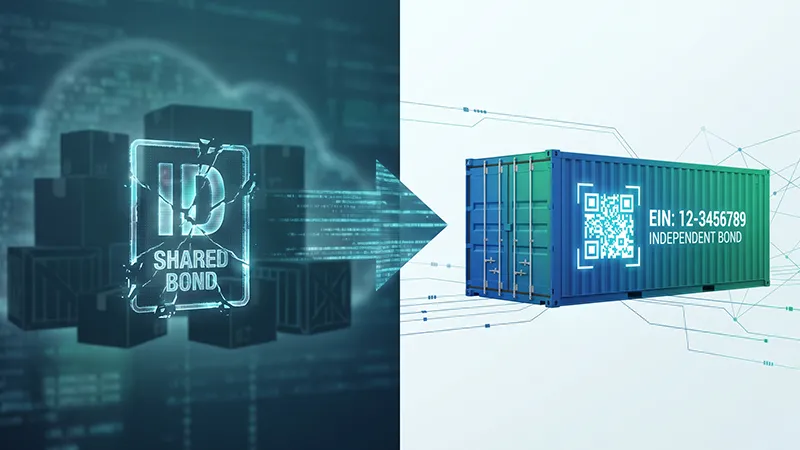
CBP enforcement shifted radically recently. The agency is actively invalidating non-compliant Importers of Record and purging the system of bad data.
The End of Shared Bonds
For years, offshore ecommerce sellers utilized "shared bonds." A freight forwarder would use their own continuous bond to clear hundreds of shipments for different clients. In 2026, CBP targeted specific surety codes handling these bulk clearances. The agency canceled thousands of shared forwarder bonds.
Borrowing a logistics provider's compliance credentials now results in immediate cargo holds. The bond on file must sit in your company's legal name, tied directly to your specific EIN. If the commercial invoice says Company A, but the bond belongs to Forwarder B, CBP rejects the entry.
The SAFE Act Implications
Legislative changes are accelerating this enforcement. Provisions under the proposed SAFE Act aim to double the minimum continuous bond floor from $50,000 to $100,000. More critically, the framework demands the Importer of Record be a US citizen, a permanent resident, or a corporation maintaining a verified physical US office. Setting up a legitimate US LLC, acquiring an IRS EIN, and securing an independent bond is the only long-term strategy for offshore sellers accessing the US market.
Frequently Asked Questions
When is a customs bond required?
A customs bond is mandatory for commercial imports exceeding $2,500. It is also required for highly regulated goods controlled by agencies like the FDA, EPA, or ATF, regardless of the total commercial value.
What is the minimum continuous customs bond amount?
The absolute floor allowed by CBP is $50,000. Above that threshold, CBP demands the bond face value equal at least 10 percent of all duties, taxes, and fees paid during the previous 12 months. It must be rounded up to the nearest $10,000.
Can a freight forwarder get a customs bond for me?
A broker or forwarder can execute the application on your behalf. They act as the filing agent. However, the bond itself must be registered precisely to your legal entity name and your EIN. Relying on shared forwarder bonds violates strict 2026 enforcement standards.
How long does a continuous customs bond last?
A continuous customs bond covers a rolling 12-month period from its effective date. It must be renewed and paid annually to maintain active importing privileges across all US ports.
What happens if my customs bond is cancelled?
CBP immediately flags your Importer of Record number. All future entries stall. Any arriving cargo halts at the port and accrues daily demurrage fees until a valid replacement bond is underwritten and verified in the ACE system


