FBA Shipping Labels: Carton, Pallet & Shipment ID Guide for Importers
Correct labeling is the invisible bridge between your products in China and Amazon's fulfillment centers around the world. Amazon has continued to tighten its inbound label requirements and accuracy now directly affects check-in speed, inventory visibility, and account performance.
As an Amazon SPN certified freight forwarder and registered ShipTrack carrier, we at Zbao Logistics help sellers manage every stage of FBA label creation, printing, and verification before export. This guide covers every label type, placement rule, and common mistake you need to know for shipping FBA from China.
Why FBA Labels Matter
Every Amazon FBA box label serves three essential purposes: identification, tracking, and compliance. A single barcode error can delay your shipment for days or cause an entire pallet to be rejected at the fulfillment center. Amazon's receiving team scans every inbound carton, and any unreadable barcode triggers a manual inspection that slows down your entire shipment.
We process hundreds of FBA shipping labels weekly at our Shenzhen and Ningbo warehouses, so every carton and pallet arrives scannable and compliant. By managing labeling at origin, you avoid costly rework and Amazon penalties. See our FBA shipping solutions from China for the full service overview.
Types of Amazon FBA Labels
| Label Type | Purpose | When to Use | Who Applies It |
|---|---|---|---|
| Carton Label | Identifies each shipping box | Every inbound shipment (mandatory) | Supplier or freight forwarder |
| Pallet Label | Identifies each pallet | LTL/FTL only (not needed for SPD) | Freight forwarder |
| Shipment ID Label | Links box to the inbound shipment plan | Every shipment (generated in Seller Central) | Seller or forwarder |
| Carrier Label | Used by UPS/FedEx for transit tracking | Provided automatically by carrier | Carrier system |
| Internal Transit Label | Optional for 3PL or bonded transfers | Only for multi-leg shipments | Forwarder (China origin) |
Among these, the Shipment ID and carrier labels are the most critical for a smooth FBA check-in process. Every carton must have both labels applied side by side, scannable and unobstructed.
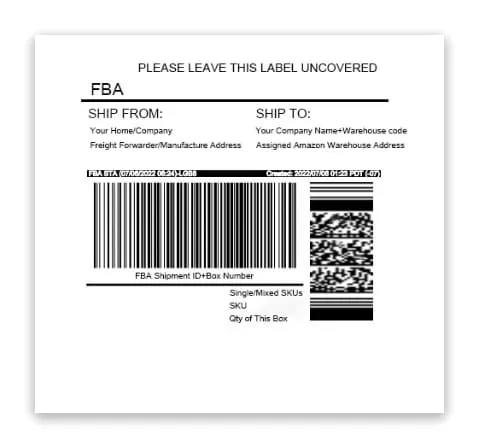
FBA Shipment Label: Key Details
Each FBA shipment label contains multiple sections that Amazon's receiving system scans upon arrival. Understanding each element helps you catch errors before the shipment leaves your supplier's factory.
- Box Number and Weight - Shows the sequence number (e.g., "Box 1 of 4") and the individual box weight.
- Ship-From - Supplier or factory address in China. Must match the origin address in your shipment plan.
- Ship-To - Amazon fulfillment center address, auto-generated by Seller Central based on placement optimization.
- Amazon Barcode and QR Code - Unique scan ID for each box. This is what Amazon's receiving scanners read.
- Quantity and SKU - Marks whether the box contains single or mixed SKUs. Mixed SKU boxes require additional documentation.
- Handling Note - Instructions such as "Leave this label uncovered" or "Do not stack."
When printed correctly, these labels support smooth receiving and traceability across Amazon's fulfillment network. Any misprint or damaged barcode at this level can break the entire tracking chain.
Label Printing and Placement Requirements
Size and Resolution
- Standard size: 4 x 6 inches (10 x 15 cm). Other sizes risk scan failure.
- Resolution: 300 DPI minimum. Lower resolution produces blurry barcodes that scanners cannot read reliably.
- Print black on white, no colors or glossy finishes. Amazon's scanners are calibrated for high-contrast black-and-white labels.
- Use thermal or laser printers for consistent clarity. Inkjet printers produce smudged barcodes that fail scan tests.
Paper and Adhesive
- Use non-reflective thermal transfer paper. Glossy or reflective paper causes scanner glare.
- Adhesive must stick firmly under varying temperatures but remove cleanly without leaving residue on the carton.
Placement
- Apply on a flat surface, at least 0.3 inches (8 mm) from edges and corners.
- Never cover barcodes with tape, shrink-wrap, or stretch film. The scanner cannot read through these materials.
- For reused cartons, fully cover or remove old labels. Any visible old barcode can cause Amazon's system to read the wrong identifier.
When shipping from China, we handle all FBA label generation and verification before dispatch to confirm Amazon-ready compliance. For official Amazon specifications, refer to Amazon's FBA labeling requirements on Seller Central.
SPD vs LTL Label Rules
| Shipment Mode | Labels per Box | Pallet Labels | Notes |
|---|---|---|---|
| SPD (Small Parcel) | 1 | None | Typical for UPS/FedEx shipments |
| LTL (Less-Than-Truckload) | 2 on adjacent sides | 4 | Mandatory for palletized cargo |
| FTL (Full Truckload) | 2 | 4 | Add "mixed SKU" sticker if needed |
The most common mistake with LTL shipments is applying only one label per box. Amazon requires labels on two adjacent sides because boxes shift during transit and a label on one side may become inaccessible. For pallet requirements including stacking and size limits, read our FBA pallet requirements guide.
Common FBA Labeling Mistakes
- Label printed on tape. When you print a label directly onto adhesive tape, the scanner cannot read the barcode through the tape layer.
- Inkjet printing. Inkjet barcodes smudge easily, especially in humid warehouse conditions. Always use thermal or laser printers.
- Only one label per LTL box. Amazon requires two labels on adjacent sides for all LTL/FTL shipments. A single label will be flagged at receiving.
- Mixed SKUs without mapping. If a box contains multiple SKUs, the label must reflect this. Amazon receiving needs to know what is inside each carton.
- Uncovered old labels on reused cartons. Any visible old barcode confuses Amazon's scan system. Cover or remove every old label completely.
Our three-step quality control:
- Pre-print check: verify SKUs, Shipment ID, and carton count against the shipment plan.
- Post-print QA: 300 DPI scan test plus photo record of every label.
- Final inspection: LTL dual-side check plus pallet labels audit before loading.
FBA Carrier Label vs Shipment Label
| Feature | Carrier Label | FBA Shipment Label |
|---|---|---|
| Purpose | Transit and tracking | Amazon receiving identification |
| Includes | Shipper/consignee, tracking number, service level | Shipment ID, warehouse address, barcode |
| HS Code / Value | No | No |
| Issued by | Carrier system (UPS, FedEx, LTL) | Amazon Seller Central |
Both labels are applied side by side on each box for faster scanning and check-in. The carrier label gets the box through transit; the FBA shipment label gets it into Amazon's inventory system. Missing either one stops the process at a different point.
Regional Labeling Requirements
- USA and Canada: Use imperial units. LTL appointments are mandatory. Amazon requires 2 labels per box on adjacent sides for all palletized shipments.
- UK and EU: Use metric units. Mixed pallet labels are required for pallets containing multiple SKUs. Amazon's European fulfillment network has stricter mixed-SKU documentation rules.
- Asia-Pacific: Manual receiving is common at some locations. Use high barcode contrast and durable label adhesive for longer transit times in humid conditions.
Check your destination warehouse in our Amazon FBA warehouse locator for region-specific receiving requirements.
Step-by-Step Labeling Checklist
- Create shipment plan in Seller Central. Confirm the Shipment ID before generating labels.
- Download carton labels and pallet labels from the shipment plan.
- Confirm SKU-to-carton mapping. Each carton label must match the correct SKU and quantity.
- Print at 300 DPI, 4 x 6 inches, black on white thermal or laser paper.
- Apply labels on two adjacent sides of each carton (required for all LTL/FTL).
- Add pallet labels to all four sides of each pallet.
- Photograph each labeled carton and pallet for your records. This documentation helps resolve any receiving disputes.
- Ship through your Amazon FBA forwarder for final QA and booking.
How We Handle FBA Labeling in China
At Zbao Logistics, we manage full-scope FBA label service from data generation to on-site application. Here is how it works:
- Coordinate with your supplier to collect SKU data and carton counts.
- Generate Shipment IDs in Seller Central based on the confirmed shipment plan.
- Print industrial-grade thermal labels at 300 DPI at our Shenzhen and Ningbo warehouses.
- Apply carton and pallet labels at our consolidation facilities, not at the factory.
- Photograph and archive every labeled carton for traceability.
- Verify barcodes with a handheld scanner before loading the container.
This forms part of our integrated DDP to Amazon FBA service, covering labeling, customs clearance, and door-to-door delivery to FBA centers in the USA, Canada, and Europe. Read our DDP shipping from China to Amazon FBA guide for the full process.
Labeling Options: Who Should Handle It?
| Method | Who Applies | Pros | Cons |
|---|---|---|---|
| Freight Forwarder (Zbao) | Our team in China | 100% compliance plus photo proof | Slightly higher service fee |
| Supplier | Factory labels before pickup | Cost effective for small batches | Higher error risk, no QA process |
| Self-labeling | Seller handles in own warehouse | Full custom control | Time and equipment cost |
We recommend completing labeling at origin with a freight forwarder who has FBA experience. The cost difference is small compared to the cost of a rejected shipment at Amazon receiving.
The Future of FBA Labeling: eLabels and Automation
Amazon is moving toward digital labeling and API-connected automation. Our team already supports electronic FBA labels (eLabels) for eligible programs, reducing paper use and scan errors. The World Shipping Council is promoting standardized paperless trade globally, and Amazon's eLabel initiative aligns with this direction. We help sellers transition smoothly to these new systems as they become available.
Frequently Asked Questions
How many labels do I need per carton?
SPD shipments need 1 label per box. LTL shipments need 2 labels on adjacent sides. Each pallet needs 4 pallet labels, one on each side.
What is the standard FBA label size?
4 x 6 inches (10 x 15 cm). Other sizes risk scan failure at Amazon receiving. Minimum resolution is 300 DPI.
Can a freight forwarder print FBA labels in China?
Yes. A freight forwarder with FBA experience can generate and print labels before export, cutting rejection risk at the fulfillment center.
What happens if I use the wrong Shipment ID?
Amazon may delay or refuse check-in until the carton is relabeled with the correct Shipment ID. This can result in unplanned storage fees and delayed inventory activation.
Do carrier labels show HS codes?
No. HS codes belong on commercial invoices, not on carrier labels. Carrier labels contain tracking information, shipper and consignee details, and service level data.
What is the difference between an FBA shipment label and a carrier label?
The FBA shipment label is generated by Amazon Seller Central and contains the Shipment ID and fulfillment center address for receiving. The carrier label is issued by UPS, FedEx, or the LTL provider and contains tracking information for transit. Both labels are applied side by side on each box.
Ready to Ship FBA from China?
Precision in FBA shipping labels is essential for fast, problem-free receiving. With Zbao Logistics, you can ship from China with confidence knowing every carton, pallet, and Shipment ID is fully Amazon-compliant. We are an official Amazon SPN service provider and registered Amazon ShipTrack carrier, offering door-to-door DDP shipping and label management from China to the USA, Canada, and Europe.


