Freight Forwarder vs. Freight Broker: What’s the Difference & Why It Matters for China Imports
For businesses importing from China to the USA—whether you are an Amazon FBA seller or a B2B distributor—the supply chain is your lifeline. However, a common confusion we see among our clients involves the distinction between a freight forwarder and a freight broker.
While the terms are often used interchangeably, the legal realities and operational capabilities are fundamentally different. Choosing the wrong partner isn't just a matter of price; it’s a matter of liability.
At Zbao Logistics, we believe in total transparency. This guide analyzes the technical differences, legal liabilities, and operational scopes to help you make the safest decision for your business.
What is a Freight Broker? (The Intermediary)
A freight broker acts strictly as an intermediary between a shipper (you) and a carrier (the trucking company).
Regulated by the Federal Motor Carrier Safety Administration (FMCSA), their primary function is to connect demand with supply. They do not take possession of your goods, and critically, they often do not assume legal liability for cargo loss or damage.
Key Characteristic: Brokers are highly effective for domestic US trucking (LTL/FTL). They excel at finding available truck space quickly within the mainland but often lack the infrastructure for international cross-border trade.
What is a Freight Forwarder? (The Architect)
A freight forwarder is a supply chain architect responsible for the end-to-end movement of goods. Unlike brokers, legitimate international forwarders—specifically those designated as NVOCCs (Non-Vessel Operating Common Carriers)—assume a much higher level of responsibility.
When we handle a shipment as a freight forwarder, we issue a House Bill of Lading (HBL). This document is crucial because it signifies that we accept carrier liability for your cargo from the factory floor in China to your warehouse door in the US.
In the context of China to USA shipping, a forwarder handles:
-
Export customs declarations in China.
-
Ocean or Air freight booking.
-
US Customs clearance (ISF Filing, Duty payments).
-
Last-mile delivery coordination.
Freight Forwarder vs. Broker: The Structural Differences
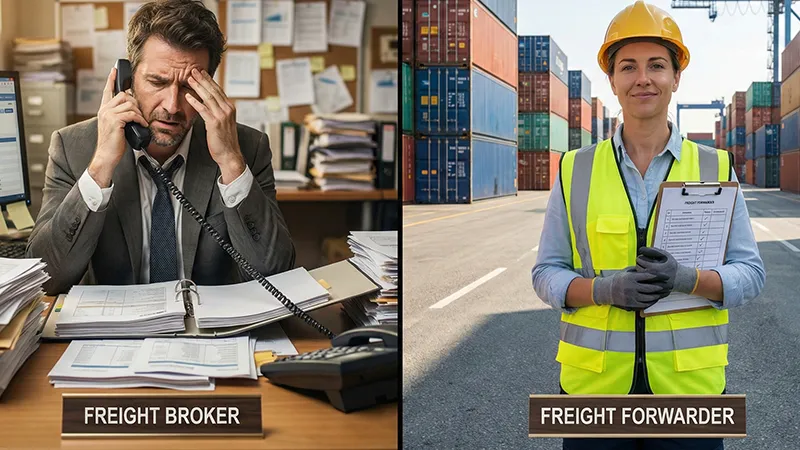
To make an informed decision, you need to look beyond the price quote. The table below outlines the structural differences that impact your risk profile.
| Feature | Freight Broker | Freight Forwarder (NVOCC) |
| Primary Scope | Domestic US Trucking (Point A to B) | International (Door-to-Door), Ocean & Air |
| Legal Liability | Low. Facilitator only. No Bill of Lading issued. | High. Issues House Bill of Lading; assumes carrier liability. |
| Customs Clearance | Rarely handles customs directly. | Integrates Customs Brokerage & Bond management. |
| Amazon FBA | Limited knowledge of FBA labeling/appointments. | Specialized in DDP, FNSKU labeling, and Amazon slots. |
| Risk Control | Reactive. Depends on the carrier's insurance. | Proactive. Covered by Cargo Liability Insurance. |
Why "China to USA" Importers Face Higher Risks with Brokers
For China–US imports, using a freight broker as the primary logistics partner is not just inefficient — in many cases, it is structurally risky.
While brokers serve a vital role in domestic logistics, relying on them for international ocean freight creates a "liability vacuum" that most importers only discover when something goes wrong.
1. The "Cost of Mistake": Exams and Demurrage

A domestic broker typically lacks the capability to file the Importer Security Filing (ISF) directly. They must outsource this to a third party. This fragmentation creates dangerous communication gaps.
Our Experience:
In the past 12 months, we have rescued multiple China–US shipments where ISF filings were delayed because the broker outsourced the compliance work.
-
The Consequence: These shipments were flagged for CBP Exams.
-
The Cost: Beyond the exam fee, the cargo sat at the port incurring demurrage charges ranging from $200 to $400 per container, per day.
-
The Result: A "cheaper" broker quote ended up costing the client $3,000+ in avoidable fees.
By keeping [See: Customs Clearance Services] in-house, a dedicated forwarder eliminates these hand-off errors.
2. The Liability Gap (HBL vs. MBL)
A freight broker typically carries a surety bond of only $75,000. If a container is lost at sea, the broker is often not legally liable because they never issued a Bill of Lading. You are left to chase the steamship line directly.
According to Federal Maritime Commission (FMC) regulations, only licensed NVOCCs are permitted to issue House Bills of Lading, which serve as the legal contract of carriage and liability assumption. (See: FMC OTI & NVOCC Guidelines).
In contrast, as an NVOCC, we issue a House Bill of Lading (HBL). This legal document proves that we are the carrier of record. It bridges the gap between the [See: Master Bill of Lading] issued by the shipping line and your cargo, ensuring you have a direct party to claim against in the event of loss.
3. Amazon FBA Rejection Risks
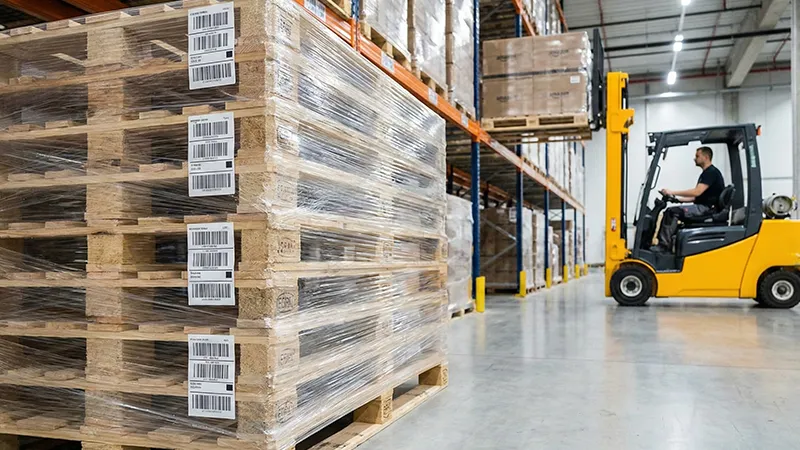
For Amazon sellers, the stakes are even higher. Amazon Fulfillment Centers do not accept "collect" shipments.
If a broker arranges a delivery without understanding Amazon's strict palletizing standards (ISO 18333) or labeling requirements, the shipment will be rejected at the dock.
-
The Pain: You must pay for the truck to return the goods, pay a warehouse to rework the pallets, and pay for redelivery.
-
The Cost: This error typically costs $500 to $1,500 per shipment, not including the loss of sales ranking due to stockouts.
We act as a specialized [See: Amazon FBA Freight Forwarder], validating your FNSKU labels and pallet height before the cargo even leaves China.
Decision Guide: When to Choose Which?
We recommend assessing your business needs based on the following criteria:
Choose a Freight Broker If:
-
Your cargo is already cleared through customs and sitting at a US port.
-
You only need domestic trucking (e.g., California to Texas).
-
You are comfortable managing your own cargo insurance separately.
Choose a Freight Forwarder (Zbao Logistics) If:
-
You are importing directly from a factory in China.
-
You need a [See: DDP Shipping] solution where one party handles duties and delivery.
-
You are an Amazon FBA seller requiring strict compliance to avoid rejection.
-
You need a partner who takes legal responsibility for the cargo from origin to destination.
Conclusion
For importers moving goods worth tens or hundreds of thousands of dollars, logistics is not a place for role ambiguity.
The choice between a freight forwarder and a broker is not just about cost—it is about control and liability. For domestic US moves, brokers are efficient. But for the complex journey from China to the USA, the risks of using an unlicensed intermediary—ranging from customs holds to total liability gaps—are simply too high for a serious business.
If you are importing from China and need one party to take legal responsibility from the factory floor to final delivery, let's talk.
FAQ: Common Questions on Forwarders vs. Brokers
1. Can a freight broker handle international shipping from China?
Technically, they can try, but it is risky. Brokers lack the NVOCC license required to issue Bills of Lading for ocean freight, meaning they cannot assume carrier liability. They must also outsource customs clearance, which increases the risk of communication errors and delays.
2. Is an NVOCC required for ocean freight?
Yes, if you want a single party to handle your shipment and assume liability. An NVOCC (Non-Vessel Operating Common Carrier) is a licensed freight forwarder authorized by the FMC to issue its own bills of lading and enter into contracts with steamship lines, providing end-to-end legal protection.
3. Is a freight forwarder legally liable for cargo loss?
Yes, if they act as the carrier (NVOCC) and issue a House Bill of Lading. In this scenario, the forwarder is your legal carrier and is liable for the cargo's safety. A broker, by comparison, is generally not liable for cargo loss.
4. Do I need a forwarder for DDP shipments to Amazon FBA?
Yes. Amazon requires shipments to be Delivered Duty Paid (DDP). Most brokers cannot handle the prepayment of duties or act as the Importer of Record's agent. A specialized freight forwarder can manage the entire DDP process, ensuring duties are paid before delivery to avoid rejection.


