Why Are Shipping Rates Going Up in 2026? The Oil Price Crisis Every China Importer Must Understand
From Brent crude at $104 per barrel to a $400 Emergency Bunker Surcharge landing on your next shipment, here's the complete breakdown, and 4 moves you can make right now.
If you're importing goods from China and your latest freight quote looks significantly higher than last quarter, you're not imagining it. Shipping rates going up in 2026 is the direct result of a perfect storm: a geopolitical crisis near the Strait of Hormuz, a surge in crude oil prices that crossed $100 per barrel in early March, and a wave of Emergency Bunker Surcharges now being rolled out by every major carrier on the planet.
This isn't a temporary blip. Maersk, MSC, CMA CGM, and Hapag-Lloyd have all announced mandatory surcharges taking effect between March 23 and April 9, 2026. For Amazon FBA sellers and B2B importers who source from China, these charges will appear on your next invoice whether you're ready for them or not.
This guide explains exactly what is happening, why it's happening, and most importantly, what practical steps you can take today even if you don't have the volume to negotiate a direct carrier contract.
The Trigger: What Is Happening With Oil Prices Right Now?
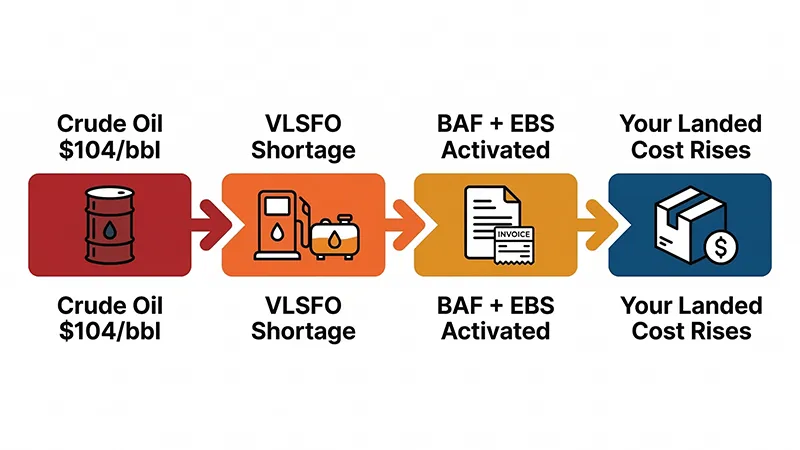
As of March 16, 2026, Brent crude oil is trading at $104.59 per barrel up from approximately $63 per barrel in early January 2026. That is a rise of over 65% in less than three months, and the primary cause is a sharp escalation of conflict in the Middle East affecting the Strait of Hormuz.
The Strait of Hormuz is the world's single most critical energy chokepoint. Approximately 20% of the global oil supply passes through this 33-kilometer-wide passage every day. When the strait faces disruption, as it has since late February 2026, the entire downstream fuel supply chain for the shipping industry begins to seize up.
As a direct consequence, daily hire rates for Very Large Crude Carriers (VLCCs) on the Middle East–to–Asia route surged to $423,736 per day up from roughly $130,000 just months prior. This capacity crunch in the energy tanker market cascades directly into container shipping costs.
How Oil Prices Directly Drive Up Your Freight Bill
The Bunker Adjustment Factor (BAF): What You Are Actually Paying For
Every ocean freight quote you receive already includes a Bunker Adjustment Factor (BAF) a fuel surcharge that carriers revise quarterly based on the average price of Very Low Sulfur Fuel Oil (VLSFO), the marine fuel that powers container vessels.
The standard BAF formula used by carriers is:
Using Maersk's official Q1 2026 reference price of $461.54/MT for VLSFO, and a modern Ultra Large Container Vessel (ULCV) burning 320 metric tons of fuel per day over a 12.6-day Shanghai–Los Angeles voyage:
→ Base BAF: $88.70 per TEU (20') | $177 per FEU (40')
Here is the number every importer should bookmark: for every $10 increase in the price of Brent crude oil, your BAF cost rises by approximately $14 per TEU or $28 per FEU on transpacific routes. From January's $63 baseline to today's $104.59, that translates to roughly +$57 per TEU in BAF increases alone before any emergency surcharges.
The $400 Problem: What Is an Emergency Bunker Surcharge (EBS)?
When the standard BAF mechanism can no longer absorb the speed or severity of fuel cost spikes, carriers activate an Emergency Bunker Surcharge (EBS). This is a separate, additional charge layered on top of the regular BAF and it is not a mechanism most importers have encountered before 2026.
| Carrier | Effective Date | 20' TEU | 40' FEU | Review Frequency |
|---|---|---|---|---|
| Maersk (Global) | March 25, 2026 | $200 | $400 | Every 14 days |
| MSC — Asia to US West Coast | April 9, 2026 | $136 | $272 | TBD |
| MSC — Asia to US East Coast | April 9, 2026 | $215 | $430 | TBD |
| CMA CGM | March 23, 2026 | TBC | TBC | TBD |
| Swire Shipping | March 24, 2026 | Applicable to all container types | TBD | |
The Full Picture: What Is Actually Inside Your All-In Freight Rate?
Most small and mid-size importers receive a single "all-in" rate from their freight forwarder. What many do not realize is that this number bundles at least four distinct fuel-related charges, some of which are not labeled as fuel costs at all.
| Layer | Charge Name | Per TEU (20') | Per FEU (40') | Visibility on Invoice |
|---|---|---|---|---|
| 1 | BAF — Base Bunker Adjustment | ~$89 | ~$177 | Usually listed |
| 2 | LSS — Low Sulphur Surcharge (ECA zones) | ~$5 | ~$9 | Often merged into BAF |
| 3 | EBS — Emergency Bunker Surcharge | $200 | $400 | Separate line (from March 25) |
| 4 | GRI — General Rate Increase | ~$60 est. | ~$120 est. | Not labeled as fuel cost |
| Approximate Total | ~$354 | ~$706 | — | |
The Low Sulphur Surcharge (LSS) reflects the price difference between standard VLSFO and the ultra-low-sulfur fuel ships must use when entering Emission Control Areas near US and European ports. Based on Maersk's Q1 2026 published rates, this spread is $243.20 per metric ton ($704.74 LSMGO minus $461.54 VLSFO). The General Rate Increase (GRI), while not explicitly labeled as a fuel charge, is partially used by carriers to recover energy costs that surcharges do not fully cover. Hapag-Lloyd, for example, announced a GRI of $2,000 per container from Asia to the USA in Q1 2026.
The Amazon FBA Seller's Double Hit: Your Margins Are Being Squeezed From Both Sides
If you sell on Amazon and source your products from China, 2026 is delivering a margin squeeze from two directions simultaneously.
Hit #1 Amazon's own fee increases: Amazon raised FBA fulfillment fees in 2026, adding approximately $0.08 per unit to standard-size products. AWD (Amazon Warehousing and Distribution) transportation costs on the West Coast increased by 21.7%, and storage fees in AWD West rose by 18.8%.
Hit #2 Emergency Bunker Surcharge on your inbound shipment: The Maersk EBS adds $400 to every 40-foot container you ship from China. For a seller importing 500 units per container, that translates to an additional $0.80 per unit in inbound shipping cost.
Product: average selling price $25 | Previous net margin: ~12% (~$3.00/unit)
FBA fee increase: +$0.08/unit
EBS impact: +$0.80/unit (based on 500 units per 40' container)
Total cost increase: ~$0.88–$1.20 per unit
Revised net margin (without price adjustment): ~8.5% or below
The sellers who protect their margins in this environment are the ones who recalculate their Landed Cost now and adjust their pricing or sourcing strategy before their next reorder, not after they receive the invoice.
You Can't Control Oil Prices. But Here Are 4 Things You Can Control Right Now
Most of the advice you'll read about managing freight costs assumes you have the volume to negotiate directly with Maersk or MSC. Most Amazon FBA sellers, e-commerce importers, and small B2B buyers don't. Here are four strategies that work regardless of your shipment volume.
① Book 4–6 Weeks Early to Get Ahead of Surcharge Effective Dates
Emergency surcharges are applied based on the vessel departure date, not the booking date. MSC's Emergency Fuel Surcharge does not take effect until April 9, 2026. If you book your shipment today for departure before that date, you may be able to avoid that specific surcharge entirely depending on your freight forwarder's rate validity window.
Working with a licensed NVOCC (Non-Vessel Operating Common Carrier) gives you a key advantage here: NVOCCs hold pre-negotiated block space agreements with carriers and can often offer rate validity of 7–14 days, compared to 24–48 hours on direct carrier spot quotes. Speak to our team about locking in your next shipment before surcharges take effect →
② Switch From FCL to LCL (Less-Than-Container-Load) for Smaller Shipments
The Emergency Bunker Surcharge is charged per container, not per cubic meter or per kilogram. If your cargo does not fill a full 40-foot container, consolidating your goods into a shared container (LCL) means you pay a proportional share of the surcharge based on your CBM (cubic meter) volume not the full $400.
LCL is most cost-effective when your shipment is under approximately 15 CBM. Above that threshold, FCL typically becomes the better value. Keep in mind that LCL adds 3–5 days to your transit time due to consolidation and deconsolidation handling, so plan your inventory timeline accordingly.
③ Switch Your Purchase Terms From EXW to FOB
Many small importers buy from Chinese suppliers on EXW (Ex-Works) terms, which means the supplier arranges and pays for everything from the factory to the port and then bills you. In practice, this means your supplier's freight agent is making all the logistics decisions, and you have no visibility into what surcharges are being applied or at what rate.
Switching to FOB (Free On Board) puts you in control of the ocean freight. You choose the freight forwarder, you receive the quotes directly, and you can shop across multiple providers to find the most competitive rate and surcharge structure. In a market where EBS rates vary significantly between carriers (Maersk $400/FEU vs. MSC West Coast $272/FEU), this control can represent hundreds of dollars in savings per shipment.
④ Recalculate Your Landed Cost Before Your Next Purchase Order
Your Landed Cost is the true total cost of getting one unit of product to your warehouse or Amazon fulfillment center. It includes product cost, freight, customs duties, destination charges, and FBA fees. Every one of these components has increased in 2026.
Before you issue your next purchase order to your China supplier, run a fresh Landed Cost calculation using current freight quotes including the EBS. If your current retail price no longer supports your minimum required margin after this exercise, you have three options: negotiate a lower product cost with your supplier, raise your retail price, or delay the order until market conditions improve.
The sellers who do this analysis before ordering will protect their margins. Those who skip this step will discover the problem when the invoice arrives.
How Long Will This Last? What to Expect in Q2 2026
The honest answer is that the duration of this disruption depends on factors outside anyone's direct control primarily the geopolitical situation around the Strait of Hormuz. However, the market structure gives us some reference points.
S&P Global's 2026 Ocean Freight Outlook, published in February 2026, anticipated a softer rate environment for the year before the March escalation. The current situation has materially changed that baseline. Container spot rates on the Shanghai–Los Angeles lane rose 26% to $3,132 per 40-foot container, and Shanghai–New York rose 20% to $3,957 per 40-foot container in the weeks preceding this report.
War risk insurance premiums for vessels transiting the Strait of Hormuz have risen from a pre-crisis baseline of approximately 0.025% of hull value per week to 1.0% per week as of early March 2026, with some insurers issuing cancellation notices and requiring individual policy renewals for Gulf-region voyages. These elevated insurance costs flow directly into the freight rates shippers pay.
The key variable to watch is Maersk's 14-day EBS review cycle. If the Strait of Hormuz situation stabilizes and VLSFO supply begins to normalize, the EBS could be reduced at the first or second review window potentially as early as mid-April 2026. If tensions escalate further, the surcharge is more likely to increase than decrease.
Stop Guessing What You're Paying in Surcharges
Our China-to-USA logistics team monitors carrier surcharge announcements daily and builds accurate, itemized freight quotes so you always know exactly what you're paying and why.
Get a Free Freight Quote Within 24 Hours → Download our free 2026 BAF & Surcharge Tracking Sheet