Shipping Container Dimensions & Everything You Need to Know
In global trade, the shipping container is the quiet hero. It is the standardized unit that keeps the world economy moving. But for importers, Amazon FBA sellers, and supply chain managers in 2026, choosing the wrong box size is a reliable way to burn profit.
Most importers look at a standard ISO table, see that a 40ft High Cube holds 76.3 CBM, and plan their shipment accordingly.
This is a critical mistake.
If you try to load 76 CBM of cargo, you will likely fail. Real-world loading efficiency, pallet gaps, US road weight limits (DOT regulations), and Amazon FBA strictness mean the usable capacity is much lower than the theoretical capacity. Furthermore, with the 2026 equipment shortages caused by the Red Sea diversions, simply getting the right container is now a strategic challenge.
This guide is not a generic spec sheet. It is a compilation of the field data Zbao Logistics uses daily to help importers avoid "Overweight Fines" and "Rejected Deliveries."
🎯 Who is this guide for?
This guide is specifically written for US and EU importers who need to calculate precise landed costs, avoid "Overweight" fines, and optimize load plans for Amazon FBA.
⚡ Quick Cheat Sheet: Paper vs. Reality (Jan 2026)
Start here. This table reflects legal US road limits and real-world palletization, not theoretical maximums.
| Container Type | Paper Volume (ISO) | Real Usable Volume | Max Payload (US Road Limit) | Door Height (Critical) |
| 20ft Standard (GP) | 33.2 CBM | 28 CBM (Palletized: ~25) | 38,000 lbs (17,236 kg) | 2.28 m (7' 6") |
| 40ft Standard (GP) | 67.7 CBM | 58 CBM (Palletized: ~55) | 44,000 lbs (19,958 kg) | 2.28 m (7' 6") |
| 40ft High Cube (HC) | 76.3 CBM | 68 CBM (Palletized: ~65) | 44,000 lbs (19,958 kg) | 2.58 m (8' 5") |
| 45ft High Cube | 86.0 CBM | 78 CBM | 44,000 lbs (19,958 kg) | 2.58 m (8' 5") |
🛠️ Need to simulate your specific load?
Calculating CBM is easy; calculating legal weight distribution is hard.
1. The "Overweight Trap": Avoid the $1,500 Fine
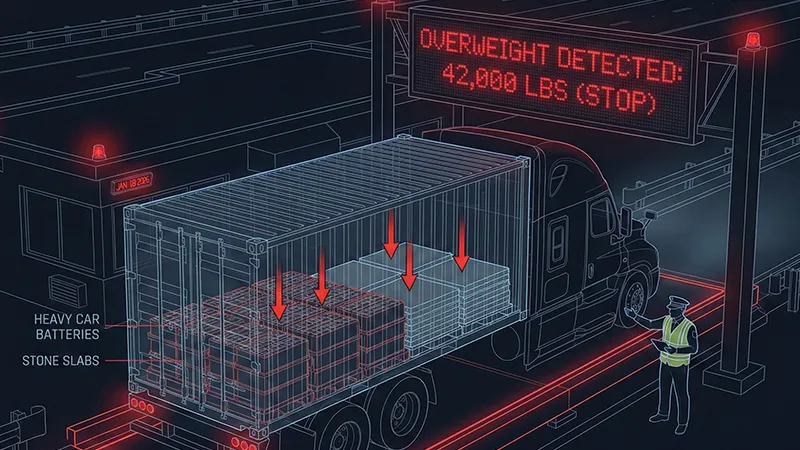
This is the most common mistake we encounter in 2026.
While ocean carriers allow up to 30 tons, the US Department of Transportation (DOT) enforces strict limits on US highways.
Field Experience Note:
In Q4 2025 alone, Zbao Logistics flagged 27 shipments that exceeded US road limits before they left China. Had these containers arrived in Long Beach overweight, the "Transloading Fees" would have cost our clients over $40,000 combined.
The Math of Getting Fined (US Road Limits)
In the US, the Federal Gross Vehicle Weight limit is 80,000 lbs (approx. 36,287 kg). This limit includes everything: the truck tractor, the chassis, the empty container, and your cargo.
-
Tractor Weight: ~17,000 lbs
-
Chassis Weight: ~7,000 lbs
-
Empty Container: ~8,500 lbs
-
Fuel & Driver: ~1,000 lbs
-
Remaining for Cargo: ~46,500 lbs (Theoretical Max)
However, due to "Bridge Formula" laws (weight distribution per axle), the safe limit is lower.
The Zbao Safe Loading Limits (No Permits):
-
20ft Container: 38,000 lbs (17.2 MT).
-
Solution: If you need to load more (up to 44,000 lbs), you must request a "Tri-axle Chassis" (a special chassis with 3 axles to spread weight). This costs extra and is in short supply.
-
-
40ft / 40HC: 44,000 lbs (19.9 MT).
-
Exceeding this? You will face "Transloading Fees". Your container will be trucked to a nearby warehouse, stripped, and the cargo split into two separate trucks. This nightmare costs $1,500+ and delays delivery by 3-5 days.
🛡️ Zbao Compliance Check
Shipping heavy goods like stone or liquids? We can check if you need a Tri-axle Chassis permit.
2. Amazon FBA Strategy: The "Pallet Illusion"
A standard 40HQ theoretically fits 25 Euro-pallets. But Amazon FBA doesn't accept Euro-pallets, and they don't accept "tight packing."
The 2026 FBA Rules
-
Pallet Type: Must use 40" x 48" GMA Standard Pallets.
-
Max Height: 72 inches (1.8m) strict limit.
-
Loading Pattern: Amazon requires clearance for forklifts. You cannot jam them wall-to-wall.
Floor Loading vs. Palletized: The Trade-off
| Method | Capacity (40HQ) | Pros | Cons |
| Floor Loading | ~65-68 CBM | Fits 30% more cargo. Cheapest ocean cost per unit. | Rejected by Amazon. High labor cost to unload at 3PL ($500+). Higher damage risk. |
| Palletized | ~55-58 CBM | Fast unloading (30 mins). Compliant with FBA. Lower damage. | Wasted space (air gaps). Higher cost per unit. |
The "Pinwheel" Solution (Zbao Exclusive)
To get the best of both worlds, we use a "Pinwheel" loading pattern for standard 40"x48" pallets. By rotating pallets (some lengthwise, some widthwise), we can optimize the fit.
-
20ft Container: Fits 10 Pallets (1 row of 10).
-
40ft / 40HC: Fits 21 - 22 Pallets (Pinwheeled).
Zbao Insider Tip: Always use 40ft High Cubes for FBA. The extra height allows you to maximize the 72" pallet height constraint without hitting the container roof.
📦 Amazon FBA Prep Service
We provide Origin Palletization in China to ensure 100% FBA acceptance upon arrival.
3. The "Big Three": Detailed Dimensions & Use Cases
While ISO 668 standards define dozens of container types, 95% of general cargo moves in these three specific units. Understanding the nuance between them can save you 15-20% in freight costs.
A. 20ft Standard Container (20GP)
The "Twenty-foot Equivalent Unit" (TEU) is the industry standard for volume measurement, but it is often the most expensive option per CBM for light goods.
-
Internal Dimensions: 5.90m (L) x 2.35m (W) x 2.39m (H)
-
Best For: Dense, Heavy Cargo.
-
Examples: Stone slabs, metal parts, liquids (in Flexitanks), EV batteries, ceramic tiles.
-
-
The 2026 Strategy: Because ocean freight is charged "per box," shipping light goods (like pillows or toys) in a 20ft container is financially inefficient. Only use 20GPs when you will hit the weight limit long before you fill the volume.
B. 40ft Standard Container (40GP)
The 40GP is becoming less common for general cargo as the price difference between 40GP and 40HQ narrows.
-
Internal Dimensions: 12.03m (L) x 2.35m (W) x 2.39m (H)
-
Best For: Goods that are voluminous but constrained by specific warehouse racking heights, or when 40HCs are unavailable.
-
Zbao Insight: Many older warehouses in the US have loading docks designed for standard height containers. Check your receiver's dock specs before switching to High Cubes.
C. 40ft High Cube Container (40HQ)
The "King of E-commerce." The 40HQ offers roughly 12% more volume than a 40GP for almost the same ocean freight cost.
-
Internal Dimensions: 12.03m (L) x 2.35m (W) x 2.69m (H)
-
Best For: Light, Bulky Cargo.
-
Examples: Furniture, textiles, home appliances, Amazon FBA inventory.
-
-
The Door Height Trap:
While the internal height is 2.69m, the door opening is only 2.58m due to the top steel rail.
-
Real World Disaster: We once saw a client ship industrial machinery that was 2.65m tall. It fit inside the box perfectly on paper, but could not fit through the door. The machine had to be dismantled at the port, costing $5,000 in delays. Always check the door height.
-
4. Specialized Equipment: When Standard Won't Work
Sometimes, your cargo is OOG (Out of Gauge) or requires temperature control. Here is your guide to special equipment available through Zbao.
Open Top Containers (OT)
-
Use Case: Machinery, glass sheets, or items that must be loaded by crane from above.
-
The Cost: Ocean freight is typically 50-100% higher than standard.
-
Zbao Tip: Use "In Gauge" Open Top if possible (height within standard limits) to save money. "Out of Gauge" (sticking out the top) incurs massive surcharges.
Flat Rack Containers (FR)
-
Use Case: Huge industrial equipment, boats, vehicles that don't fit in a box.
-
Structure: No side walls, no roof. Just a heavy-duty floor and end walls.
-
The Trap: Securement (Lashing) is critical. If your cargo shifts, the vessel captain will refuse to load it.
Reefer Containers (RF) & The "NOR" Hack
-
Use Case: Perishables, pharmaceuticals, cosmetics.
-
Spec Note: Internal volume is smaller (approx. 60 CBM for 40HQ) due to thick insulation walls and the cooling motor.
-
NOR (Non-Operating Reefer): A secret hack! Carriers often move empty Reefers back to Asia. They sell them as "NOR" for dry cargo (like paper or scrap) at extremely low rates. Ask Zbao if your cargo qualifies for NOR rates.
5. Container Condition: Don't Let "Rain" Ruin Your Cargo
Not all containers are created equal. The physical condition of the box determines whether your goods arrive dry or moldy.
Grading Standards
-
New / One-Trip: The gold standard. Built within the last 12 months. Clean floor, perfect seals. Required for: Electronics, Fashion, Food.
-
IICL-5: High quality used containers. Good for general cargo.
-
CW (Cargo Worthy): Structurally sound for ocean transport, but may have rust, dents, or floor stains. Standard for general B2B freight.
-
WWT (Wind & Water Tight): The lowest grade. Often old, retired boxes. Avoid for high-value goods.
The "Container Rain" Phenomenon
During the voyage, temperature changes cause moisture in the air (and from pallets) to condense on the cool steel roof. It then "rains" down on your cargo.
-
Prevention:
-
Check container floor moisture content (<12%).
-
Use Desiccant Poles (Zbao recommends 4-6 poles per 40ft).
-
Avoid WWT containers with poor door seals.
-
6. How to Calculate CBM (The Math)
Don't guess. Use this formula to determine your exact volume.
Formula:

Example:
You have 500 cartons. Each carton is  .
.
-
Convert to meters:
 CBM per carton.
 -
Total Volume:
 CBM.
CBM. -
Selection: This fits easily in a 40ft Standard (58 CBM usable) or a 40HQ. It will NOT fit in a 20ft (28 CBM usable).
Important: Always add a "Stacking Loss" factor of 10-15%. You can never stack boxes perfectly tight like Lego bricks. If your math says 67 CBM, do NOT book a 67 CBM container. Book the 76 CBM High Cube.
7. 2026 Market Context: The Equipment Shortage
Shipping in 2026 is unique due to the Red Sea Crisis. Because ships are diverting around Africa (adding 14 days to the voyage), containers are tied up at sea longer.
-
The Shortage: Empty 40HC containers are slow to return to China.
-
The Impact: In Q1 2026, booking a 40HC often requires 14 days advance notice.
-
The Pivot: If 40HCs are unavailable, consider splitting your shipment into 2x 20GP containers. While usually more expensive, in 2026, carrier pricing distortions sometimes make this a viable "Plan B" to avoid delays.
Summary: Don't Just Measure, Optimize.
Shipping in 2026 is about compliance and efficiency, not just volume. A "cheap" rate becomes expensive if you pay overweight fines or get rejected by Amazon.
Your Next Step:
Don't rely on guesswork. Let Zbao's team verify your load plan before the container arrives at your factory.


