What Is LCL Shipping? A Practical Guide for Importers
What is LCL shipping? Several shippers share one ocean container, while each shipment is measured, documented, and delivered separately. The handoffs, quote scope, and cargo details sent before booking all matter.
What is LCL shipping? Several shippers share one ocean container, but each shipment is measured, documented, and delivered separately. LCL stands for Less than Container Load. The LCL meaning is not "a smaller FCL". It is a handling plan built around consolidation.
A buyer will sometimes write, "I have two pallets. What is the rate?" Two pallets are a starting point, not a usable quote. The carton dimensions, gross weight, stackability, pickup location, destination address, and delivery conditions can change the plan before a carrier or CFS even handles the cargo.
What does LCL shipping mean?
LCL freight meaning: an LCL shipment is partial ocean cargo placed inside a consolidated container. A forwarder receives cargo from several shippers, measures and documents it, then separates the shipments after the container reaches the destination CFS (Container Freight Station).
So, what is an LCL shipment in day-to-day terms? Your cartons travel under their own shipment documents, but they share container space and some origin and destination handling with other cargo. That shared handling is why packing, labels, documents, and delivery instructions matter more than a product name alone.
FCL (Full Container Load) gives one shipper the container and more control over loading. LCL gives a partial shipment access to ocean freight without reserving the entire box. For a broader look at the service behind both modes, see the sea freight service.
Is LCL shipping right for your cargo?
LCL is usually a sensible option when the cargo is a partial load, the receiving date has some flexibility, and the cartons can tolerate shared handling. It becomes less attractive when the shipment is urgent, unusually fragile, non-stackable, or close to the point where a full-container plan offers better control.
| When this is true | LCL may fit | Ask about another plan when |
|---|---|---|
| The shipment is partial | You do not need the space or control of a whole container. | The cargo nearly fills a container; request an all-in FCL comparison. |
| The cartons are prepared | Cartons are measurable, stable, and suitable for shared handling. | The load is fragile, non-stackable, restricted, or exceptionally high value. |
| The schedule has room | You can allow for consolidation and destination deconsolidation. | A stockout, launch, or receiving appointment leaves little tolerance. |
The LCL shipping advantages and disadvantages come from the same trade-off. Shared space can suit a partial load, while extra handoffs and less control can work against fragile or time-sensitive cargo. A small-looking shipment is not enough reason to choose LCL.
How the LCL shipping process works
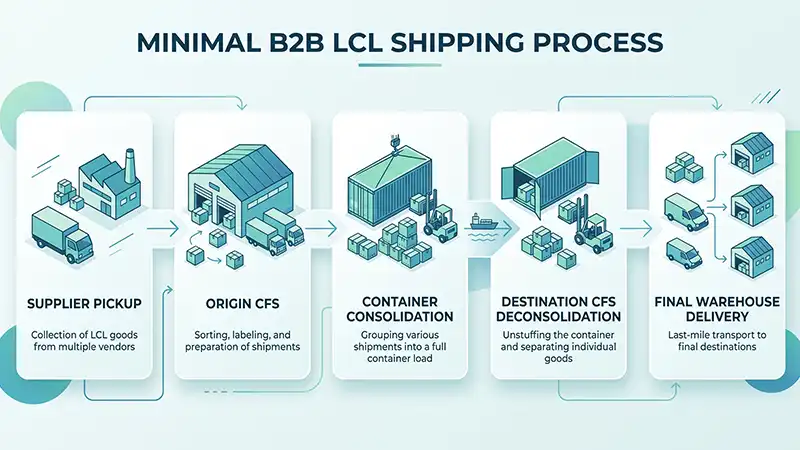
The lcl shipping process is easier to follow when you know where responsibility changes hands. People often ask, "how does LCL shipping work?" For LCL cargo, the answer is a series of handoffs rather than one single ocean-freight step. The sequence below is typical, but the exact included services must be confirmed in the quote.
- Start with cargo ready. The supplier or shipper confirms the pickup point, ready date, carton count, dimensions, and gross weight.
- At origin, the cargo goes to a warehouse or CFS. Staff can measure, weigh, check, and prepare it for consolidation.
- The forwarder groups the cargo with other shipments. Stackability, packaging condition, labels, and documents affect the handling plan.
- The consolidated container moves through the agreed port and sailing plan. A schedule is an estimate, not a delivery guarantee.
- At destination, the container is opened at a CFS and the shipments are separated for release and delivery.
- Trucking or another agreed delivery leg takes the shipment to the warehouse, business address, or approved receiving location.
Many first-time shippers focus on the ocean leg and miss the CFS handoff. Measurement, storage, release, customs coordination, appointment requirements, and final delivery can all change what the quote covers.
LCL vs FCL: what changes for the shipper?
LCL and FCL solve different planning problems. LCL trades container exclusivity for shared space; FCL trades a larger booking commitment for more control over loading, seals, and handling.
| Factor | LCL | FCL |
|---|---|---|
| Space | Shared with other shippers. | Booked for one shipper. |
| Pricing logic | Usually reflects cargo volume, weight, handling, and delivery scope. | Usually reflects container type, route, and included services. |
| Handling | More consolidation and deconsolidation handoffs. | More control over loading and seal management. |
| Good starting point | Test orders, smaller replenishment, or partial cargo. | Larger, repeatable loads that benefit from container control. |
A CBM break-even point only makes sense when the lane and quote scope are the same. Ask for an all-in comparison that uses the same origin, destination, cargo data, delivery scope, and customs assumptions. For route-specific cost context, use the China-USA container shipping cost guide.
What should an LCL shipping quote cover?
A useful LCL shipping quote explains what the number includes. "Ocean freight" may describe the main carriage while leaving origin receiving, CFS handling, destination release, customs coordination, or final delivery outside the line you are comparing.
Before comparing two quotes, ask five plain questions:
- Does the scope include pickup and origin receiving?
- How are measurement, consolidation, storage, and CFS handling treated?
- Which port pair and sailing assumptions are being used?
- Are destination CFS, release, customs coordination, and storage included?
- Is final trucking included, and does the address require an appointment or special equipment?
Rates, duties, taxes, and timing depend on route, commodity, season, carrier space, documentation, and destination rules. U.S. importers can review the U.S. Customs and Border Protection importer and exporter basics for general context, then use the customs clearance support page to discuss shipment-specific scope.
What to send before requesting an LCL quote
An LCL quote gets better when a vague product description becomes measurable cargo data. Send what you have from the list below. Missing information can be filled in during review.
| Information | Why it changes the plan |
|---|---|
| Product and compliance details | The commodity affects documents, handling, and whether a channel review is needed. |
| Origin and destination | Pickup, port, customs scope, trucking, and delivery access depend on the locations. |
| Cartons, dimensions, and gross weight | These fields support measurement, consolidation planning, and quote accuracy. |
| Stackability and packaging | Non-stackable, fragile, or palletized cargo may require different handling. |
| Ready date and receiving limits | The delivery plan must fit the receiving hours, appointment, and schedule tolerance. |
For Amazon shipments, include the destination fulfillment-center details and current shipment-plan information, then confirm the current requirements through the Amazon FBA shipping service. Do not treat a general LCL explanation as a substitute for current Amazon instructions.
Where LCL problems usually start
Most avoidable problems begin before the container leaves the origin. A product name without carton dimensions creates a weak quote. A non-stackable load described as stackable creates a handling mismatch. A delivery address without access or appointment details creates a last-mile surprise.
Use a clear handoff. Record the cargo facts, state what the quote includes, flag what still needs confirmation, and keep the receiving party's constraints visible.
Common LCL shipping questions
What does LCL shipping mean?
LCL means Less than Container Load. Your cargo shares an ocean container with other shippers, while your cartons and documents remain separately identified for release and delivery.
Who should use LCL shipping?
LCL usually suits importers, ecommerce sellers, and businesses with partial ocean shipments when the cargo can tolerate shared handling and the receiving schedule has some room. The quote scope still decides whether it fits.
Is LCL cheaper than FCL?
Sometimes. A partial shipment does not reserve a full container, but CFS, documentation, and delivery charges can change the comparison. Use the same origin, destination, cargo data, delivery scope, and customs assumptions for both options.
What is the minimum volume for LCL shipping?
There is no single minimum for every forwarder or lane. A forwarder may apply a minimum chargeable volume, weight, documentation fee, or handling charge. Confirm the rule in the quote.
Request an LCL shipping quote
Send the product description, pickup location, destination, carton dimensions, carton count, gross weight, stackability, ready date, and delivery requirements. A shipment review can then compare the LCL scope with other sea-freight options.


