Sea Waybill vs Bill of Lading: What FBA Sellers Need to Know
A Sea Waybill is a non-negotiable shipping document. It is a receipt for cargo loaded onto a vessel, nothing more. Unlike a Bill of Lading, it is not a document of title. The consignee named on the document can claim the cargo upon arrival with proof of identity alone. No original paper is required.
This one distinction — negotiable versus non-negotiable — changes the entire logistics chain. Under the CMI Uniform Rules for Sea Waybills, the carrier must deliver to the named consignee, not to whoever holds a paper document. For context on how the full set of shipping documents fits together, see our MBL vs HBL vs Telex Release guide.
Practical bottom line: if you are shipping from China to an Amazon FBA warehouse and the goods are already paid for, a Sea Waybill gets your cargo released at the destination port faster than any other method. No courier delays, no surrender fees, no document handling errors.
Sea Waybill vs Bill of Lading: 5 Operational Differences
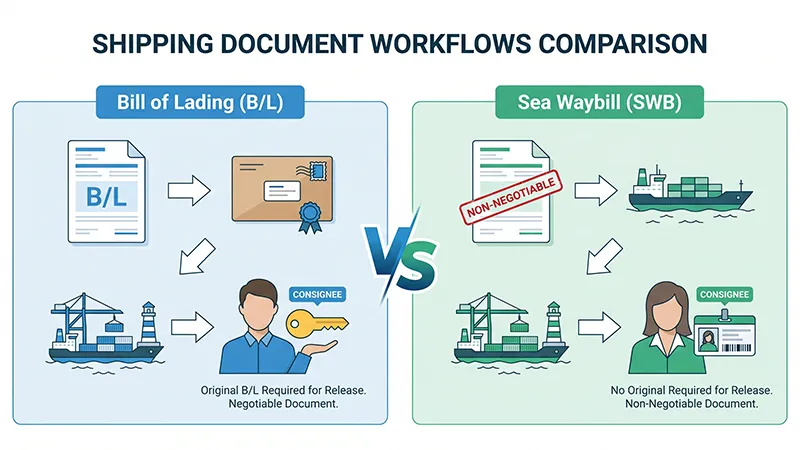
These five dimensions matter in day-to-day operations, not just in legal theory.
| Dimension | Bill of Lading (B/L) | Sea Waybill (SWB) |
|---|---|---|
| Document of Title | Yes. Holder owns the cargo. | No. Named consignee owns the cargo. |
| Release Trigger | Surrender original B/L at destination | Consignee shows ID at destination |
| Transit Speed Impact | Courier delay: 3-5 days for paper to arrive | Zero delay: release on vessel arrival |
| Document Cost | Original printing + courier: $30-50 | $0 (included in freight) |
| Loss/Fraud Risk | If original is lost, cargo held until court order or bank guarantee | Minimal. No paper to lose. |
The trade-off is speed versus control. A Bill of Lading gives the shipper leverage. The cargo stays locked until that paper is physically surrendered. A Sea Waybill gives the importer speed. The cargo is available for pickup the moment the vessel docks. For Amazon sellers restocking before Prime Day or rushing a hot SKU, those 3 to 5 days of courier time are real money.
Sea Waybill vs Telex Release: Stop Confusing the Two
This is the most common mix-up we see from FBA sellers.
Telex Release starts with a Bill of Lading. The carrier prints a full set of originals. The shipper takes those originals, physically surrenders them back to the carrier at the origin port (Shanghai, Ningbo, or Shenzhen), and pays a surrender fee. The carrier then transmits an electronic release message to the destination agent. Goods are released without paper. This is the standard setup for most FBA DDP shipments.
Sea Waybill never involves a Bill of Lading. No originals are printed. No surrender happens. No electronic release message is sent. The document is issued as "non-negotiable" from day one, and the destination agent releases cargo to the named consignee using the manifest data already in the carrier's system.
Here is how the costs compare:
| Release Method | Document Fee | Courier Fee | Surrender/Telex Fee | Total Cost |
|---|---|---|---|---|
| Original B/L | $0 | $30-50 (DHL/FedEx) | N/A | $30-50 |
| Telex Release | $0 | $0 | $45-75 | $45-75 |
| Sea Waybill (SWB) | $0 | $0 | $0 | $0 |
So why does anyone still use Telex Release instead of Sea Waybill? Because Telex Release keeps one control point: the shipper must actively surrender the originals before the electronic release fires. If the buyer has not paid by the time the cargo reaches the transshipment port, the shipper does not surrender, and the cargo stays locked. With a Sea Waybill, that lever does not exist. Once the vessel departs, the consignee can claim the goods.
For FBA sellers importing from China on DDP terms where payment is already settled, Sea Waybill is the right choice every time. If payment depends on document surrender, Telex Release is the middle ground.
When FBA Sellers Should Use a Sea Waybill
Use a Sea Waybill when:
- The shipment is fully paid before sailing (T/T 100% advance, or DDP terms through a forwarder)
- You work with a repeat supplier where payment risk is minimal
- You have no intention of selling the goods mid-transit (cargo is for your own inventory)
- The delivery window is tight: restocking before Prime Day, Q4 peak, or a promo
- You are shipping to an Amazon fulfillment center (FCs do not handle paper title documents at the gate)
Do not use a Sea Waybill when:
- Payment is pending and tied to document release (Letter of Credit, D/P, CAD terms)
- You are working with a new supplier for the first time
- The goods might be resold to a different buyer while in transit
- The consignee is a third-party distributor you have not vetted
- Confirm payment has cleared in full
- Verify the consignee name on the SWB matches the actual importer of record
- Check that your forwarder has the correct delivery address on file. Once the vessel sails, you cannot change the consignee field on a Sea Waybill.
What Does a Sea Waybill Look Like? Key Fields Walkthrough
You get the Sea Waybill from your forwarder 1 to 2 days after the vessel departs. Here are the fields to check before filing it.
| Field | What It Means | Why You Check It |
|---|---|---|
| Shipper | Your factory or trading company in China | Must match the exporter on the commercial invoice |
| Consignee | Your US company (the actual importer) | Must match the customs bond importer of record. A mismatch triggers a CBP hold. |
| Notify Party | Your customs broker or the party to contact on arrival | Usually your forwarder's destination agent or your broker. Wrong name = missed arrival notice. |
| Vessel / Voyage | Ship name and voyage number (e.g., COSCO SHIPPING ARIES / 045W) | Used for tracking on carrier websites |
| Port of Loading (POL) | Origin port (e.g., Shanghai, Ningbo, Yantian) | Confirms which China port your container loaded from |
| Port of Discharge (POD) | Destination port (e.g., Los Angeles, Long Beach, Savannah) | Confirms which US port your container will arrive at |
| Container No. / Seal No. | Container identifier and tamper-proof seal | Cross-check against your packing list. Seal mismatch at CFS means re-examination. |
| SWB Number | Unique reference number, usually starts with carrier prefix (e.g., COSU, MEDU, MSCU) | This is your tracking number. Enter it on the carrier's website to follow the vessel. |
| "Non-Negotiable" Stamp | Printed across the face of the document | Confirms this is not a Bill of Lading and carries no title rights |
The document is a single-page PDF. There is no "original" and no "copy" for a Sea Waybill. The PDF is the document. Your customs broker uses the SWB number and container number to file the entry with CBP.
How to Track a Sea Waybill Shipment
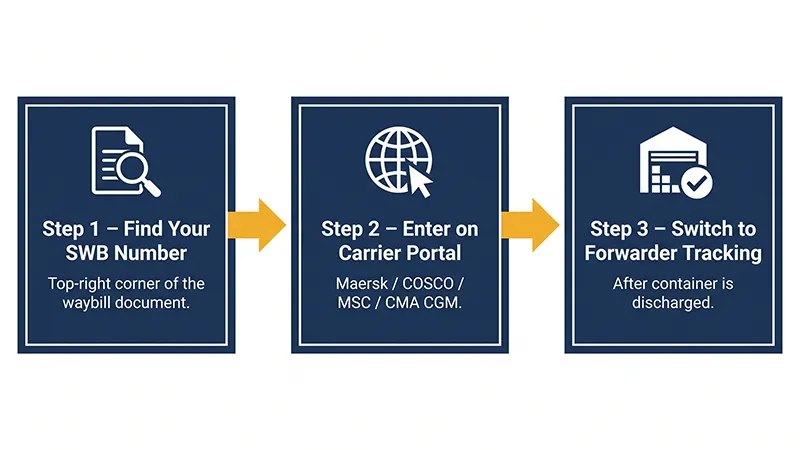
Tracking a Sea Waybill is simple once you know where to look.
Step 1: Find your SWB number on the document. It is usually in the top-right corner, or in a box labeled "B/L No." or "Waybill No." depending on the carrier's template. Common prefixes include COSU (COSCO), MEDU (MSC), MAEU (Maersk), and CMAU (CMA CGM).
Step 2: Go to the carrier's tracking portal. Most major carriers have a public tracking page:
| Carrier | Tracking URL |
|---|---|
| Maersk | track.maersk.com |
| COSCO | elines.coscoshipping.com (e-Business → Cargo Tracking) |
| MSC | msc.com/track-trace |
| CMA CGM | cmacgm-group.com (eBusiness → Track) |
| Evergreen | shipmenttracking.evergreen-marine.com |
| ONE | one-line.com (eCommerce → Track) |
| HMM | hmm21.com (Cargo Tracking) |
Enter your SWB number or container number. Either works on most portals. The tracking page shows the vessel's current position, the estimated arrival date at the destination port, and whether the container has been discharged.
Step 3: After the container is discharged, switch from carrier tracking to your forwarder's system. The carrier tracking stops at "Container Discharged." Your forwarder handles the drayage, customs clearance, and final delivery. Their system tells you what you actually need to know: has the container been picked up from the terminal, has customs released it, and when will it deliver to your FBA warehouse.
- The vessel may not have departed yet. SWB tracking goes live roughly 24 hours after sailing.
- You might be on the wrong portal. SWB numbers use carrier prefixes, so you need the correct carrier's site.
- The SWB number on your document might be your forwarder's internal reference, not the carrier's. Ask your forwarder for the carrier bill of lading number.
Sea Waybill vs Express Release: What Is the Difference?
Another confusion point: Express Release vs Sea Waybill.
An Express Release is a variant of Telex Release. The carrier creates a Bill of Lading in their system (no paper originals are printed), and the shipper instructs the carrier to release the cargo without requiring a paper surrender. A release message is sent electronically. In practice, it works just like a Telex Release but skips the step of printing and surrendering physical originals.
A Sea Waybill is issued as non-negotiable from the start. There is no Bill of Lading record in the carrier's system at all. The SWB replaces it.
| Aspect | Express Release | Sea Waybill |
|---|---|---|
| B/L exists in system? | Yes | No |
| Paper originals printed? | No | No |
| Release mechanism | Electronic release message | Consignee ID at destination |
| Fee | Usually $25-50 | $0 |
| Legal framework | Bill of Lading law | CMI Uniform Rules for Sea Waybills |
Different carriers use different terminology. Maersk calls all electronic releases "Sea Waybill" in their booking system. COSCO draws a clear line between "Telex Release" and "Sea Waybill." If your forwarder says "we use Sea Waybill for all shipments," ask them to clarify: true non-negotiable SWB, or Express Release? The distinction matters when something goes wrong at destination and you need to know your legal footing.
Frequently Asked Questions
Is a Sea Waybill the same as Telex Release?
No. Telex Release starts with a Bill of Lading and the shipper must surrender the originals at the origin port. A Sea Waybill is issued non-negotiable from the beginning. No B/L is ever created, and no surrender process takes place.
Can I use a Sea Waybill for Amazon FBA shipments?
Yes. It is the standard document type for DDP FBA shipments from China. Amazon fulfillment centers do not handle physical Bills of Lading at the delivery gate. Your forwarder manages the release internally, and the delivery driver checks in at the FC using the delivery appointment number, not the B/L.
What happens if the consignee refuses the cargo under a Sea Waybill?
This is the main risk. Because the SWB gives the shipper no title-based control, you cannot stop the carrier from releasing cargo to the named consignee. If the consignee refuses delivery, the cargo sits at the destination terminal and demurrage charges start piling up. Your recourse is through the commercial contract with the buyer, not through the shipping document. For higher-risk transactions, use Original B/L or Telex Release.
Can a Sea Waybill be used with a Letter of Credit?
In practice, no. Most commercial Letters of Credit require a negotiable Bill of Lading as the shipping document. Under UCP 600, a Sea Waybill is governed by Article 21, which treats it as a separate, non-negotiable document type. Unless the credit explicitly states that a non-negotiable sea waybill is acceptable (which is rare), banks will reject the SWB and refuse payment. If your buyer is paying by L/C, instruct your forwarder to issue an Original B/L.
Who issues the Sea Waybill?
The ocean carrier (steamship line) issues the Sea Waybill. When you ship through a freight forwarder, the forwarder gives you a House Sea Waybill, the non-negotiable equivalent of an HBL. The carrier's Master Sea Waybill stays between the carrier and the forwarder.
How much does a Sea Waybill cost?
$0. It is included in the ocean freight rate. Telex Release typically adds $45 to $75 per bill, and couriered Original B/Ls cost $30 to $50. Sea Waybill has no extra documentation charge.
Your Shipping Documents, Handled End to End
Zbao Logistics manages the full documentation chain for FBA shipments from China. Factory booking confirmation, House Sea Waybill issuance, carrier Master Sea Waybill verification, customs entry filing, and destination delivery to your Amazon warehouse. One contact covers the entire document flow. That means no chasing your forwarder for the SWB number after the vessel sails, no mismatched consignee fields between the SWB and your customs bond, and no delivery delays from Amazon rejecting the paperwork at the gate.


