Air Freight from China to USA: The Complete Cost, Transit Time & FBA Guide
Quick Takeaways
- Standard air freight from China to the U.S. takes 7 to 12 business days door to door, depending on route and service level.
- Rates typically range from $4 to $8 per kg for commercial shipments. Always ask for an all-in DDP quote, not just a base rate.
- Most FBA and B2B importers use air freight for time-sensitive restocks and high-value goods, not as their default shipping method.
Speed is expensive. Except when a stockout costs you more than the freight bill. For most importers sourcing from China, there comes a moment when ocean shipping simply is not fast enough. A product launch is coming up, a peak season window is closing, or a supplier delay has eaten through your buffer. That is when air freight becomes the only real option on the table.
This guide walks through how it works, what it costs, how long it takes, and what you need to know before you book. It is written for Amazon FBA sellers replenishing inventory and B2B buyers receiving goods at their own warehouse.
What Is Air Cargo from China? (Express vs. Standard vs. Economy)
Air freight is the commercial transportation of goods on aircraft between Chinese airports and U.S. destinations. It is not the same as dropping a package off at a DHL counter, and it is not the same as booking a shipping container. It sits in its own lane. Faster than ocean, more economical than express courier, and priced accordingly.
The service exists in three distinct tiers, and knowing which one applies to your shipment changes how you plan the entire move.
Express courier is what most people picture when they hear "air shipping." DHL, FedEx, and UPS handle the full process door to door, including customs clearance. It works well for small urgent shipments, product samples, or emergency restocks under 100 kg. The trade-off is cost, because express rates sit at the top of the market.
Standard air freight is what most commercial shippers use. Your forwarder books space with a cargo airline, the goods move airport to airport, and a separate customs broker handles U.S. import clearance. This is the practical choice for shipments between roughly 100 kg and 2,000 kg, where express pricing becomes difficult to justify but ocean shipping is simply too slow.
Economy air, sometimes called deferred air or consolidated air, routes cargo through an intermediate hub, often Seoul, Tokyo, or Taipei, before it continues to the U.S. It takes a few extra days but costs noticeably less. For importers with two weeks or more of lead time who still need something faster than sea freight, this option is consistently underused.
Before You Book: Can Your Cargo Actually Fly?
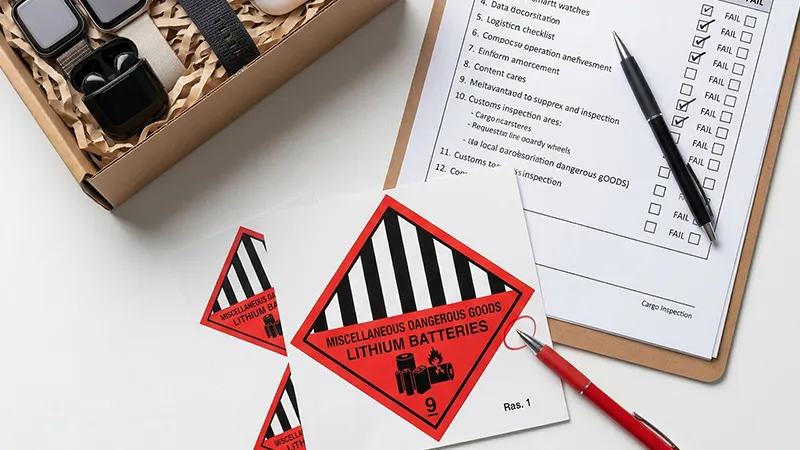
Not everything can go on a plane. Air cargo is subject to strict international safety regulations, and certain product categories require additional documentation or special handling before they can be loaded.
Lithium batteries are the most common issue for e-commerce sellers. Any product with a built-in rechargeable battery, including wireless earbuds, smartwatches, power banks, and LED devices, falls under IATA Class 9 Dangerous Goods Regulations. Under current IATA DGR rules, devices shipped with built-in lithium-ion batteries must have their charge level reduced to 30% or below before loading. For a full breakdown of documentation and packaging requirements, see our dedicated guide on Shipping Lithium Batteries from China to USA. Required documentation includes:
- A completed Shipper's Declaration for Dangerous Goods, signed by a certified person
- UN number marking on each carton (UN 3481 for lithium-ion batteries packed with equipment)
- A Class 9 hazard diamond label
- A separate lithium battery mark, which is required in addition to the Class 9 label
- An MSDS or SDS safety data sheet listing battery type, capacity in watt-hours, and chemistry
- Watt-hour calculation documentation using the formula: Wh = mAh divided by 1,000, multiplied by voltage
Liquids require leak-proof, UN-certified packaging. Individual units are generally limited to one liter or less when traveling in passenger aircraft cargo holds. Cosmetics, essential oils, and cleaning products all fall into this category.
Powders weighing more than 350 grams per package are subject to enhanced screening at most international airports. Protein supplements, pigments, and washing powders all qualify. Budget extra time and confirm your forwarder is aware before booking.
If your product does not fall into any of these categories, the booking process is considerably more straightforward.
Typical Transit Times to US Gateways
Transit time is the main reason people choose air over sea. But the answer to "how long does it take" depends entirely on which service tier you are using and which airports are involved.
Express courier is the fastest option available. A shipment handed to DHL or FedEx in China can realistically reach a U.S. address in two to five business days, door to door, with customs clearance included. That covers factory pickup, export processing, the flight, U.S. customs, and final delivery.
Standard air freight takes longer because more parties are involved. On the main trans-Pacific routes, the actual flight from Shanghai (PVG) to Los Angeles (LAX) takes roughly 12 to 14 hours. From Shenzhen (SZX) to New York (JFK), you are looking at 15 to 17 hours in the air. Flight time, however, is only one piece of the total journey.
The realistic door-to-door sequence works like this. Factory pickup and cargo station handling takes half a day to one full day. Export clearance in China adds another day. Depending on airline schedules, cargo may wait one to two days at the origin airport before it gets loaded onto a flight. After landing, U.S. customs processing takes one to two business days under normal conditions, although a physical exam can push this to five days or more. Truck delivery from the airport to your final destination adds one to three additional days.
| Origin | Destination | Airport to Airport | Door to Door |
|---|---|---|---|
| Shanghai (PVG) | Los Angeles (LAX) | 2 to 4 days | 5 to 8 days |
| Shanghai (PVG) | Chicago (ORD) | 3 to 5 days | 6 to 9 days |
| Shenzhen (SZX) | Los Angeles (LAX) | 3 to 5 days | 6 to 9 days |
| Shenzhen (SZX) | New York (JFK) | 4 to 7 days | 7 to 12 days |
| Hong Kong (HKG) | Los Angeles (LAX) | 3 to 5 days | 6 to 9 days |
| Hong Kong (HKG) | New York (JFK) | 4 to 6 days | 7 to 11 days |
Economy air via a third country adds three to five days on top of standard timing, bringing the total door-to-door transit to roughly ten to eighteen days.
One practical note about U.S. gateway airports: JFK handles an enormous volume of international cargo and is structurally more prone to processing delays, especially during busy periods. Shippers delivering to the East Coast who have some flexibility sometimes find it worthwhile to route through Newark (EWR) instead. Newark sits closer to Amazon's New Jersey fulfillment center cluster and tends to clear ground handling faster.
Breaking Down Air Freight Rates & Surcharges
The base rate you see in a quote is only part of what you will actually pay. Air freight pricing has several components, and forwarders do not always present them the same way.
The base rate is charged per kilogram of chargeable weight and scales with shipment size. Larger shipments get better rates because they are more valuable to the airline. As a general market reference:
| Weight Bracket | Standard Air Freight | Express Courier |
|---|---|---|
| Below 21 kg | $8.50 to $9.10/kg | $10 to $15/kg |
| 21 to 75 kg | $7.60 to $8.80/kg | $8 to $12/kg |
| +45 kg | $4.50 to $6.00/kg | $6.50 to $8.00/kg |
| +100 kg | $4.00 to $5.50/kg | $6.00 to $7.50/kg |
| +500 kg | $3.80 to $4.85/kg | N/A |
On top of the base rate, carriers apply a fuel surcharge (FSC) that adjusts periodically based on international jet fuel prices. There is also a security surcharge and terminal handling charges at both the origin and destination airports. When these are added together, the all-in cost is typically 25 to 40 percent higher than the base rate alone.
Customs brokerage, ISF filing, and inland trucking are separate from the freight charge and are not automatically included in a standard quote.
This is why experienced importers ask for a DDP (Delivered Duty Paid) all-in price rather than a base rate. A DDP quote covers everything: the flight, all surcharges, customs clearance, duties, and delivery to your door or your Amazon warehouse. It is the only reliable way to compare two forwarders on equal footing and understand your true landed cost before committing. If you are new to the term, our guide on What Is DDP Shipping explains exactly what is covered and why it matters.
How Chargeable Weight Works
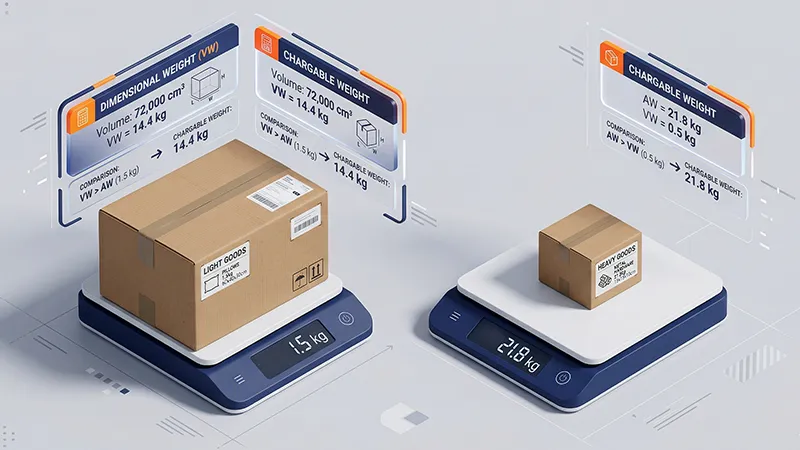
Airlines charge based on whichever is greater: the actual physical weight of your shipment, or its volumetric weight. Volumetric weight is calculated by multiplying the package dimensions in centimeters and then dividing by 6,000. Use our Volumetric Weight Calculator to run the numbers on your own cartons before requesting a quote.
💡 Real-World Example: Light Cargo vs. Dense Cargo
Same carton: 50cm x 40cm x 40cm
Volumetric weight = 50 x 40 x 40 divided by 6,000 = 13.3 kgScenario A: Phone cases, actual weight 8 kg
Chargeable weight = the greater of 8 and 13.3 = 13.3 kg ⚠️
You pay for 13.3 kg even though the goods weigh only 8 kg. That is a 66% premium.Scenario B: Metal hardware, actual weight 28 kg
Chargeable weight = the greater of 28 and 13.3 = 28 kg ✅
Actual weight wins. Dense goods almost always do.
The practical rule: goods with a density below 166.7 kg per cubic meter get charged on volumetric weight. Light, bulky products such as foam packaging, inflatable items, stuffed toys, and apparel almost always fall below that threshold. If you are shipping anything in that category, calculate volumetric weight before requesting a quote.
Air Freight vs. Sea Freight vs. Sea-Air: How to Choose
Most experienced importers do not think of this as a permanent choice. They treat it as a toolkit, and the right tool depends on how much time they have and what the cargo is worth.
Air freight makes the most sense when speed is non-negotiable. A product launch with a fixed date, an Amazon stockout that costs you ranking every single day, or a hard deadline that cannot be pushed all point toward air. It also makes sense when your goods are high-value relative to their weight, because the freight cost becomes a smaller percentage of the total shipment value.
Ocean freight wins on cost for any shipment without a time constraint. It is the standard method for bulk restocking, seasonal inventory, and heavy or oversized cargo. Lead times run 14 to 20 days to the U.S. West Coast and 25 to 35 days to the East Coast.
Sea-air is the option that sits between them and gets overlooked far too often. Your cargo travels by fast ocean vessel to the U.S. West Coast, then transfers to a domestic carrier for final delivery. The total journey typically runs 14 to 20 days door to door. That is about a week longer than standard air freight, but the cost can be 40 to 50 percent lower per kilogram. For a detailed breakdown of when sea-air beats standard air on value, see our guide on Matson vs. Air Freight for FBA Sellers.
| Method | Door to Door | Cost Range per kg | Best For |
|---|---|---|---|
| Express Courier | 2 to 5 days | $8 to $15 | Urgent small shipments under 100 kg |
| Standard Air Freight | 7 to 12 days | $4 to $8 | 100 to 2,000 kg, time-sensitive cargo |
| Sea-Air (fast vessel plus domestic) | 14 to 20 days | $2.50 to $4.50 | 300 kg and above, moderate lead time |
| Ocean Freight (FCL) | 25 to 45 days | $0.50 to $1.50 | Large bulk restocks |
The most common approach among experienced sellers is to run ocean freight as the baseline and reserve air or sea-air for reactive restocking when inventory drops faster than expected. This hybrid model keeps overall logistics costs down without leaving you exposed to stockouts.
Air Freight for Amazon FBA: What Sellers Need to Know
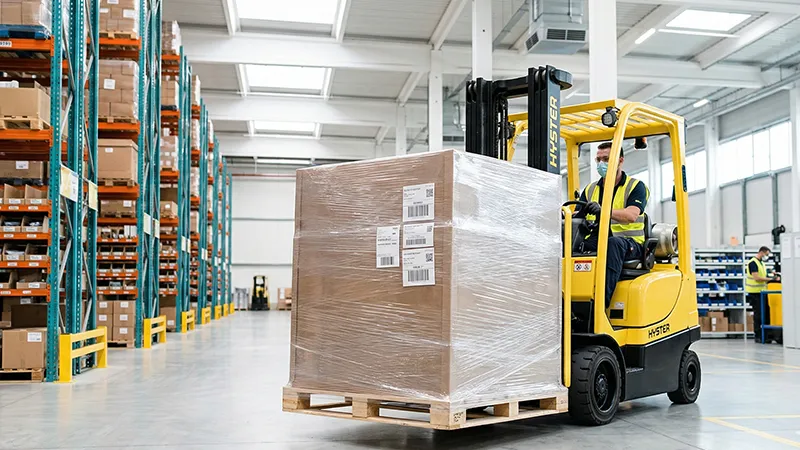
Shipping by air is faster, but it does not exempt you from Amazon's inbound requirements. If anything, the speed of air freight makes compliance more important, because there is no time to fix mistakes once the cargo lands.
The Section 321 change affects every seller shipping from China. The de minimis exemption previously allowed goods valued under $800 to enter the U.S. without formal customs clearance or duties. That exemption has been fully suspended for goods of Chinese origin. Every commercial shipment from China now requires a formal entry, which means a licensed customs broker, a Customs Bond, accurate HTS codes, and a commercial invoice that reflects the true value of your goods. For a full overview of what this means for your import process, see our US Customs Guide 2026. This applies regardless of shipment size or declared value.
Amazon no longer offers prep or labeling services at U.S. warehouses. Every unit needs to arrive with the correct FNSKU barcode already applied, covering any existing barcodes. Every carton label must match the Shipment ID exactly as it appears in Seller Central. All prep and labeling must be completed before goods leave the origin country, either at your factory or through a China-based FBA prep center.
For palletized air freight deliveries, Amazon's inbound requirements are:
- ✅ Accepted pallet size: 48 by 40 inches (GMA standard only)
- ✅ Maximum height: 72 inches total, including the pallet itself
- ✅ Maximum weight: 1,500 lbs (approximately 680 kg) per pallet
- ✅ Overhang: No more than 1 inch beyond pallet edges on any side
- ✅ Stretch wrap: Must be 100% transparent so labels remain scannable
- ✅ Pallet labels: Applied to all four sides at mid-height, facing outward
- ✅ Heavy cartons: Any box over 50 lbs must display a "Heavy Package / Team Lift" warning label
- ✅ Mixed shipments: One Shipment ID per pallet only, no mixing allowed
For air freight entering as Small Parcel Delivery (SPD), each individual carton must stay within the 50-pound limit. Anything heavier needs to be treated as a separate LTL delivery with a dock appointment booked in advance. These requirements are sourced directly from Amazon's official Shipping and Routing Requirements.
How to Book Your Shipment & Required Documents
The booking process follows a predictable sequence. Knowing it in advance helps you avoid the delays that catch first-time shippers off guard.
Start with a quote. Provide your forwarder with cargo weight, dimensions, origin city, destination, and the date your goods will be ready. Ask explicitly for an all-in DDP price. Once you confirm the booking, the forwarder secures space with the airline and issues an Air Waybill (AWB). This is the document that travels with your cargo and tracks it through every handoff.
Your cargo is then collected from the factory, moved to the origin cargo terminal, and prepared for loading. Export clearance in China covers document review and customs release. After the flight arrives at the U.S. gateway, import customs processes your formal entry. The Importer Security Filing (ISF), as required by U.S. Customs and Border Protection, must be submitted at least 24 hours before the cargo departs China. Once released, a domestic carrier handles final delivery to your warehouse, FBA check-in location, or business address.
Documents required for every commercial air freight shipment from China:
- Commercial Invoice with accurate declared value and HTS codes
- Packing List showing quantities, weights, and dimensions per carton
- Air Waybill issued by the forwarder
- ISF Filing confirmation, submitted 24 hours before departure
- Customs Bond, either Single Entry or Continuous
- Product certifications where applicable, such as FCC, CPSC, or FDA
- For DG cargo: Shipper's Declaration, MSDS, and all required hazard markings
5 Ways to Reduce Your Air Freight Bill
1. Rethink Packaging to Cut Volumetric Weight
Volumetric weight is the single biggest controllable cost variable in air freight, and most sellers never address it at the factory level. Work with your supplier to switch to custom-fit carton dimensions that eliminate empty space inside each box. For soft goods, vacuum compression can reduce carton volume by 40 to 60 percent. That reduction translates directly into a lower chargeable weight and a lower invoice.
2. Use Consolidated Air for Shipments Between 50 and 300 kg
When you ship as part of a consolidation, your forwarder combines your cargo with other customers' shipments into a single airline booking. You pay rates closer to high-volume pricing and typically save 20 to 35 percent compared to booking independently. Transit time is slightly longer, but for non-emergency restocks that trade-off is usually worth it.
3. Lock In Q4 Capacity Before Summer
The October through December window is consistently the most expensive and most congested period for trans-Pacific air freight. Shippers who wait until September often face both space shortages and significant rate increases at the same time. If Q4 is critical to your business, start conversations with your forwarder about capacity agreements before the summer restock season kicks off.
4. Always Request an All-In DDP Quote
The most common air freight billing surprise is not one hidden fee. It is several surcharges accumulating quietly because nobody mentioned them upfront. A DDP price covers the full journey including duties and taxes, and it is the only format that lets you compare two forwarders accurately. It also removes the post-arrival invoice shock that catches inexperienced importers off guard every time.
5. Consider Sea-Air for Shipments Above 300 kg
If your restocking cycle allows 15 to 20 days and your shipment is large enough, sea-air can reduce your per-kilogram cost by 40 to 50 percent compared to standard air freight. The time difference is usually less than a week. For planned replenishment cycles rather than emergency restocks, it is the most cost-effective option that most sellers never seriously consider.
Frequently Asked Questions
How much does air freight from China to the USA cost?
Standard commercial air freight typically runs $4 to $8 per kilogram for shipments above 100 kg. Express courier services range from $8 to $15 per kilogram. Both figures reflect base rates only. The all-in delivered cost including surcharges and customs clearance will be higher. Always request a DDP all-in quote for an accurate number.
How long does air freight from China to the USA take?
Standard air freight takes 7 to 12 business days door to door. Shanghai to Los Angeles typically runs 5 to 8 days. Shenzhen to New York is usually 9 to 12 days. Express courier delivers in 2 to 5 days. Economy air through a third-country hub takes 10 to 18 days.
Is standard air freight cheaper than express courier for large shipments?
Yes, for shipments above 100 kg, standard air freight is almost always more cost-effective. Per-kilogram rates drop as volume increases, while express courier rates stay flat. The transit time difference between the two services is often only one to two days at the airport-to-airport level.
What is volumetric weight in air freight?
Volumetric weight is calculated by multiplying a package's length, width, and height in centimeters, then dividing by 6,000. If that figure exceeds the actual physical weight, you pay based on volumetric weight. It mostly affects light, bulky goods such as foam products, pillows, and inflatable items.
Ready to Ship from China to the USA?
Zbao Logistics provides DDP air freight from China to Amazon FBA warehouses, third-party logistics centers, and direct business addresses across the United States. Our all-in pricing covers pickup, export clearance, the flight, U.S. customs, duties, and final delivery. One number, no surprises.
Get a free all-in quote within 24 hours
Planning your broader shipping strategy? Read our guides on Sea Freight from China to USA and Matson vs. Air Freight for FBA Sellers.


